CK12 logo
Compound Inequalities Study Guide

Algebra I

Compound Inequalities

Big Picture

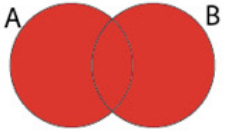
Compound inequalities refer to a group of multiple inequalities joined by either “and” or “or”. Venn diagrams are a good visual way to represent the solutions to the compound inequalities. Each circle in a Venn diagram represents the set of solutions for each individual inequality

Key Terms

Compound Inequality: Two or more inequalities joined by and or or.

Types of Compound Inequalities

Inequalities joined by and

  • The solution must make both inequalities true
  • If a number makes only one of the inequalities true, that number is not a solution for the compound inequality
  • Solutions are like the intersection of two sets. A is the set of solutions for one of the inequalities, and B is the set of solutions for the other inequalities. The solution for the compound inequality is A∩B

Inequalities joined by or

  • The solution must make at least one inequality true
  • Solutions are like the union of two sets. A is the set of solutions for one of the inequalities, and B is the set of solutions for the other inequalities. The solution for the compound inequality is A∪B

Compound Inequalities on a Number Line

Inequality Joined by And

x>a and x<b (can be rewritten as a<x<b)

  • a must be less than b

Example: x≥−40 and x<60 (can be rewritten as −40≤x<60)

Inequality Joined by Or

x<a or x>b

  • a must be greater than b

Example: x≤−1 or x≥4

Remember that an open circle means that point is not included and a filled circle means that point is included.

Solving Compound Inequalities

Inequality Joined by And

Separate the inequalities and solve them separately.

  • Review the Linear Inequalities study guide on how to solve inequalities.
  • Combine the solutions at the end.

Example: 3x−5<x+9≤5x+13

3x−5<x+9
2x<14
x<7
and
x+9≤5x+13
−4≤4x
−1≤x

Answer: x<7 and x≥−1 (rewritten as −1≤x<7)

Inequality Joined by Or

Solve each inequality separately

  • Review the Linear Inequalities study guide on how to solve inequalities.

Example: 9−2x≤3 or 3x+10≤6−x

9−2x≤3
−2x≤−6
x≥3
or
3x+10≤6−x
4x≤−4
x≤−1

Answer: x≥3 and x≤−1

Page 1 of 1