CK12 logo
Irrational Numbers and Radicals Study Guide

Algebra I

Irrational numbers & radicals

Big Picture

Irrational numbers are numbers that cannot be expressed as a fraction. Radicals such as 2 are the most common type of irrational number. Radicals can be added, subtracted, multiplied, divided, and simplified using certain rules. Radical equations and functions can be graphed on the coordinate plane and generally look like half of a sideways U.

Key Terms

Rational Number: Ratio of one integer to another: ab, as long as b≠0.

Irrational Number: Number that cannot be expressed as a fraction, such as 2 or π.

Radicand: Number or expression inside the radical symbol (x).

Perfect Square: A number with a whole-number square root.

Radical Expression: An expression containing a radical.

Rational vs. Irrational

  • Rational numbers can be expressed as a fraction (e.g. ½)
  • Irrational numbers can’t be expressed as fractions (e.g. π)

Decimals and Fractions

  • Fractions are in the form ab
  • Fractions can be expressed in decimal form (e.g. 6.28)

Radicals

The nth root is the inverse operation of raising a number to the nth power. So the inverse operation of xn=y is yn=x.

  • (x) is called the radical sign
  • n is the index
  • y is the radicand
  • When the index is even, the radical is called an even root. When it is odd, it is called an odd root.
  • When n=2, we usually write (), no (2), and we call it the square root. It is an even root.
  • When n=3, we call it the cube root. It is an odd root.

Fractional Exponents

Radicals can be written as exponents: anm=anm

Square Roots  & Cube Roots

Square roots are even roots.

  • 0 has one square root, 0. (02=0,so0,0
  • A positive number has two square roots. If a2=b, then (−a)2=b and b=±a
  • A negative number has no square roots. We cannot take the square root of a negative number!

Unlike square roots, cube roots are odd roots.

  • Odd roots can have negative roots, so we can take the cube root of a negative number. (−x)(−x)(−x)=(−x)3, so −x33=−x.
  • Cube roots can have up to three roots.

Perfect Squares

The first five perfect squares (1, 4, 9, 16, and 25) are shown below.
‍

Page 1 of 2

Algebra I

Irrational numbers & radicals cont.

Radical Expressions

A radical expression is in its simplest form if:

  • The radicand does not have any factors, other than 1, that are perfect squares (e.g. 27 contains the perfect square factor 9, so it is not in its simplest form).
  • The radicand does not have any fractions.
  • No radicals appear in the denominator

Products and Quotients of Square Roots

Product of Square Roots: a.b=ab

Quotient of Square Roots: ab=ab

  • This needs to be further simplified so that the radicand does not have any fractions.

Rationalization

To remove a radical from the denominator, we need to rationalize the denominator. We do this by multiplying the radical expression with some form of 1 that will remove the radical from the denominator.

Example: 23

Quotient of square roots: 23=23

Rationalizing the denominator: 23.23=63

  • We can multiply the expression by 33 because it is the same as multiplying both sides of the equation by 1

Sums and Products of Radicals

To find the sum:

  • First simplify all radicals, if possible.
  • Then combine like terms: ax+bx=(a+b)x

To find the product:

  • Multiply all the numbers without radicals, then multiply the radicals together and simplify the radicals.
  • a.b=ab, but a+b≠a+b!

Equations Involving Radicals

When solving equations with radicals, to get rid of radicals, raise each side of the equation to the power of the radical.

  • Example: if it’s a square root, square both sides.

When raising the equation to a power, be sure to raise the whole side and not just individual terms.

  • Example: 4+3=x If you square both sides, you should get (4+3)2=49=x, but if you square the individual terms, you get 42+32=25=x, which is the wrong answer.

Always plug answers back into the equation to check for extraneous solutions (solutions that don’t work or don’t make sense for the problem).

Graphing Radical Functions & Equations

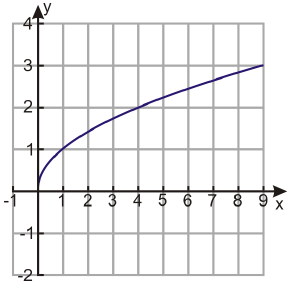
The graph of y=x looks like this:

  • It’s the top part of the graph of x=y2 where  y≥0,  since x is always greater than 0.
  • In general, the graphs of radical functions look like a sideways U-shaped curve that have been partially cut off.
  • Graph y=x (shown on right) to see the sideways U-shaped curve

Page 2 of 2