Biology
Fertilization to old age

Big Picture
Fertilization creates a zygote, which undergoes cell divisions and implants in the uterus. After implantation, it becomes an embryo and forms 3 cell layers, which differentiate and develop into different organs. At nine weeks, the embryo becomes a fetus, and the fetus continues to grow and takes nutrients from the placenta. During childbirth, uterus contractions push the baby out of the mother’s body. The baby grows rapidly throughout infancy and grows more slowly during childhood. During adolescence, children develop into adults. Starting in middle adulthood, health declines as cells lose their ability to divide.
Key Terms
Fertilization: Process in which two gamete cells unite.
Gamete: Reproductive cells.
Zygote: A fertilized cell (the result of fertilization).
Blastocyst: Ball of cells with a fluid-filled cavity inside.
Implantation: Process in which a blastocyst embeds in the endometrium lining the uterus.
Embryo: Stage of growth and development that occurs from implantation through the eighth week after fertilization in humans
Differentiation: Process where an unspecialized cell becomes specialized.
Fetus: The developing human organism between week eight and birth (typically 38 weeks).
Placenta: Temporary organ connecting mother to fetus that provides fetus with necessary nutrients.
Amniotic Sac: Membrane surrounding and protecting the fetus.
Pregnancy: Carrying offspring from fertilization until birth.
Infancy: First year of life after birth.
Adolescence: Period of life between puberty and adulthood
Fertilization & Implantation
Fertilization takes place when the male gamete cell (sperm) and the female gamete cell (egg) unite
- Sperm are deposited in the vagina during sexual intercourse
- The sperm must reach the egg one or two days after the ovary releases the egg
- A sperm that penetrates the egg triggers the egg to complete meiosis
- The nucleus of the egg fuses with nucleus of sperm to create a zygote
- While the zygote travels down the fallopian tube toward the uterus, it divides into a ball of cells called a morula
- Fluid-filled cavity forms inside the morula–it becomes a blastocyst
- Blastocyst implants in uterus 4-5 days after fertilization and becomes an embryo
Growth & Development: Embryo
- Week 2: Cells in embryo form 3 layers–ectoderm, mesoderm, and endoderm
- Week 3: Cells undergo differentiation–gene expression is regulated in cells so that certain genes are expressed while others are switched off, allowing for specialized cells to develop
- Many factors affect gene expression and cell differentiation such as the environment and drugs taken by the mother
- Major organs form after differentiation
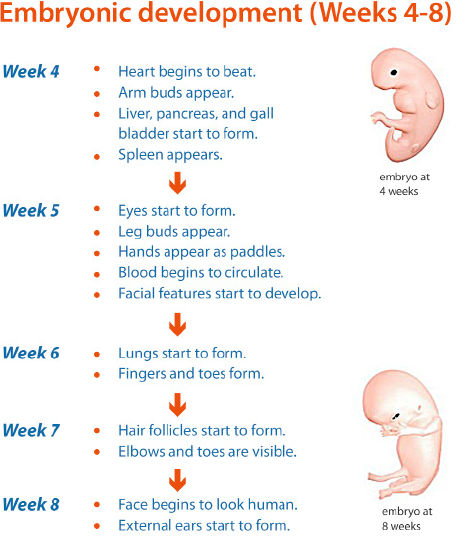
- Embryo continues to develop and grow in size - see figure on right for embryonic development during weeks 4-8
CC-BY-SA 2.5