
Bisectors, Medians, Altitudes Study Guide

Within a given triangle, there are many theorems involving bisectors, medians, and altitudes. Recall that a bisector is a line segment or line that divides a geometric shape into two congruent shapes. A median is a line segment that divides a triangles by joining a vertex to the midpoint of the opposite side. An altitude is a line segment that joins the vertex of a triangle perpendicularly to the opposite side.
Midsegment: The segment that joins the midpoints of a pair of sides of a triangle.
Perpendicular Bisector: A line, ray, or segment that passes through the midpoint of a segment and intersects that segment at a right angle.
Equidistant: The same distance from one figure as from another figure.
Median: A line segment drawn from one vertex of a triangle to the midpoint of the opposite side.
Altitude: A line segment drawn from a vertex of the triangle and is perpendicular to the other side.
Point of Concurrency: The point where three or more lines intersect.
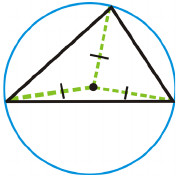
Circumcenter: The point of concurrency for the perpendicular bisectors of the sides of a triangle.
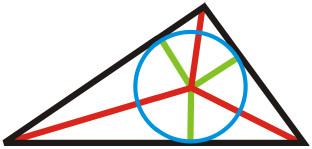
Incenter: The point of concurrency for the angle bisectors of a triangle.
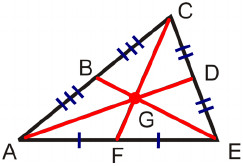
Centroid: The point of concurrency for the medians of a triangle.
Orthocenter: The point of concurrency for the altitudes of a triangle.
For every triangle, there are three midsegments.
Furthermore,
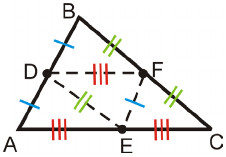
Midsegment Theorem: The midsegment of a triangle is half the length of the side it is parallel to.
Perpendicular Bisector Theorem: If a point is on the perpendicular bisector of a segment, then it is equidistant from the endpoints of the segment.
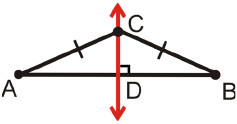
Converse of the Perpendicular Bisector Theorem: If a point is equidistant from the endpoints of a segment, then the point is on the perpendicular bisector of the segment.
Isosceles Perpendicular Bisector Theorem: The angle bisector of the vertex angle in an isosceles triangle is the perpendicular bisector to the base.
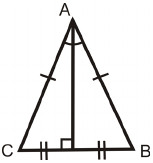

This is not true for any angle other than the vertex angle!

Concurrency of Perpendicular Bisectors Theorem: The perpendicular bisectors of the sides of a triangle intersect in a point that is equidistant from the vertices.
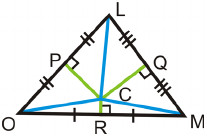
Angle Bisector Theorem: If a point is on the bisector of an angle, then the point is equidistant from the sides of the angle.
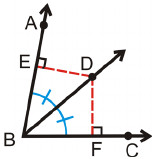
Converse of the Angle Bisector Theorem: If a point is in the interior of an angle and equidistant from the sides, then it lies on the bisector of the angle.
The Angle Bisector Theorem and its converse can be rewritten as a biconditional: A point is on the angle bisector if and only if it is equidistant from the sides of the triangle.
Concurrency of Angle Bisectors Theorem: The angle bisectors of a triangle intersect in a point that is equidistant from the three sides of the triangle.
Concurrency of Medians Theorem: The medians of a triangle intersect in a point that is two-thirds of the distance from the vertices to the midpoint of the opposite side.
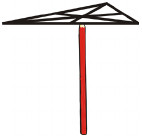
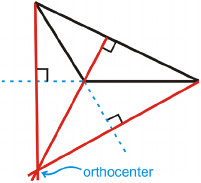
The altitude does not have to be inside the triangle. In an obtuse triangle, the altitude is outside the triangle. In these cases, you find the altitude the same way, but imagine that the opposite side extends further out and allow the altitude to be perpendicular to it. As a result, the orthocenter can be inside or outside of the triangle, depending on the triangle type.
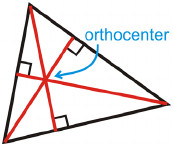
The orthocenter is inside the triangle.
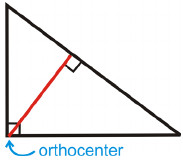
The legs of the triangle are two of the altitudes.
The orthocenter is the vertex of the right angle.
The orthocenter is outside the triangle.
Here is a way to remember the different points of concurrency. Remember the first letter of each word in this saying: The first letters correspond to:
Peanut Butter CookiesPerpendicular Bisectors Circumcenter
Are Best In Angle Bisectors Incenter
Milk Chocolate Medians Centroid
And Ovaltine Altitudes Orthocenter