
Lines in the Coordinate Plane

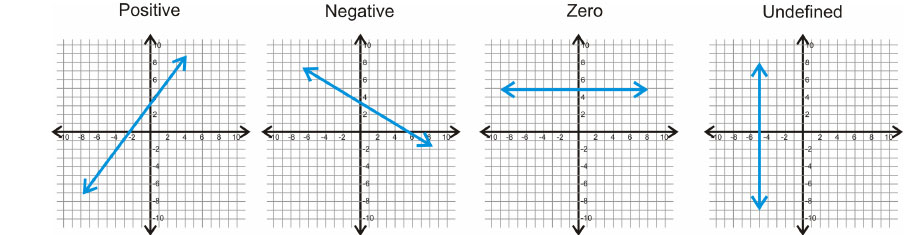
In addition to having many properties involving transversals, parallel and perpendicular lines also have special relationships on the coordinate plane involving slope. Two parallel lines always have the same slope, and perpendicular lines have slopes that are negative reciprocals of each other. Equations can be written in the slope - intercept form to make it easier for us to graph them and find their slopes.
Slope: The steepness of a line, usually denoted by m.
y-Intercept: The point where the line crosses the y-axis.
Given two points
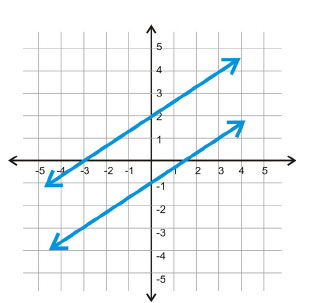
Postulate: If two lines are parallel, they have the same slope and different y-intercepts.
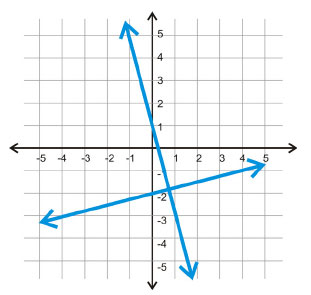
Postulate: If two lines are perpendicular, their slopes are reciprocals of each other (e.g. 1⁄2 and -2). The product of their slopes is -1.

Slope-intercept form:
Standard form:
If given a graph of a line, the equation of the line can be found using the slope-intercept form:
If asked to draw a line parallel or perpendicular to a given line that goes through a given point:
The steps to draw the perpendicular bisector of a given line segment are similar.
The shortest distance between a point and a line: the length of the segment starting at the point that’s perpendicular to the line.
To calculate the distance, there are a few more steps to follow:
The shortest distance between two parallel lines is found in a similar way. The shortest distance is the length of the perpendicular segment that cuts between the two lines.
