
Circles: Segments and Lengths Study Guide

Along with angle measurements are the segments and lengths of a circle. Knowing the theorems can be useful in solving for chords in a circle.
Chord: A line segment whose endpoints are on a circle.
Secant: A line that intersects a circle in two points.
Tangent: A line, line segment, or ray that intersects a circle in exactly one point.
Theorem: In the same circle or congruent circles, two chords are congruent if and only if they are equidistant from the center.

When two chords intersect in the interior of a circle, each chord is divided into two segments called segments of the chord.
Theorem: If two chords intersect a circle so that one chord is divided into segments of lengths a and b and the other chord into lengths c and d, the product of the segments of one chord is equal to the product of segments of the second chord.

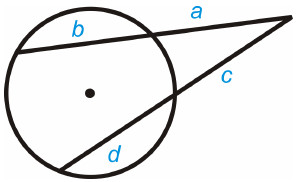
A secant segment contains a chord of a circle and has exactly one endpoint outside the circle. The part of the secant segment outside the circle is called an external segment.

Theorem: If two secants are drawn from a common point outside a circle, then the product of the lengths of one secant segment and its external segment equals the product of the lengths of the other secant segment and its external segment.

Theorem: If two tangent segments are drawn from the same point outside the circle, then the segments are equal.

Theorem: If a tangent and a secant are drawn from a common external point, then the product of the lengths of the secant segment and its external segment equals the square of the length of the tangent segment.
