
Segments Study Guide

A segment is a section of a line between two points. Segments have many properties, but the most important property to understand is that line segments have a start point and an end point. Line segments can be bisected by other segments or lines. Often times, we will be asked to find the length of a segment. Two segments can be added together so that the length of the new segment is the sum of the lengths of the old segments.
Segment: Portion of a line that is ended by two points.
Endpoint: Point at the end of a segment or at the start of a ray.
Distance: How far apart two geometric objects are.
Coordinate: The real number that corresponds to a point.
Congruent Segments: Two segments that have the same length.
Midpoint: A point on a line segment that divides the segment into two congruent segments.
Segment Bisector: A line, segment, or ray that passes through a midpoint of another segment.
The distance is the length between two points. Distance is ALWAYS positive!
A line segment is labeled
Ruler Postulate: Using a ruler to find the distance between two points, the distance will be the absolute value of the difference between the numbers shown on the ruler.


Warning: Do not use the edge of the ruler or any portion of the ruler left of the zero mark in your measurements!
The line segment on this ruler is 5 cm long, so
Segment Addition Postulate: The measure of any line segment can be found by adding the measures of the smaller segments that make it up.
If B is between A and C, then
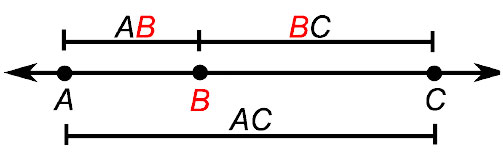
If the points are not on a straight line, the Segment Addition Postulate does not apply.

Using the Ruler Postulate, we can find the distances for horizontal and vertical lines plotted in the x - y plane.
If two points line up horizontally, the change in the x-coordinates will be the distance between the points.

If two points line up vertically, the change in the y-coordinates will be the distance between the points.

The general distance formula to find the length between two points is:
Be careful of signs when working with negative coordinates!

See Geometry Study Guide: Pythagorean Theorem for a proof of this formula
When two segments have the same length, they are congruent. The symbol
To label congruent segments in a diagram, tick marks are used. Segments that are congruent will have the same number of tick marks.

Use = to mean equality for numbers and
Midpoint Postulate: Any line segment will have exactly one midpoint.
B is the midpoint of
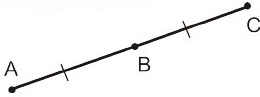
A segment bisector is any ray, segment, or line that intersects the segment at its midpoint.

Midpoint formula: The midpoint for two points
Example:
