
Triangle Congruence Study Guide

One important relationship between triangles that we can prove is congruence, meaning that two triangles are exactly the same shape and size. congruent triangles have certain properties that are the same, namely their angle measurements and side lengths. Geometric theorems and postulates dictate the different characteristics of congruent triangles.
Congruent Triangles: Two triangles are congruent if the three corresponding angles and sides are congruent.
Corresponding Parts: The parts of two figures that have congruent measurements (e.g. corresponding angles, corresponding sides, etc.).
Included Angle: When an angle is between two given sides of a triangle (or polygon).
Included Side: When a side is between two given angles of a triangle (or polygon).
△△△ABC and △DEF are congruent because:

For congruent triangles, the order the vertices is listed in becomes important. Corresponding parts must be written in the same order in congruence statements.
Once we know two triangles are congruent, we also know that Corresponding Parts of Congruent Triangles are Congruent, often abbreviated CPCTC for short.

To identify corresponding parts, redraw the figures so that corresponding parts are easier to identify.
The properties of congruence will apply to congruent triangles:
Third Angle Theorem: If two angles in one triangle are congruent to two angles in another triangle, then the third pair of angles must also be congruent.

Side-Side-Side (SSS) Congruence Postulate: If three sides in one triangle are congruent to those of another triangle, then the triangles are congruent.


Side-Angle-Side (SAS) Congruence Postulate: If two sides and the included angle in one triangle are congruent to those of another triangle, then the two triangles are congruent.

The next two work because of the Third Angle Theorem:
Angle-Side-Angle (ASA) Congruence Postulate: If two angles and the included side in one triangle are congruent to those of another triangle, then the two triangles are congruent.

Angle-Angle-Angle and Side-Side-Angle (or Angle-Side-Side) do not show triangles are congruent!
Angle-Angle-Side (AAS) Congruence Theorem: If two angles and a non-included side in one triangle are congruent to those of another triangle, then the triangles are congruent. Also Side-Angle-Angle (SAA) Congruence Theorem.

There are also some theorems that apply to right triangles only:

Hypotenuse-Leg (HL) Congruence Theorem: If the hypotenuse and leg in one right triangle are congruent to those of another right triangle, then the two triangles are congruent.

Leg-Leg (LL) Theorem: If the legs of two right triangles are congruent, then the triangles are congruent.
Angle-Leg (AL) Theorem: If an angle and a leg of a right triangle are congruent to those of another right triangle, then the two triangles are congruent.
Hypotenuse-Angle (HA) Theorem: If an angle and the hypotenuse of a right triangle are congruent to those of another right triangle, then the two triangles are congruent.
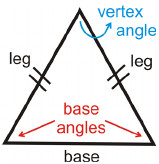
Base Angles Theorem: The base angles of an isosceles triangle are congruent.
Base Angles Theorem Converse: If two angles in a triangle are congruent, then the op-posite sides are also congruent.