
Newton's Laws Study Guide

Newton’s laws form the basis for all of mechanics and describe the effects of forces on an object’s motion. Newton’s laws can be applied to all sorts of problems in mechanics and even some in electrostatics. Anytime a force is involved, Newton’s laws will determine the motion of the object the force is acting on.
Inertia: An object’s resistance to changes in its motion.
Force: Any push or pull. SI unit: N
Normal Force (N): The reaction force exerted on an object by the surface that is supporting it. SI unit: N
Friction: The force that acts between moving materials. It always acts opposite the direction of the object’s motion or applied force (if the object isn’t moving). The frictional force is proportional to the coefficient of friction μ, which depends on the surface the object is moving over, and the normal force N. SI unit: N
Coefficient of Static Friction: Coefficient of friction used for objects at rest to determine how much force is required to make it begin moving.
Coefficient of Kinetic Friction: Coefficient of friction used for objects moving across a surface to determine the force resisting the motion.
Tension: Force on an object provided by a wire, string, cable, or similar object.
Known as law of inertia, it states that an object in motion tends to stay in motion and an object at rest tends to stay at rest unless acted on by an external force.
Explains how the force acting on an object will affect its motion. The acceleration a (change in velocity) of an object is directly proportional to the force F exerted on it and inversely proportional to the mass m (inertia) of the object. F = ma
This law states that for any force exerted by one object on another, the other object exerts an equal force in the opposite direction on the first object. For example, if a person is pushing on a wall, the wall is also pushing back on them with an equal force in the opposite direction.
The forces on an object are often visualized using a free body diagram (FBD). FBDs are useful for looking at the different types of forces acting on an object.
Be careful when assigning signs. For each of the
Gravity is a force that acts on all objects. Near the surface of the Earth, the force due to gravity (Fg) is equal to mg, where g is approximately
Normal force (N) can be understood using Newton’s third law. It is the force opposing gravity so that the net force on both objects (the mass and the table) is zero.


Another type of problem is an object on a ramp or tilted table. The normal force is still perpendicular to the table, but gravity is always pointing straight down.

Gravity can be decomposed into its x- and y-components (relative to the ramp), as shown below. Because of Newton’s third law, we know that
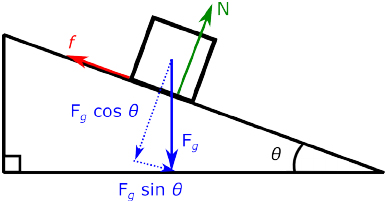
Friction force is always in the opposite direction of motion. In the ramp example, gravity pulls the object down the ramp, so friction acts in the opposite direction (up the ramp), impeding the object’s motion.

For objects attached to a string (or similar string-like objects), the force provided by the string is called tension. This could be an object hanging from a string or an object being pulled by a string.

F = ma
F - force
m - mass
a - acceleration
f = μN
f - force of friction
μ - coefficient of friction
N - normal force
Equilibrium problems (where there is no net force) are the most common type of problem involving Newton’s laws.
A block of mass m is at rest on an incline of angle
The first step in any problem involving Newton’s laws is to draw an FBD of the situation and carefully label all the forces involved. The FBD on the right shows all the forces all drawn from a single point instead of from where they’re acting so that it’s easier to visualize the axes. In these sort of problems it is best to angle the coordinate system so that the x-axis is parallel to the incline. This forces us to break the weight vector into its components. Since the object is in equilibrium, the weight vector’s components can be matched to the normal force and friction.

Here is the mathematical process to solve this problem:
start with the equation for friction
substitute the y-component of the weight vector (mg cos θ) for N
substitute the x-component of the weight vector (mg sin θ) for f
solve for
simplify the result