Computer hackers stole files and emails from the Climate Research Unit’s server. These messages were alleged to show that scientists had a conspiracy to promote the idea of global warming. Government and scientific bodies investigated the charges and found no evidence of a conspiracy. Science is done with a great deal of quality control and nearly all allegations of scientific misconduct are found to be false.
Sharing Results
A hypothesis will not be fully accepted unless it is supported by the work of many scientists. Although a study may take place in a single laboratory, a scientist must present her work to the community of scientists in her field.
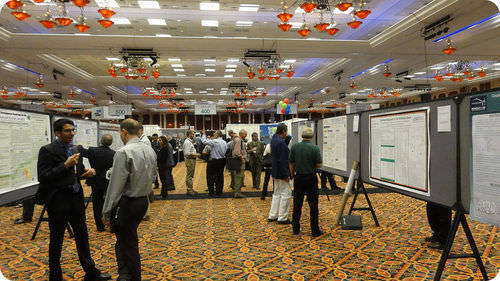
Participants share their results at a scientific conference.
Initially, she may present her data and conclusions at a scientific conference where she will talk with many other scientists. Later, she will write a paper to be published in a scientific journal. After she submits the paper, several scientists will review the paper – a process called peer review – to suggest further investigations or changes in interpretation to make the paper stronger. The scientists will then recommend or deny the paper for publication. Once it is published, other scientists incorporate the results into their own research. If they cannot replicate her results, her work will be thrown out!
Scientific ideas are advanced after many papers on a topic are published.
Scientific Integrity
There scientific community controls the quality and type of research that is done by project funding. Most scientific research is expensive, so scientists must write a proposal to a funding agency, such as the National Science Foundation or the National Aeronautics and Space Administration (NASA), to pay for equipment, supplies, and salaries. Scientific proposals are reviewed by other scientists in the field and are evaluated for funding. In many fields, the funding rate is low and the money goes only to the most worthy research projects.
The scientific community monitors scientific integrity. During their training, students learn how to conduct good scientific experiments. They learn not to fake, hide, or selectively report data, and they learn how to fairly evaluate data and the work of other scientists. Scientists who do not have scientific integrity are strongly condemned by the scientific community.
Nothing is perfect, but considering all the scientific research that is done, there are few incidences of scientific dishonesty. Yet when they do occur, they are often reported with great vehemence by the media. Often this causes the public to mistrust scientists in ways that are unwarranted.
Summary
If science is done well, other scientists who replicate the same work will get the same results.
Scientists peer review a scientific paper before it is published to be sure the work was done using the scientific method.
There are lots of controls in science, including oversight of the projects that get funded.
The checks and balances assure that nearly all scientists operate with a great deal of integrity.
Review
How does peer review work keep quality control high in scientific research?
What happens if a scientist’s results cannot be replicated by other scientists?
What procedures are present in science to insure scientific integrity?
Vocabulary
termdefinition
peer reviewone process in which scientists monitor the work of other scientists by making sure scientific method was followed before a professional manuscript is published.
Notes/Highlights
Color
Highlighted Text
Notes
Please Sign In to create your own Highlights / Notes


 FlexiA FREE Digital Tutor for Every Student
 FlexBooks 2.0Customizable, digital textbooks in a new, interactive platform
 FlexBooksCustomizable, digital textbooks
 SchoolsFlexBooks from schools and districts near you
 Study GuidesQuick review with key information for each concept
 Adaptive PracticeBuilding knowledge at each student’s skill level
 SimulationsInteractive Physics & Chemistry Simulations
 PLIXPlay. Learn. Interact. eXplore.
 CCSS MathConcepts and FlexBooks aligned to Common Core
 NGSSConcepts aligned to Next Generation Science Standards
 Certified EducatorStand out as an educator. Become CK-12 Certified.
 WebinarsLive and archived sessions to learn about CK-12