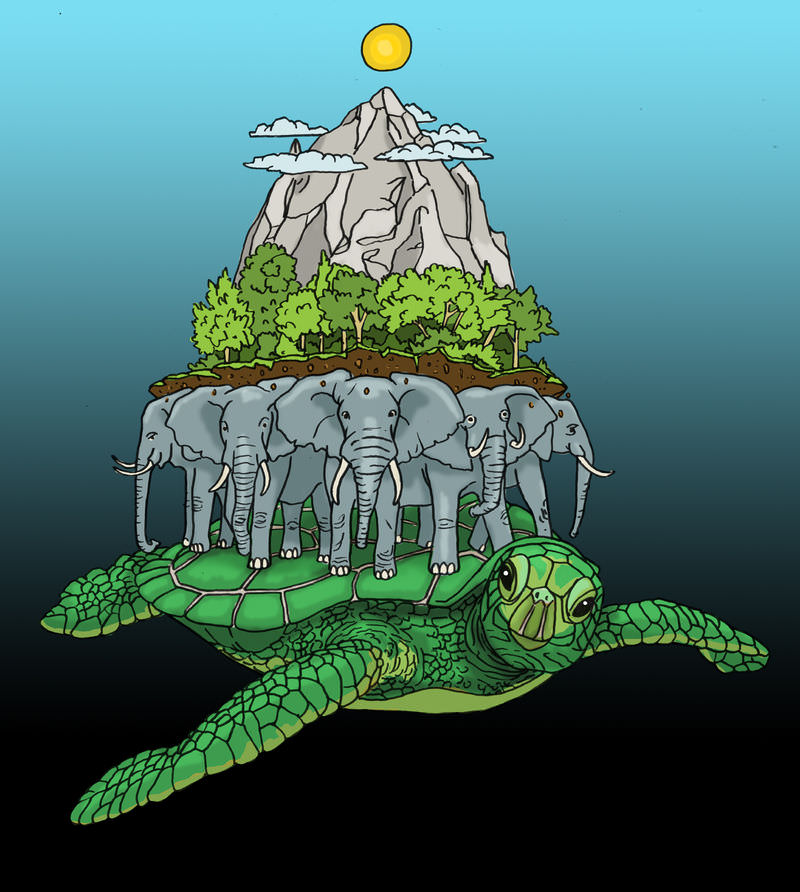
How do you know this isn't what the world is like?
The natural world wouldn’t make much sense without the theories scientists have developed to explain the things that happen or that we observe. Without science, we might think that the world was on the back of an elephant that rested on a tortoise (an inquisitive person would then wonder what the tortoise is resting on). With science, we have theories. Some are essential for earth science.
Three Essential Theories
Scientific theories are sometimes thrown out when the data shows them to be wrong. Before plate tectonics theory was accepted, people thought that fossil organisms had spread around using land bridges. Although a land bridge across the Atlantic seemed a bit far-fetched, there was no better idea. Most scientists were relieved when they could toss that theory out.
But some theories account for so many phenomena and are so broadly supported by so many lines of evidence that they are unlikely ever to be disproved. Additional scientific evidence may reveal problems and scientists may need to modify the theories. But there is so much evidence to support them and nothing major to refute them that they have become essential to their fields of science.
The Theory of Evolution
Darwin’s theory of evolution has been under attack ever since Darwin proposed it. But nearly all biologists accept the theory and recognize that everything they learn about life on Earth supports the theory. Evolution is seen in the fossil record, in the developmental paths of organisms, in the geographic distribution of organisms, and in the genetic codes of living organisms. Evolution has a mechanism, called natural selection. People often refer to natural selection as “the survival of the fittest.” With natural selection, the organism that is best adapted to its environment will be most likely to survive and produce offspring, thus spreading its genes to the next generation.
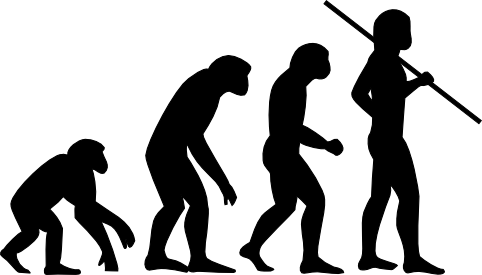
The theory of evolution maintains that modern humans evolved from ape-like ancestors.
The Theory of Plate Tectonics
The theory of plate tectonics is the most important theory in much of earth science. Plate tectonics explains why much geological activity happens where it does, why many natural resources are found where they are, and can be used to determine what was happening long ago in Earth's history. The theory of plate tectonics will be explored in detail in later concepts.
The Theory That Climate is Changing Due to Human Activities
The theory of climate change is a much newer theory than the previous two. We know that average global temperatures are rising. We even know why: Carbon dioxide is released into the atmosphere when fossil fuels are burned. Carbon dioxide is a greenhouse gas. In the atmosphere, greenhouse gases trap heat. This is like putting an extra blanket over Earth. Since more heat is being trapped, global temperature is rising.
There is very little information that contradicts the theory that climate is changing due in large part to human activities. Unless some major discrepancy is discovered about how the atmosphere works, the theory is very likely to stand. So far, the evidence that is being collected supports the idea and global warming can be used to predict future events, which are already taking place. This idea will be explored in detail in later concepts.
Summary
Since scientific ideas must be testable and falsifiable, theories are sometimes tested and shown to be wrong.
Many theories have held up against most tests over many decades. These theories may need to be modified but they are solid at their core.
Three essential theories for Earth Science are the theory of evolution, the theory of plate tectonics, and the theory that human activities are altering Earth’s climate.
Review
1. Scientists are reluctant to say that any theory is absolutely true. Why do you think that is?
2. What reasons do people have outside science to think that a theory is incorrect? Are these valid scientific arguments?
3. What are the three essential theories in Earth science as stated here?
Explore More
Use these resource to answer the questions that follow. Note that plate tectonics will be described in great detail in coming concepts.
Briefly explain the theory of evolution.
Why is evolution by natural selection called the unifying theory of biology?
How many experiments have been done that show evolution not to be true?
Is it likely that scientists will unearth something that will show the theory of evolution to be false?
How does the process of evolution differ from the theory of evolution?
Briefly explain the theory of climate change as mentioned here.
What evidence is there for this theory?
Most people, including scientists, do not call this a theory. Why not? Do you think it should be called a theory? Would calling it a theory saddle it with the same air of uncertainty that follows the theory of evolution?
Vocabulary
termdefinition
natural selectionevolutionary process in which organisms best suited to their environment are more likely to survive and pass on their traits to future generations.
Notes/Highlights
Color
Highlighted Text
Notes
Please Sign In to create your own Highlights / Notes
Currently there are no resources to be displayed.
Description
Looks at the theories of evolution, plate tectonics, and global warming.
Learning Objectives
Describe the three essential theories of Earth science: the theory of evolution, the theory of plate tectonics, and the theory of climate change.


 FlexiA FREE Digital Tutor for Every Student
 FlexBooks 2.0Customizable, digital textbooks in a new, interactive platform
 FlexBooksCustomizable, digital textbooks
 SchoolsFlexBooks from schools and districts near you
 Study GuidesQuick review with key information for each concept
 Adaptive PracticeBuilding knowledge at each student’s skill level
 SimulationsInteractive Physics & Chemistry Simulations
 PLIXPlay. Learn. Interact. eXplore.
 CCSS MathConcepts and FlexBooks aligned to Common Core
 NGSSConcepts aligned to Next Generation Science Standards
 Certified EducatorStand out as an educator. Become CK-12 Certified.
 WebinarsLive and archived sessions to learn about CK-12