We can picture deep space, but what does deep time look like? If you divided up the 4.6 billion years of Earth history into one calendar year, as is done at the end of this concept, you might get an idea.
The Geologic Time Scale
To be able to discuss Earth history, scientists needed some way to refer to the time periods in which events happened and organisms lived. With the information they collected from fossil evidence and using Steno’s principles, they created a listing of rock layers from oldest to youngest. Then they divided Earth’s history into blocks of time with each block separated by important events, such as the disappearance of a species of fossil from the rock record. Since many of the scientists who first assigned names to times in Earth’s history were from Europe, they named the blocks of time from towns or other local places where the rock layers that represented that time were found.
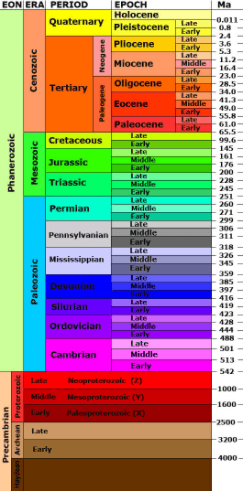
From these blocks of time the scientists created the geologic time scale (Figurebelow). In the geologic time scale the youngest ages are on the top and the oldest on the bottom. Why do you think that the more recent time periods are divided more finely? Do you think the divisions in the scale below are proportional to the amount of time each time period represented in Earth history?
The geologic time scale is based on relative ages. No actual ages were placed on the original time scale.
In what eon, era, period and epoch do we now live? We live in the Holocene (sometimes called Recent) epoch, Quaternary period, Cenozoic era, and Phanerozoic eon.
Geologic Time Condensed to One Year
It's always fun to think about geologic time in a framework that we can more readily understand. Here are when some major events in Earth history would have occurred if all of earth history was condensed down to one calendar year.
January 1 12 am: Earth forms from the planetary nebula – 4600 million years ago
February 25, 12:30 pm: The origin of life; the first cells – 3900 million years ago
March 4, 3:39 pm: Oldest dated rocks – 3800 million years ago
March 20, 1:33 pm: First stromatolite fossils – 3600 million years ago
July 17, 9:54 pm: first fossil evidence of cells with nuclei – 2100 million years ago
November 18, 5:11 pm: Cambrian Explosion – 544 million years ago
December 1, 8:49 am: first insects – 385 million years ago
December 2, 3:54 am: first land animals, amphibians – 375 million years ago
December 5, 5:50 pm: first reptiles – 330 million years ago
December 12, 12:09 pm: Permo-Triassic Extinction – 245 million years ago
December 13, 8:37 pm: first dinosaurs – 228 million years ago
December 14, 9:59 am: first mammals -- 220 million years ago
December 22, 8:24 pm: first flowering plants – 115 million years ago
December 26, 7:52 pm: Cretaceous-Tertiary Extinction – 66 million years ago
December 26, 9:47 pm: first ancestors of dogs – 64 million years ago
December 27, 5:25 am: widespread grasses – 60 million years ago
December 27, 11:09 am: first ancestors of pigs and deer – 57 million years ago
December 28, 9:31 pm: first monkeys – 39 million years ago
December 31, 5:18 pm: oldest hominid – 4 million years ago
December 31, 11:02 pm: oldest direct human ancestor – 1 million years ago
December 31, 11:48 pm: first modern human – 200,000 years ago
December 31, 11:59 pm: Revolutionary War – 235 years ago
Summary
The geologic time scale divides earth history into named units that are separated by major events in earth or life history.
Naming time periods makes it easier to talk about them.
Humans have been around for a miniscule portion of earth history.
Review
Why do earth scientists need a geologic time scale?
Why are some units of the geologic time scale longer and some shorter?
How does the section that condenses all of geologic time into one year make you feel?
Resources
Vocabulary
termdefinition
geologic time scalea division of Earth’s history into blocks of time distinguished by geologic and evolutionary events.
Notes/Highlights
Color
Highlighted Text
Notes
Please Sign In to create your own Highlights / Notes


 FlexiA FREE Digital Tutor for Every Student
 FlexBooks 2.0Customizable, digital textbooks in a new, interactive platform
 FlexBooksCustomizable, digital textbooks
 SchoolsFlexBooks from schools and districts near you
 Study GuidesQuick review with key information for each concept
 Adaptive PracticeBuilding knowledge at each student’s skill level
 SimulationsInteractive Physics & Chemistry Simulations
 PLIXPlay. Learn. Interact. eXplore.
 CCSS MathConcepts and FlexBooks aligned to Common Core
 NGSSConcepts aligned to Next Generation Science Standards
 Certified EducatorStand out as an educator. Become CK-12 Certified.
 WebinarsLive and archived sessions to learn about CK-12