What defines the beginning of the Quaternary and the Holocene?
The most recent period of the Cenozoic is the Quaternary, which began about 2.6 million years ago. The most recent epoch is the Holocene, which began around 12,000 years ago. Go back to the concept on human evolution in the chapter Life History to figure out what events mark the beginning of these time periods.
Cenozoic
The Cenozoic began around 65.5 million years ago and continues today. Although it accounts for only about 1.5% of the Earth’s total history, as the most recent era it is the one scientists know the most about. Much of what has been discussed elsewhere in CK-12 Earth Science Concepts For High School describes the geological situation of the Cenozoic. A few highlights are mentioned here.
Plate Tectonics
The paleogeography of the era was very much like it is today. Early in the Cenozoic, blocks of crust uplifted to form the Rocky Mountains, which were later eroded away and then uplifted again. Subduction off of the Pacific Northwest formed the Cascades volcanic arc. The Basin and Range province that centers on Nevada is where crust is being pulled apart.
Evolution of the San Andreas Fault
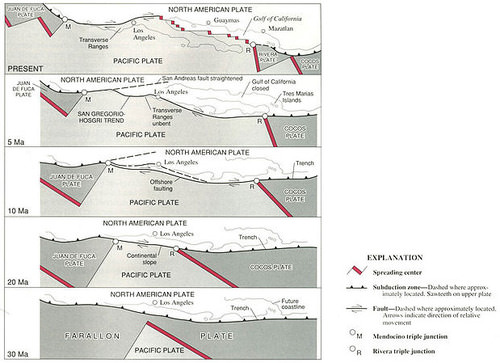
The San Andreas Fault has grown where the Pacific and North American plates meet. The plate tectonic evolution of that plate boundary is complex and interesting (Figurebelow). The Farallon Plate was subducting beneath the North American Plate 30 Ma. By 20 Ma the Pacific Plate and East Pacific Rise spreading center had started to subduct, splitting the Farallon Plate into two smaller plates. Transform motion where the Pacific and North American plates meet formed the San Andreas Fault. The fault moved inland and at present small sea floor spreading basins along with the transform motion of the San Andreas are splitting Baja California from mainland Mexico.
This figure shows the evolution of the San Andreas Fault zone from 30 million years ago (bottom) to present (top).
Although most plate tectonic activity involves continents moving apart, smaller regions are coming together. Africa collided with Eurasia to create the Alps. India crashed into Asia to form the Himalayas.
Ice Ages
As the continents moved apart, climate began to cool. When Australia and Antarctica separated, the Antarctic Circumpolar Current could then move the frigid water around Antarctica and spread it more widely around the planet.
Antarctica drifted over the south polar region and the continent began to grow a permanent ice cap in the Oligocene. The climate warmed in the early Miocene but then began to cool again in the late Miocene and Pliocene when glaciers began to form. During the Pleistocene ice ages, which began 2.6 million years ago, glaciers advanced and retreated four times (Figurebelow). During the retreats, the climate was often warmer than it is today.
Glacial ice at its maximum during the Pleistocene.
These continental ice sheets were extremely thick, like the Antarctic ice cap is today. The Pleistocene ice ages guided the evolution of life in the Cenozoic, including the evolution of humans.
Summary
During the Cenozoic, the crust that had once been joined as Pangaea has mostly been moving apart.
Subduction of the Farallon plate has resulted in the formation of the Rocky Mountains and the San Andreas Fault.
The Pleistocene was marked by four advances of ice, the remnants of which are found today.
Review
Why did the plate boundary that runs up California change from convergent to transform?
Which plate tectonics setting is creating each of these: the Rocky Mountains, the Cascades and the Basin and Range?
What is the history of the advance and retreat of ice during the Pleistocene? Could we still be in the Pleistocene?
Explore More
Use this resource (watch from 6:55 to 9:21) to answer the questions that follow.
What happens with India during the Cenozoic?
What are the Asian subcontinents, like North and South Korea, doing?
What formed between Australia and Antarctica? What was the result of this?
What caused the Red Sea to form?
What is happening now?
Notes/Highlights
Color
Highlighted Text
Notes
Please Sign In to create your own Highlights / Notes


 FlexiA FREE Digital Tutor for Every Student
 FlexBooks 2.0Customizable, digital textbooks in a new, interactive platform
 FlexBooksCustomizable, digital textbooks
 SchoolsFlexBooks from schools and districts near you
 Study GuidesQuick review with key information for each concept
 Adaptive PracticeBuilding knowledge at each student’s skill level
 SimulationsInteractive Physics & Chemistry Simulations
 PLIXPlay. Learn. Interact. eXplore.
 CCSS MathConcepts and FlexBooks aligned to Common Core
 NGSSConcepts aligned to Next Generation Science Standards
 Certified EducatorStand out as an educator. Become CK-12 Certified.
 WebinarsLive and archived sessions to learn about CK-12