H - two - O. Why is something so simple so important?
Water is the most important substance on Earth. Think about all the things you use water for? If your water access were restricted what would you miss about it?
The Water Molecule
Water is simply two atoms of hydrogen and one atom of oxygen bonded together (Figurebelow). The hydrogen ions are on one side of the oxygen ion, making water a polar molecule. This means that one side, the side with the hydrogen ions, has a slightly positive electrical charge. The other side, the side without the hydrogen ions, has a slightly negative charge.
A water molecule. The hydrogen atoms have a slightly positive charge, and the oxygen atom has a slightly negative charge.
Despite its simplicity, water has remarkable properties. Water expands when it freezes, has high surface tension (because of the polar nature of the molecules, they tend to stick together), and others. Without water, life might not be able to exist on Earth and it certainly would not have the tremendous complexity and diversity that we see.
Three States of Matter
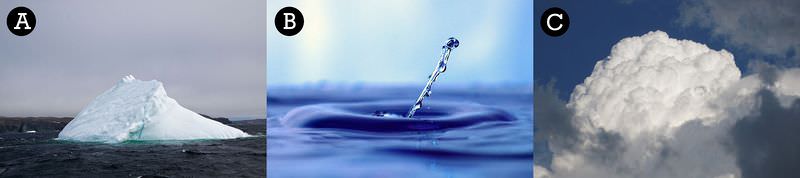
Water is the only substance on Earth that is present in all three states of matter – as a solid, liquid or gas. (And Earth is the only planet where water is abundantly present in all three states.) Because of the ranges in temperature in specific locations around the planet, all three phases may be present in a single location or in a region. The three phases are solid (ice or snow), liquid (water), and gas (water vapor). See ice, water, and clouds (Figurebelow).
(a) Ice floating in the sea. Can you find all three phases of water in this image? (b) Liquid water. (c) Water vapor is invisible, but clouds that form when water vapor condenses are not.
Summary
Water is a polar molecule with a more positive charge on one side and a more negative charge on the other side.
Water is the only substance on Earth that is stable in all three states.
Earth is the only planet in the Solar System that has water in all three states.
Review
What is a polar molecule?
What makes water a polar molecule?
What are the three states that a substance can have?
Where in the solar system is water found in all three states?
Explore More
Use this resource (watch up to 5:50) to answer the questions that follow.
What is the only substance that occurs naturally on Earth in all three states of matter?
Why do scientists look for water in other places in the solar system?
Describe the bond that keeps the water molecule together.
What does it mean to say that the water molecule is polar?
What are hydrogen bonds?
Why does water form a droplet if it is placed on waxed paper or teflon?
Why does water experience adhesion rather than cohesion with glass?
What causes water in a straw to rise higher than the surface level of the water in the beaker the tube is in?
Why is water such a great solvent?
Why doesn't oil mix with water?
Vocabulary
termdefinition
water vaporwater in the form of a gas; water vapor is invisible to humans; when we see clouds, we actually are seeing liquid water in the clouds.
Notes/Highlights
Color
Highlighted Text
Notes
Please Sign In to create your own Highlights / Notes
Credit:Image copyright Kristin Smith, 20114;Hana Zavadska Source:http://www.shutterstock.com;CK-12 Foundation License:Used under license from Shutterstock.com


 FlexiA FREE Digital Tutor for Every Student
 FlexBooks 2.0Customizable, digital textbooks in a new, interactive platform
 FlexBooksCustomizable, digital textbooks
 SchoolsFlexBooks from schools and districts near you
 Study GuidesQuick review with key information for each concept
 Adaptive PracticeBuilding knowledge at each student’s skill level
 SimulationsInteractive Physics & Chemistry Simulations
 PLIXPlay. Learn. Interact. eXplore.
 CCSS MathConcepts and FlexBooks aligned to Common Core
 NGSSConcepts aligned to Next Generation Science Standards
 Certified EducatorStand out as an educator. Become CK-12 Certified.
 WebinarsLive and archived sessions to learn about CK-12