People often think of groundwater as an underground river, but that is rarely true. In Florida, though, water has so thoroughly dissolved the limestone that streams travel underground and above ground. This photo shows where a large spring brings groundwater to the surface as if from nowhere.
Features of an Aquifer
To be a good aquifer, the rock in the aquifer must have good:
porosity: small spaces between grains
permeability: connections between pores
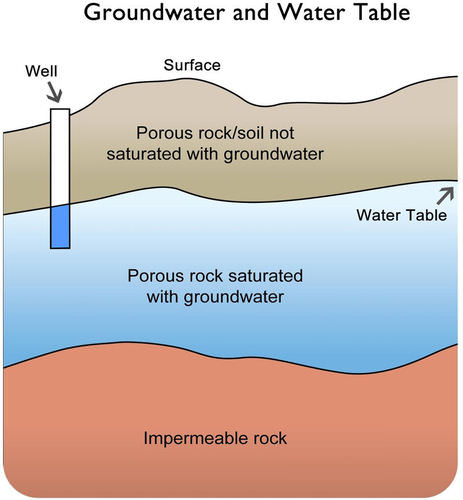
To reach an aquifer, surface water infiltrates downward into the ground through tiny spaces or pores in the rock. The water travels down through the permeable rock until it reaches a layer that does not have pores; this rock is impermeable (Figurebelow). This impermeable rock layer forms the base of the aquifer. The upper surface where the groundwater reaches is the water table.
Groundwater is found beneath the solid surface. Notice that the water table roughly mirrors the slope of the land’s surface. A well penetrates the water table.
The Water Table
For a groundwater aquifer to contain the same amount of water, the amount of recharge must equal the amount of discharge. What are the likely sources of recharge? What are the likely sources of discharge?
What happens to the water table when there is a lot of rainfall? What happens when there is a drought? Although groundwater levels do not rise and fall as rapidly as at the surface, over time the water table will rise during wet periods and fall during droughts.
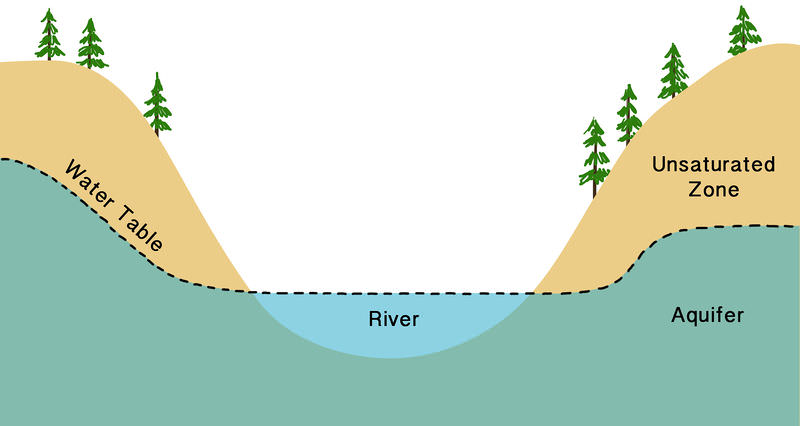
In wet regions, streams are fed by groundwater; the surface of the stream is the top of the water table (Figurebelow). In dry regions, water seeps down from the stream into the aquifer. These streams are often dry much of the year. Water leaves a groundwater reservoir in streams or springs. People take water from aquifers, too.
The top of the stream is the top of the water table. The stream feeds the aquifer.
Springs
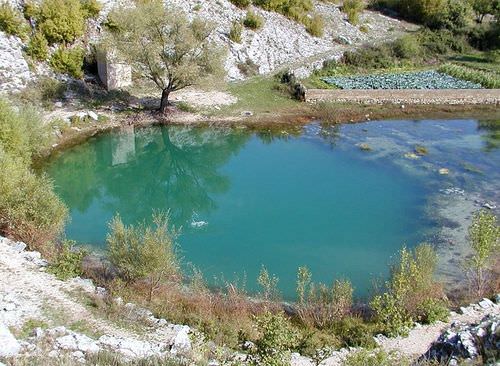
Groundwater meets the surface in a stream (Figureabove) or a spring (Figurebelow). A spring may be constant, or may only flow at certain times of year. Towns in many locations depend on water from springs. Springs can be an extremely important source of water in locations where surface water is scarce.
A spring in Croatia bubbles to the surface and feeds the river Cetina.
Wells
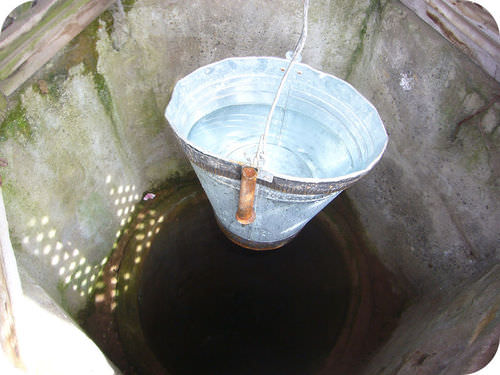
A well is created by digging or drilling to reach groundwater. It is important for anyone who intends to dig a well to know how deep beneath the surface the water table is. When the water table is close to the surface, wells are a convenient method for extracting water. When the water table is far below the surface, specialized equipment must be used to dig a well. Most wells use motorized pumps to bring water to the surface, but some still require people to use a bucket to draw water up (Figurebelow).
An old-fashioned well that uses a bucket drawn up by hand.
Summary
A rock layer must be porous and permeable to be a good aquifer. An impermeable layer makes up the bottom of an aquifer.
The water table rises and falls with additions or subtractions to the groundwater system.
Although people get groundwater from springs, which bring water to the surface, most groundwater is accessed using wells.
Review
What happens to the water table in an extremely wet year? In an extremely dry one?
What characteristics are needed for rock in and around an aquifer?
What causes a spring?
Explore More
Use this resource to answer the questions that follow.
How and where does water get into the aquifer?
What happens in the recharge zone?
What is the artesian zone?
What does hydrologic pressure do?
Where are the wells located and why?
What is a confined aquifer?
What is the saline water zone?
What happens when pollution leaks from a single area?
Explain the two types of pollutants.
What can cause each type of pollution?
How can the pollution of aquifers be prevented?
Resources
Vocabulary
termdefinition
impermeablesomething that water cannot penetrate.
permeablea material with interconnecting holes so that water can move through it easily.
porositythe small holes that exist between grains in a rock or sediment.
springwater that flows out of the ground where the water table meets the surface.
water tabletop of the underground layer of porous rock that is saturated with groundwater.
wella circular hole that goes into an aquifer to allow people to access groundwater.
Notes/Highlights
Color
Highlighted Text
Notes
Please Sign In to create your own Highlights / Notes


 FlexiA FREE Digital Tutor for Every Student
 FlexBooks 2.0Customizable, digital textbooks in a new, interactive platform
 FlexBooksCustomizable, digital textbooks
 SchoolsFlexBooks from schools and districts near you
 Study GuidesQuick review with key information for each concept
 Adaptive PracticeBuilding knowledge at each student’s skill level
 SimulationsInteractive Physics & Chemistry Simulations
 PLIXPlay. Learn. Interact. eXplore.
 CCSS MathConcepts and FlexBooks aligned to Common Core
 NGSSConcepts aligned to Next Generation Science Standards
 Certified EducatorStand out as an educator. Become CK-12 Certified.
 WebinarsLive and archived sessions to learn about CK-12