It may not look like it, but various processes work to moderate Earth's temperature across the latitudes. Atmospheric circulation brings warm equatorial air poleward and frigid polar air toward the Equator. If the planet had an atmosphere that was stagnant, the difference in temperature between the two regions would be much greater.
Air Pressure Zones
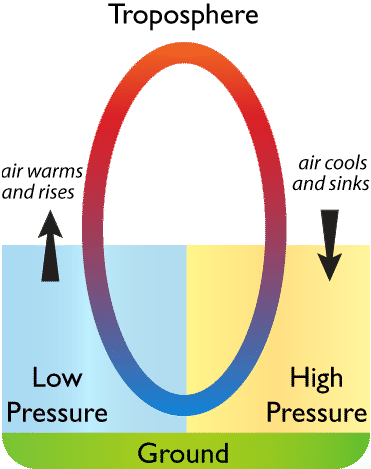
Within the troposphere are convection cells (Figurebelow). Air heated at the ground rises, creating a low pressure zone. Air from the surrounding area is sucked into the space left by the rising air. Air flows horizontally at top of the troposphere; horizontal flow is called advection. The air cools until it descends. When the air reaches the ground, it creates a high pressure zone. Air flowing from areas of high pressure to low pressure creates winds. The greater the pressure difference between the pressure zones, the faster the wind blows.
Warm air rises, creating a low pressure zone; cool air sinks, creating a high pressure zone.
Warm air can hold more moisture than cool air. When warm air rises and cools in a low pressure zone, it may not be able to hold all the water it contains as vapor. Some water vapor may condense to form clouds or precipitation. When cool air descends, it warms. Since it can then hold more moisture, the descending air will evaporate water on the ground.
Wind
Air moving between large high and low pressure systems at the bases of the three major convection cells creates the global wind belts. These planet-wide air circulation systems profoundly affect regional climate. Smaller pressure systems create localized winds that affect the weather and climate of a local area.
Atmospheric Circulation
Two Convection Cells
Because more solar energy hits the Equator, the air warms and forms a low pressure zone. At the top of the troposphere, half moves toward the North Pole and half toward the South Pole. As it moves along the top of the troposphere it cools. The cool air is dense, and when it reaches a high pressure zone it sinks to the ground. The air is sucked back toward the low pressure at the Equator. This describes the convection cells north and south of the Equator.
Plus Coriolis Effect
If the Earth did not rotate, there would be one convection cell in the northern hemisphere and one in the southern with the rising air at the Equator and the sinking air at each pole. But because the planet does rotate, the situation is more complicated. The planet’s rotation means that the Coriolis effect must be taken into account.
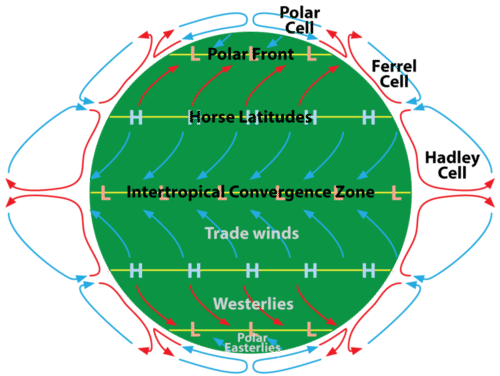
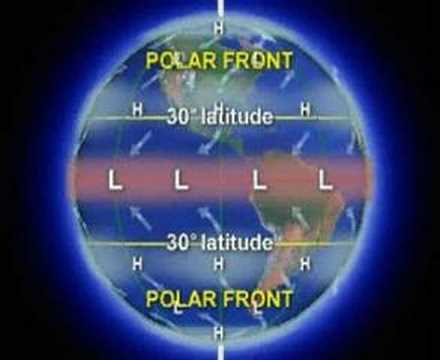
Let’s look at atmospheric circulation in the Northern Hemisphere as a result of the Coriolis effect (Figurebelow). Air rises at the Equator, but as it moves toward the pole at the top of the troposphere, it deflects to the right. (Remember that it just appears to deflect to the right because the ground beneath it moves.) At about 30°N latitude, the air from the Equator meets air flowing toward the Equator from the higher latitudes. This air is cool because it has come from higher latitudes. Both batches of air descend, creating a high pressure zone. Once on the ground, the air returns to the Equator. This convection cell is called the Hadley Cell and is found between 0° and 30°N.
The atmospheric circulation cells, showing direction of winds at Earth's surface.
Equals Three Convection Cells
There are two more convection cells in the Northern Hemisphere. The Ferrell cell is between 30°N and 50° to 60°N. This cell shares its southern, descending side with the Hadley cell to its south. Its northern rising limb is shared with the Polar cell located between 50°N to 60°N and the North Pole, where cold air descends.
Plus Three in the Southern Hemisphere
There are three mirror image circulation cells in the Southern Hemisphere. In that hemisphere, the Coriolis effect makes objects appear to deflect to the left. The total number of atmospheric circulation cells around the globe is six.
Summary
The atmosphere has six major convection cells, three in the northern hemisphere and three in the southern.
Coriolis effect results in there being three convection cells per hemisphere rather than one.
Winds blow at the base of the atmospheric convection cells.
Review
Diagram and label the parts of a convection cell in the troposphere.
How many major atmospheric convection cells would there be without Coriolis effect? Where would they be?
How does Coriolis effect change atmospheric circulation?
Explore More
Use this resource to answer the questions that follow.
What is the engine that drives atmospheric circulation?
What happens to air at the equator? Where does it go?
Why is there a lot of precipitation at the equator? What is the pressure?
What is the pressure at 30-degrees north and south and what type of climate is there?
What does Coriolis Effect do to the base of of the circulation cells? What is created?
In which direction to the winds curve north of the equator? South of the equator?
What happens to the air that sinks at the poles?
Vocabulary
termdefinition
advectionhorizontal movement of a fluid or the transport of a substance or heat in the flow.
high pressure zonea region where relatively cool, dense air is sinking.
low pressure zonea region where relatively warm, lower density air is rising.
Notes/Highlights
Color
Highlighted Text
Notes
Please Sign In to create your own Highlights / Notes
 AI Teacher Tools

 FlexiA FREE Digital Tutor for Every Student
 FlexBooks 2.0Customizable, digital textbooks in a new, interactive platform
 FlexBooksCustomizable, digital textbooks
 SchoolsFlexBooks from schools and districts near you
 Study GuidesQuick review with key information for each concept
 Adaptive PracticeBuilding knowledge at each student’s skill level
 SimulationsInteractive Physics & Chemistry Simulations
 PLIXPlay. Learn. Interact. eXplore.
 CCSS MathConcepts and FlexBooks aligned to Common Core
 NGSSConcepts aligned to Next Generation Science Standards
 Certified EducatorStand out as an educator. Become CK-12 Certified.
 WebinarsLive and archived sessions to learn about CK-12