Did you know that you can see the layers of the atmosphere?
The layers of the atmosphere appear as different colors in this image from the International Space Station.
Air Temperature
The atmosphere is layered, corresponding with how the atmosphere’s temperature changes with altitude. By understanding the way temperature changes with altitude, we can learn a lot about how the atmosphere works.
Papers held up by rising air currents above a radiator demonstrate the important principle that warm air rises.
Warm Air Rises
Why does warm air rise (Figureabove)? Gas molecules are able to move freely, and if they are uncontained, as they are in the atmosphere, they can take up more or less space.
When gas molecules are cool, they are sluggish and do not take up as much space. With the same number of molecules in less space, both air density and air pressure are higher.
When gas molecules are warm, they move vigorously and take up more space. Air density and air pressure are lower.
Warmer, lighter air is more buoyant than the cooler air above it, so it rises. The cooler air then sinks down, because it is denser than the air beneath it. This is convection, which was described in the chapter Plate Tectonics.
Temperature Gradient
The property that changes most strikingly with altitude is air temperature. Unlike the change in pressure and density, which decrease with altitude, changes in air temperature are not regular. A change in temperature with distance is called a temperature gradient.
Layers
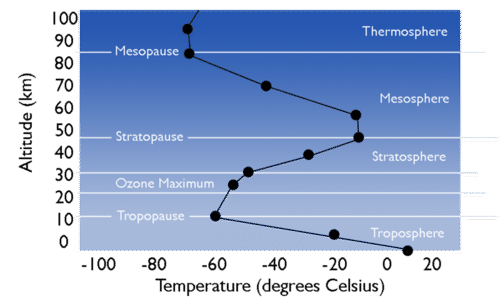
The atmosphere is divided into layers based on how the temperature in that layer changes with altitude, the layer’s temperature gradient (Figurebelow). The temperature gradient of each layer is different. In some layers, temperature increases with altitude and in others it decreases. The temperature gradient in each layer is determined by the heat source of the layer (See opening image).
The four main layers of the atmosphere have different temperature gradients, creating the thermal structure of the atmosphere.
Most of the important processes of the atmosphere take place in the lowest two layers: the troposphere and the stratosphere.
This video is very thorough in its discussion of the layers of the atmosphere. Remember that the chemical composition of each layer is nearly the same except for the ozone layer that is found in the stratosphere.
Summary
Warm air rises, cool air sinks. Warm air has lower density.
Different layers of the atmosphere have different temperature gradients.
Temperature gradient is the change in temperature with distance.
Review
What causes convection in the atmosphere?
Why do the different layers of the atmosphere have different temperature gradients?
What is temperature gradient?
Vocabulary
termdefinition
temperature gradientthe change in temperature with distance.
Notes/Highlights
Color
Highlighted Text
Notes
Please Sign In to create your own Highlights / Notes


 FlexiA FREE Digital Tutor for Every Student
 FlexBooks 2.0Customizable, digital textbooks in a new, interactive platform
 FlexBooksCustomizable, digital textbooks
 SchoolsFlexBooks from schools and districts near you
 Study GuidesQuick review with key information for each concept
 Adaptive PracticeBuilding knowledge at each student’s skill level
 SimulationsInteractive Physics & Chemistry Simulations
 PLIXPlay. Learn. Interact. eXplore.
 CCSS MathConcepts and FlexBooks aligned to Common Core
 NGSSConcepts aligned to Next Generation Science Standards
 Certified EducatorStand out as an educator. Become CK-12 Certified.
 WebinarsLive and archived sessions to learn about CK-12