Does it really never rain in California like the song says?
In California, the predominant winds are the westerlies blowing in from the Pacific Ocean, which bring in relatively cool air in summer and relatively warm air in winter. The winds do bring rain, quite a bit in northern California, but in San Diego there are only 10 inches a year on average.
Atmospheric Circulation Cells
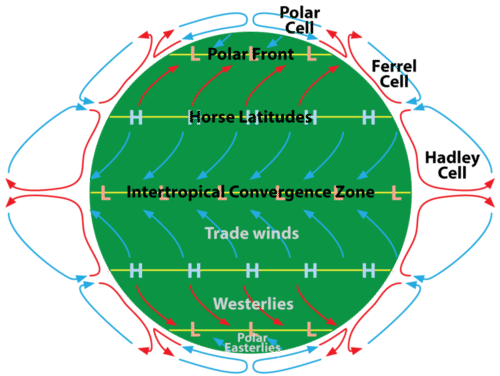
The position of a region relative to the circulation cells and wind belts has a great effect on its climate. In an area where the air is mostly rising or sinking, there is not much wind.
The atmospheric circulation cells and their relationships to air movement on the ground.
The ITCZ
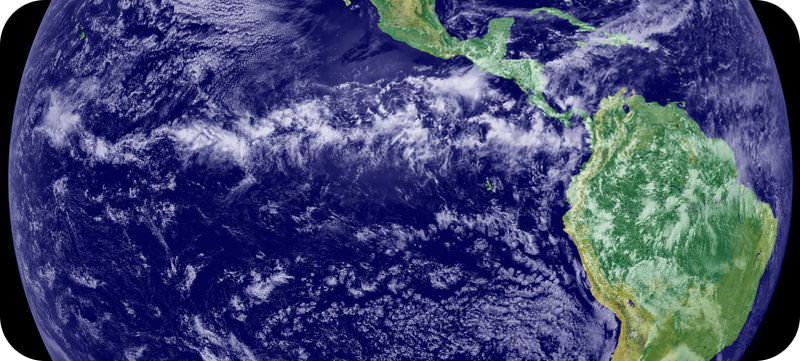
The Intertropical Convergence Zone (ITCZ) is the low pressure area near the Equator in the boundary between the two Hadley Cells. The air rises so that it cools and condenses to create clouds and rain (Figurebelow). Climate along the ITCZ is therefore warm and wet. Early mariners called this region the doldrums because their ships were often unable to sail due to the lack of steady winds.
The ITCZ can easily be seen where thunderstorms are lined up north of the Equator.
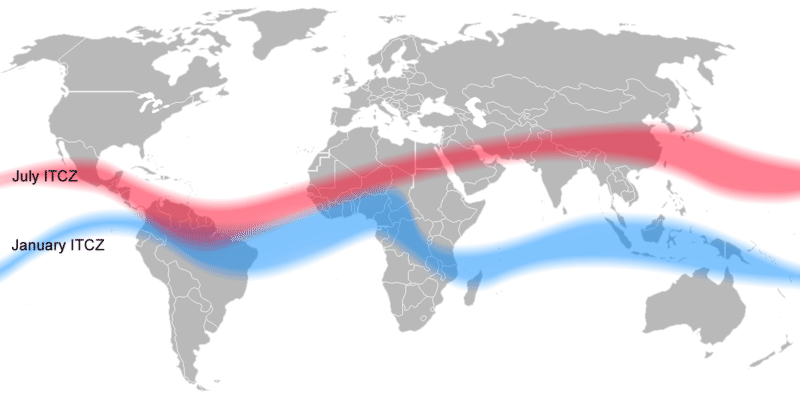
The ITCZ migrates slightly with the season. Land areas heat more quickly than the oceans. Because there are more land areas in the Northern Hemisphere, the ITCZ is influenced by the heating effect of the land. In Northern Hemisphere summer, it is approximately 5° north of the Equator, while in the winter it shifts back and is approximately at the Equator. As the ITCZ shifts, the major wind belts also shift slightly north in summer and south in winter, which causes the wet and dry seasons in this area (Figurebelow).
Seasonal differences in the location of the ITCZ are shown on this map.
Hadley Cell and Ferrell Cell Boundary
At about 30°N and 30°S, the air is fairly warm and dry because much of it came from the Equator, where it lost most of its moisture at the ITCZ. At this location the air is descending, and sinking air warms and causes evaporation.
Mariners named this region the horse latitudes. Sailing ships were sometimes delayed for so long by the lack of wind that they would run out of water and food for their livestock. Sailors tossed horses and other animals over the side after they died. Sailors sometimes didn’t make it either.
Ferrell Cell and Polar Cell Boundary
The polar front is around 50° to 60°, where cold air from the poles meets warmer air from the tropics. The meeting of the two different air masses causes the polar jet stream, which is known for its stormy weather. As the Earth orbits the Sun, the shift in the angle of incoming sunlight causes the polar jet stream to move. Cities to the south of the polar jet stream will be under warmer, moister air than cities to its north. Directly beneath the jet stream, the weather is often stormy and there may be thunderstorms and tornadoes.
Prevailing Winds
The prevailing winds are the bases of the Hadley, Ferrell, and polar cells. These winds greatly influence the climate of a region because they bring the weather from the locations they come from. Local winds also influence local climate. For example, land breezes and sea breezes moderate coastal temperatures.
Summary
High and low pressure zones related to the atmospheric circulation cells are important in determining a region's climate.
Prevailing winds influence the climate of a region because they bring in weather from the upwind area.
Boundaries between cells are often known for winds and stormy weather due to the contact of different air masses.
Review
What are prevailing winds and how do they affect climate?
What is the ITCZ? How does its location affect weather?
Where is there not much wind?
NOTES / HIGHLIGHTS
Please Sign In to create your own Highlights / Notes
Notes/Highlights
Color
Highlighted Text
Notes
Please Sign In to create your own Highlights / Notes


 FlexiA FREE Digital Tutor for Every Student
 FlexBooks 2.0Customizable, digital textbooks in a new, interactive platform
 FlexBooksCustomizable, digital textbooks
 SchoolsFlexBooks from schools and districts near you
 Study GuidesQuick review with key information for each concept
 Adaptive PracticeBuilding knowledge at each student’s skill level
 SimulationsInteractive Physics & Chemistry Simulations
 PLIXPlay. Learn. Interact. eXplore.
 CCSS MathConcepts and FlexBooks aligned to Common Core
 NGSSConcepts aligned to Next Generation Science Standards
 Certified EducatorStand out as an educator. Become CK-12 Certified.
 WebinarsLive and archived sessions to learn about CK-12