Air pressure and air temperature decrease with altitude. The closer molecules are packed together, the more likely they are to collide. Collisions between molecules give off heat, which warms the air. At higher altitudes, the air is less dense and air molecules are more spread out and less likely to collide. A location in the mountains has lower average temperatures than one at the base of the mountains. In Colorado, for example, Lakewood's (5,640 feet) average annual temperature is 62oF (17oC), while Climax Lake's (11,300 feet) is 42oF (5.4oC).
Mountain ranges have two effects on the climate of the surrounding region:
rainshadow effect, which brings warm, dry climate to the leeward side of a mountain range (Figurebelow).
separation in the coastal region from the rest of the continent. Since a maritime air mass may have trouble rising over a mountain range, the coastal area will have a maritime climate but the inland area on the leeward side will have a continental climate.
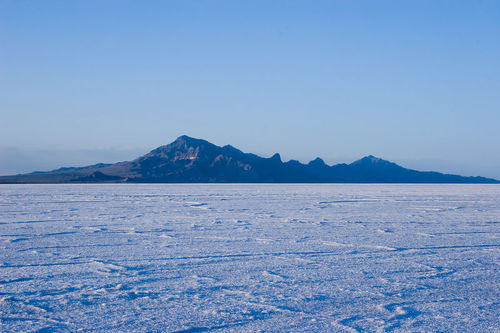
The Bonneville Salt Flats are part of the very dry Great Basin of the Sierra Nevada of California. The region receives little rainfall.
Five factors that Affect Climate takes a very thorough look at what creates the climate zones. The climate of a region allows certain plants to grow, creating an ecological biome.
Summary
Collisions between molecules increase temperature: where air is denser, the air temperature is higher.
Rainshadow effect occurs on the leeward side of a mountain range.
Maritime air may become stuck on the windward side of a mountain range and so is unable to bring cooler air further inland.
Review
Why does an increase in altitude cause a change in temperature?
What is rainshadow effect?
Besides rainshadow effect, how else do mountains affect weather downwind?
Explore More
Use this resource to answer the questions that follow.
What happens when wind crashes into a mountain range?
What weather occurs on the windward side of a mountain?
What is the climate on the windward side of the mountain relative to the leeward side of the mountain?
What are rain shadow deserts?
Describe the characteristics seen on the windward side of the Sierra Nevada Mountains.
Describe the characteristics see on the leeward side of the Sierra Nevada Mountains.
Notes/Highlights
Color
Highlighted Text
Notes
Please Sign In to create your own Highlights / Notes

 FlexiA FREE Digital Tutor for Every Student
 FlexBooks 2.0Customizable, digital textbooks in a new, interactive platform
 FlexBooksCustomizable, digital textbooks
 SchoolsFlexBooks from schools and districts near you
 Study GuidesQuick review with key information for each concept
 Adaptive PracticeBuilding knowledge at each student’s skill level
 SimulationsInteractive Physics & Chemistry Simulations
 PLIXPlay. Learn. Interact. eXplore.
 CCSS MathConcepts and FlexBooks aligned to Common Core
 NGSSConcepts aligned to Next Generation Science Standards
 Certified EducatorStand out as an educator. Become CK-12 Certified.
 WebinarsLive and archived sessions to learn about CK-12