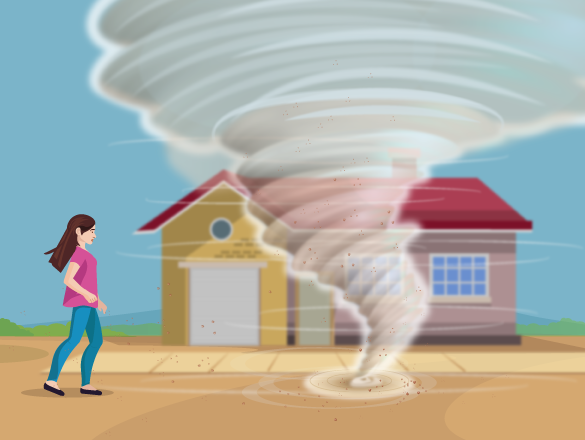
Dorothy's house flies up in a tornado to the magical land of Oz. When the tornado ends, the house it falls on the witch. Dorothy becomes a hero for killing the tyrannical witch, but despite that yearns for home. In the real world, tornadoes do kill, but houses don't usually fly, and wicked witches usually avoid tornadoes.
Tornadoes
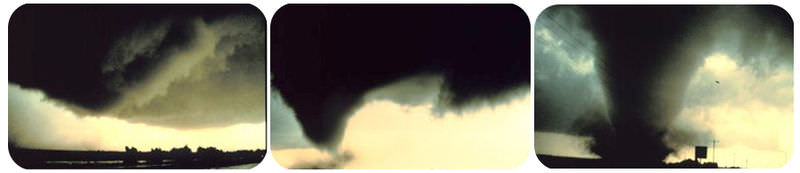
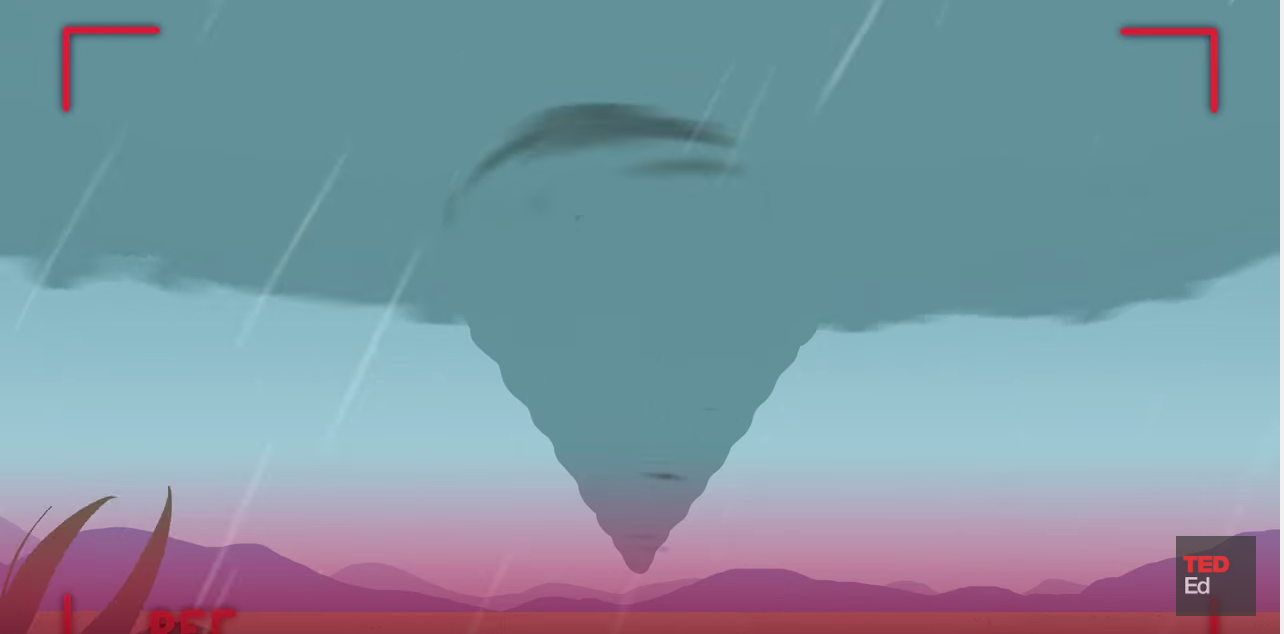
Tornadoes, also called twisters, are fierce products of severe thunderstorms (Figurebelow). As air in a thunderstorm rises, the surrounding air races in to fill the gap. This forms a tornado, a funnel-shaped, whirling column of air extending downward from a cumulonimbus cloud.
The formation of this tornado outside Dimmit, Texas, in 1995 was well studied.
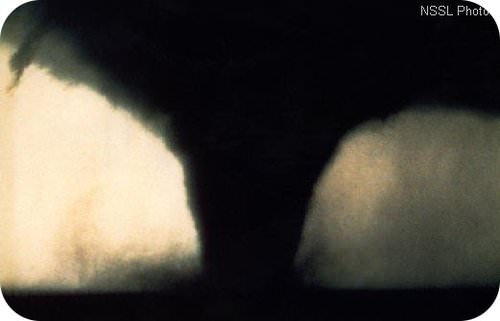
A tornado lasts from a few seconds to several hours. The average wind speed is about 177 kph (110 mph), but some winds are much faster. A tornado travels over the ground at about 45 km per hour (28 miles per hour) and goes about 25 km (16 miles) before losing energy and disappearing (Figurebelow).
This tornado struck Seymour, Texas, in 1979.
Damage
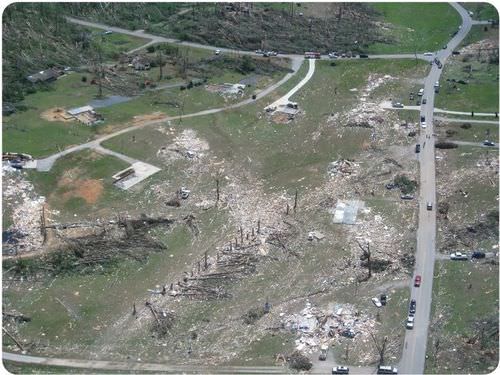
An individual tornado strikes a small area, but it can destroy everything in its path. Most injuries and deaths from tornadoes are caused by flying debris (Figurebelow). In the United States an average of 90 people are killed by tornadoes each year. The most violent two percent of tornadoes account for 70% of the deaths by tornadoes.
Tornado damage at Ringgold, Georgia in April 2011.
Location
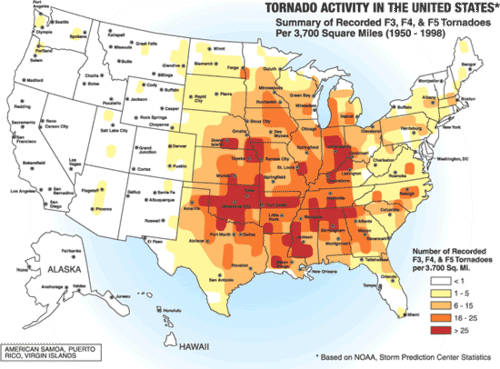
Tornadoes form at the front of severe thunderstorms. Lines of these thunderstorms form in the spring where where maritime tropical (mT) and continental polar (cP) air masses meet. Although there is an average of 770 tornadoes annually, the number of tornadoes each year varies greatly (Figurebelow).
The frequency of F3, F4, and F5 tornadoes in the United States. The red region that starts in Texas and covers Oklahoma, Nebraska, and South Dakota is called Tornado Alley because it is where most of the violent tornadoes occur.
April 2011
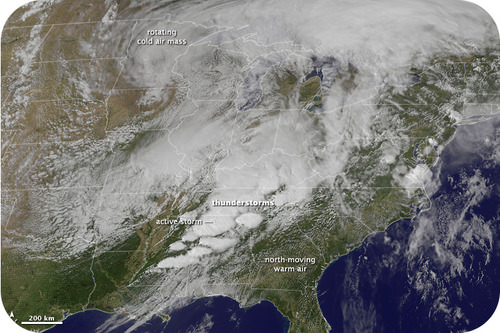
In late April 2011, severe thunderstorms pictured in the satellite image spawned the deadliest set of tornadoes in more than 25 years. In addition to the meeting of cP and mT mentioned above, the jet stream was blowing strongly in from the west. The result was more than 150 tornadoes reported throughout the day (Figurebelow).
April 27-28, 2011. The cold air mass is shown by the mostly continuous clouds. Warm moist air blowing north from the Atlantic Ocean and Gulf of Mexico is indicated by small low clouds. Thunderstorms are indicated by bright white patches.
The entire region was alerted to the possibility of tornadoes in those late April days. But meteorologists can only predict tornado danger over a very wide region. No one can tell exactly where and when a tornado will touch down. Once a tornado is sighted on radar, its path is predicted and a warning is issued to people in that area. The exact path is unknown because tornado movement is not very predictable.
Fujita Scale
The intensity of tornadoes is measured on the Fujita Scale (see Tablebelow), which assigns a value based on wind speed and damage.
The Fujita Scale (F Scale) of Tornado Intensity
F Scale
(km/hr)
(mph)
Damage
F0
64-116
40-72
Light - tree branches fall and chimneys may collapse
F1
117-180
73-112
Moderate - mobile homes, autos pushed aside
F2
181-253
113-157
Considerable - roofs torn off houses, large trees uprooted
F3
254-333
158-206
Severe - houses torn apart, trees uprooted, cars lifted
F4
333-419
207-260
Devastating - houses leveled, cars thrown
F5
420-512
261-318
Incredible - structures fly, cars become missiles
F6
>512
>318
Maximum tornado wind speed
Summary
A tornado is a whirling funnel of air extending down from a cumulonimbus cloud.
The Fujita scale measures tornado intensity based on wind speed and damage.
Tornadoes can only be predicted over a wide region.
Review
What causes the tornadoes of Tornado Alley?
How does the Fujita scale resemble the scales for assessing earthquake intensity? Which does it most resemble?
What circumstances led to the intensity of tornado activity in April 2011?
Explore More
Use this resource to answer the questions that follow.
Why do tornadoes form from supercells?
What two elements are present in a thunderstorm that will form a tornado?
What are winds doing within a thunderstorm to create a tornado?
Where does a supercell thunderstorm get its power?
What happens when a thunderstorm can finally form in spite of the cap?
The meeting of which air masses causes thunderstorms in the spring?
Which factor increases the chance of powerful thunderstorms and tornadoes?
Why might global warming produce more thunderstorms and tornadoes?
Vocabulary
termdefinition
tornadoviolently rotating funnel cloud that grows downward from a cumulonimbus cloud.
Notes/Highlights
Color
Highlighted Text
Notes
Please Sign In to create your own Highlights / Notes


 FlexiA FREE Digital Tutor for Every Student
 FlexBooks 2.0Customizable, digital textbooks in a new, interactive platform
 FlexBooksCustomizable, digital textbooks
 SchoolsFlexBooks from schools and districts near you
 Study GuidesQuick review with key information for each concept
 Adaptive PracticeBuilding knowledge at each student’s skill level
 SimulationsInteractive Physics & Chemistry Simulations
 PLIXPlay. Learn. Interact. eXplore.
 CCSS MathConcepts and FlexBooks aligned to Common Core
 NGSSConcepts aligned to Next Generation Science Standards
 Certified EducatorStand out as an educator. Become CK-12 Certified.
 WebinarsLive and archived sessions to learn about CK-12