How is a community of people like a community of organisms?
Different species have different jobs within their community. Some are the farmers, some are traders, some are the janitors, and others have different roles.
Biological Communities
A population consists of all individuals of a single species that exist together at a given place and time. A species is a single type of organism that can interbreed and produce fertile offspring. All of the populations living together in the same area make up a community.
Ecosystems
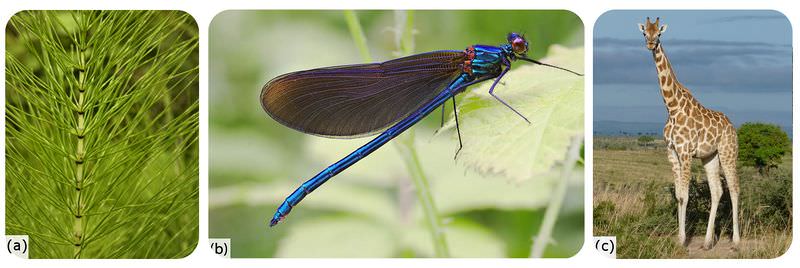
An ecosystem is made up of the living organisms in a community and the nonliving things, the physical and chemical factors, that they interact with. The living organisms within an ecosystem are its biotic factors (Figurebelow). Living things include bacteria, algae, fungi, plants, and animals, including invertebrates, animals without backbones, and vertebrates, animals with backbones.
(a) The horsetail Equisetum is a primitive plant. (b) Insects are among the many different types of invertebrates. (c) A giraffe is an example of a vertebrate.
Physical and chemical features are abiotic factors. Abiotic factors include resources living organisms need, such as light, oxygen, water, carbon dioxide, good soil, and nitrogen, phosphorous, and other nutrients. Nutrients cycle through different parts of the ecosystem and can enter or leave the ecosystem at many points. Abiotic factors also include environmental features that are not materials or living things, such as living space and the right temperature range. Energy moves through an ecosystem in one direction.
Niches
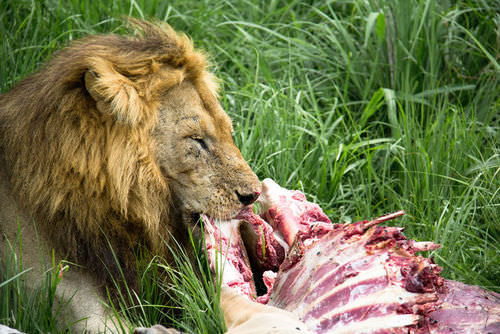
Organisms must make a living, just like a lawyer or a ballet dancer. This means that each individual organism must acquire enough food energy to live and reproduce. A species' way of making a living is called its niche. An example of a niche is making a living as a top carnivore, an animal that eats other animals, but is not eaten by any other animals (Figurebelow). Every species fills a niche, and niches are almost always filled in an ecosystem.
The top carnivore niche is filled by lions on the savanna.
Habitat
An organism’s habitat is where it lives (Figurebelow). The important characteristics of a habitat include climate, the availability of food, water, and other resources, and other factors, such as weather.
Birds living in a saguaro cactus. A habitat may be a hole in a cactus or the underside of a fern in a rainforest. It may be rocks and the nearby sea.
Summary
All of the individuals of a species that exist together at a given place and time make up a population. A community is made up of all of the populations in an area.
The living and nonliving factors that living organisms need plus the communities of organisms themselves make up an ecosystem.
A habitat is where an organism lives and a niche is what it does to make a living.


 FlexiA FREE Digital Tutor for Every Student
 FlexBooks 2.0Customizable, digital textbooks in a new, interactive platform
 FlexBooksCustomizable, digital textbooks
 SchoolsFlexBooks from schools and districts near you
 Study GuidesQuick review with key information for each concept
 Adaptive PracticeBuilding knowledge at each student’s skill level
 SimulationsInteractive Physics & Chemistry Simulations
 PLIXPlay. Learn. Interact. eXplore.
 CCSS MathConcepts and FlexBooks aligned to Common Core
 NGSSConcepts aligned to Next Generation Science Standards
 Certified EducatorStand out as an educator. Become CK-12 Certified.
 WebinarsLive and archived sessions to learn about CK-12