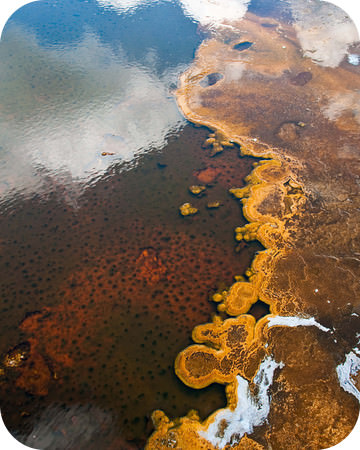
How can you tell a blob of organic material from a living creature? What characteristics does something need to be considered alive? Is this material rust or is it bacteria?
The Origin Of Life
No one knows how or when life first began on the turbulent early Earth. There is little hard evidence from so long ago. Scientists think that it is extremely likely that life began and was wiped out more than once; for example, by the impact that created the Moon.
This issue of what's living and what's not becomes important when talking about the origin of life. If we're going to know when a blob of organic material crossed over into being alive, we need to have a definition of life.
Characteristics of Life
To be considered alive a molecule must:
be organic. The organic molecules needed are amino acids, the building blocks of life.
have a metabolism.
be capable of replication (be able to reproduce).
Learning About the Origin of Life
To look for information regarding the origin of life, scientists:
perform experiments to recreate the environmental conditions found at that time.
study the living creatures that make their homes in the types of extreme environments that were typical in Earth’s early days.
seek traces of life left by ancient microorganisms, also called microbes, such as microscopic features or isotopic ratios indicative of life. Any traces of life from this time period are so ancient it is difficult to be certain whether they originated by biological or non-biological means.
Amino Acids
Amino acids are the building blocks of life because they create proteins. To form proteins, the amino acids are linked together by covalent bonds to form polymers called polypeptide chains (Figurebelow).
Amino acids form polypeptide chains.
These chains are arranged in a specific order to form each different type of protein. Proteins are the most abundant class of biological molecules.
An important question facing scientists is where the first amino acids came from: did they originate on Earth or did they fly in from outer space? No matter where they originated, the creation of amino acids requires the right starting materials and some energy.
Miller-Urey Experiment
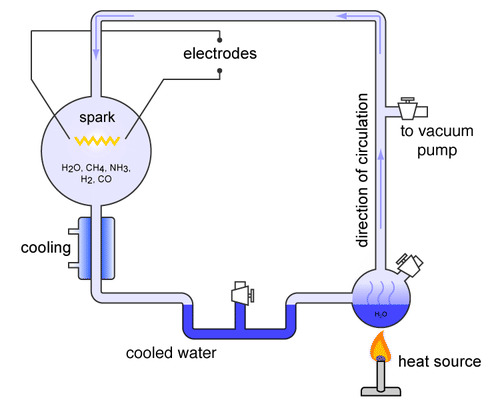
The setup of the Miller-Urey experiment.
To see if amino acids could originate in the environment thought to be present in the first years of Earth’s existence, Stanley Miller and Harold Urey performed a famous experiment in 1953. To simulate the early atmosphere they placed hydrogen, methane, and ammonia in a flask of heated water that created water vapor, which they called the primordial soup. Sparks simulated lightning, which the scientists thought could have been the energy that drove the chemical reactions that created the amino acids. It worked! The gases combined to form water-soluble organic compounds including amino acids.
Amino acids might also have originated at hydrothermal vents or deep in the crust where Earth’s internal heat is the energy source. Meteorites containing amino acids currently enter the Earth system and so meteorites could have delivered amino acids to the planet from elsewhere in the solar system (where they would have formed by processes similar to those outlined here).
Summary
Amino acids are linked by covalent bonds to form peptide chains that are ordered to create specific types of proteins.
For something to be alive it must be organic, have a metabolism, and be capable of replication.
Miller and Urey simulated the early atmosphere with hydrogen, methane, ammonia, and water vapor, to which they added sparks and created amino acids.
Review
Why must something that is alive be capable of replication?
Why do scientists that are interested in the origin of life study extreme environments?
How do scientists learn about the origins of life?
Explore More
Use this resource to answer the questions that follow.
What is the first characteristic of living things presented in the video and what does it mean?
How can an organism be just one cell?
What is the second characteristic of living things presented in the video and what does it mean?
What is the third characteristic of living things presented in the video and what does it mean?
What is the fourth characteristic of living things presented in the video and what does it mean?
How does your body do homeostasis?
What is the fifth characteristic of living things presented in the video and what does it mean?
How is the walking stick adapted to its environment?
NOTES / HIGHLIGHTS
Please Sign In to create your own Highlights / Notes
Vocabulary
termdefinition
microbea microorganism.
Notes/Highlights
Color
Highlighted Text
Notes
Please Sign In to create your own Highlights / Notes


 FlexiA FREE Digital Tutor for Every Student
 FlexBooks 2.0Customizable, digital textbooks in a new, interactive platform
 FlexBooksCustomizable, digital textbooks
 SchoolsFlexBooks from schools and districts near you
 Study GuidesQuick review with key information for each concept
 Adaptive PracticeBuilding knowledge at each student’s skill level
 SimulationsInteractive Physics & Chemistry Simulations
 PLIXPlay. Learn. Interact. eXplore.
 CCSS MathConcepts and FlexBooks aligned to Common Core
 NGSSConcepts aligned to Next Generation Science Standards
 Certified EducatorStand out as an educator. Become CK-12 Certified.
 WebinarsLive and archived sessions to learn about CK-12