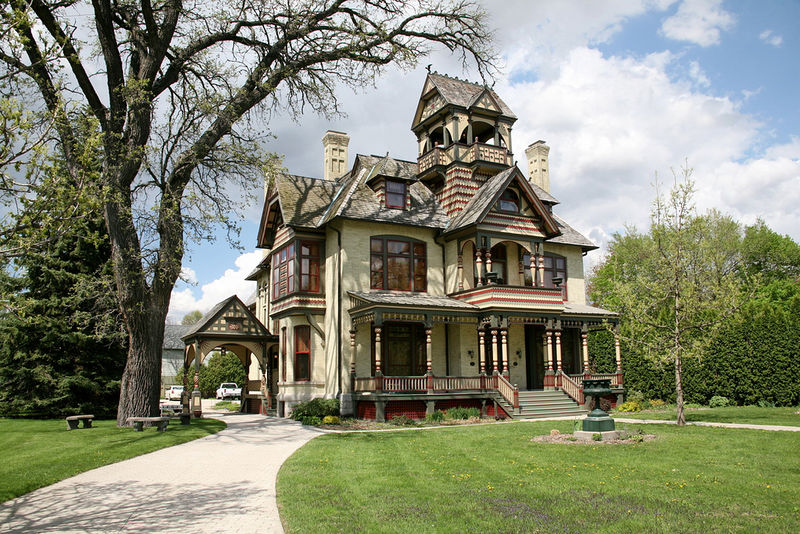
The amount of space and resources used by each resident of this house far exceeds the average for a single human resident of planet Earth and even more for a single person in a poor country in sub-Saharan Africa.
Consequences of the Green Revolution
The Green Revolution has brought enormous impacts to the planet.
Land Loss
Natural landscapes have been altered to create farmland and cities. Already, half of the ice-free lands have been converted to human uses. Estimates are that by 2030, that number will be more than 70%. Forests and other landscapes have been cleared for farming or urban areas. Rivers have been dammed and the water is transported by canals for irrigation and domestic uses. Ecologically sensitive areas have been altered: wetlands are now drained and coastlines are developed.
Pollution
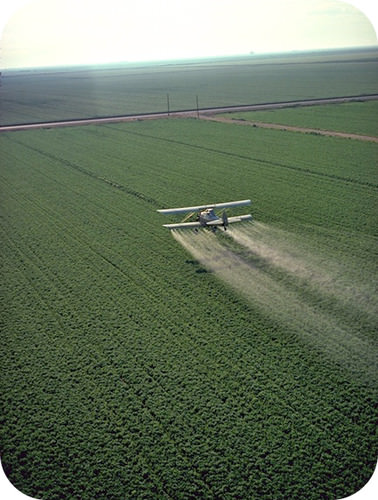
Modern agricultural practices produce a lot of pollution (Figurebelow). Some pesticides are toxic. Dead zones grow as fertilizers drain off farmland and introduce nutrients into lakes and coastal areas. Farm machines and vehicles used to transport crops produce air pollutants. Pollutants enter the air, water, or are spilled onto the land. Moreover, many types of pollution easily move between air, water, and land. As a result, no location or organism — not even polar bears in the remote Arctic — is free from pollution.
Pesticides are hazardous in large quantities and some are toxic in small quantities.
Consequences for Other Resources
The increased numbers of people have other impacts on the planet. Humans do not just need food. They also need clean water, secure shelter, and a safe place for their wastes. These needs are met to different degrees in different nations and among different socioeconomic classes of people. For example, about 1.2 billion of the world’s people do not have enough clean water for drinking and washing each day (Figurebelow).
The percentage of people in the world that live in abject poverty is decreasing somewhat globally, but increasing in some regions, such as Sub-Saharan Africa.
Over-Consumption
The addition of more people has not just resulted in more poor people. A large percentage of people expect much more than to have their basic needs met. For about one-quarter of people there is an abundance of food, plenty of water, and a secure home. Comfortable temperatures are made possible by heating and cooling systems, rapid transportation is available by motor vehicles or a well-developed public transportation system, instant communication takes place by phones and email, and many other luxuries are available that were not even dreamed of only a few decades ago. All of these require resources in order to be produced, and fossil fuels in order to be powered (Figurebelow). Their production, use, and disposal all produce wastes.
Many people refer to the abundance of luxury items in these people’s lives as over-consumption. People in developed nations use 32 times more resources than people in the developing countries of the world.
Since CO2 is a waste product from fossil fuel burning, CO2 emissions tell which countries are using the most fossil fuels, which means that the population has a high standard of living.
Summary
The Green Revolution has allowed more people to be fed and the human population to increase. The consequences are land loss, pollution, and a tremendous use of fossil fuels.
By keeping more people alive, the Green Revolution has put a strain on other needed resources like water and materials.
Overpopulation is a big problem, but over-consumption is also depleting Earth's resources as some people in the world use far more materials than others.
Review
Why has so much natural land been converted to human uses? What happens to the ecosystems that are affected?
What causes pollution and why is it so widespread?
What do you use in your daily life that would be inconceivable for a poor teenager in sub-Saharan Africa? What about contrasting yourself with a poor teen living in an urban ghetto in the U.S.?
Explore More
Use these resources to answer the questions that follow.
What is the bank the announcer is referring to?
What are the two factors that our impact on this bank depend on?
Earth is now home to 7 billion people yet there is the statement that if everyone lived like an average European Earth could only support 2 billion in the long term, so what does that mean about the present?
What are ecosystem services? What are some examples?
What is overconsumpulation?
What does the speaker say will happen if we don't get population down to 2 billion?
What are the two options?
What will happen if population continue to grow or doesn't shrink?
Vocabulary
termdefinition
over-consumptionresource use that is unsustainable in the long term; obtaining or using many more products than people need.
Notes/Highlights
Color
Highlighted Text
Notes
Please Sign In to create your own Highlights / Notes


 FlexiA FREE Digital Tutor for Every Student
 FlexBooks 2.0Customizable, digital textbooks in a new, interactive platform
 FlexBooksCustomizable, digital textbooks
 SchoolsFlexBooks from schools and districts near you
 Study GuidesQuick review with key information for each concept
 Adaptive PracticeBuilding knowledge at each student’s skill level
 SimulationsInteractive Physics & Chemistry Simulations
 PLIXPlay. Learn. Interact. eXplore.
 CCSS MathConcepts and FlexBooks aligned to Common Core
 NGSSConcepts aligned to Next Generation Science Standards
 Certified EducatorStand out as an educator. Become CK-12 Certified.
 WebinarsLive and archived sessions to learn about CK-12