Fertilizer makes things grow. How could it cause a dead zone?
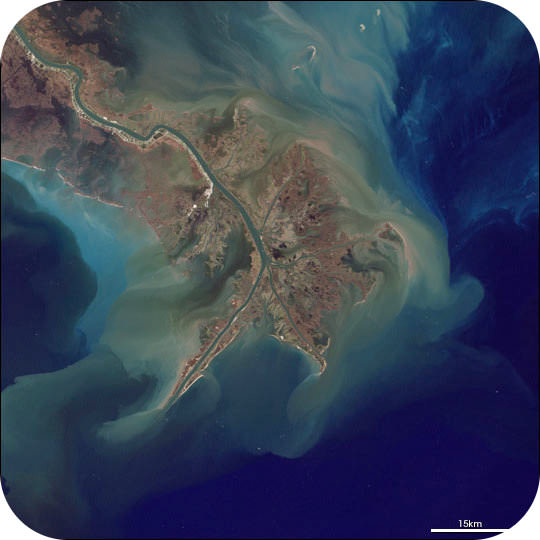
Fertilizer from farms and yards carried from the Mississippi River into the Gulf of Mexico creates an enormous dead zone, where algae use up all the oxygen and nothing else can live. The largest, in 2002, was about 22,000 square kilometers (8,400 mi2).
Ocean Pollution
Most ocean pollution comes as runoff from land and originates as agricultural, industrial, and municipal wastes (Figurebelow). The remaining 20% of water pollution enters the ocean directly from oil spills and people dumping wastes directly into the water. Ships at sea empty their wastes directly into the ocean, for example.
In some areas of the world, ocean pollution is all too obvious.
Coastal pollution can make coastal water unsafe for humans and wildlife. After rainfall, there can be enough runoff pollution that beaches must be closed to prevent the spread of disease from pollutants. A surprising number of beaches are closed because of possible health hazards each year.
A large proportion of the fish we rely on for food live in the coastal wetlands or lay their eggs there. Coastal runoff from farm waste often carries water-borne organisms that cause lesions that kill fish. Humans who come in contact with polluted waters and affected fish can also experience harmful symptoms. More than one-third of the shellfish-growing waters of the United States are adversely affected by coastal pollution.
Dead Zones
Fertilizers that run off of lawns and farm fields are extremely harmful to the environment. Nutrients, such as nitrates, in the fertilizer promote algae growth in the water they flow into. With the excess nutrients, lakes, rivers, and bays become clogged with algae and aquatic plants. Eventually these organisms die and decompose. Decomposition uses up all the dissolved oxygen in the water. Without oxygen, large numbers of plants, fish, and bottom-dwelling animals die.
Every year dead zones appear in lakes and nearshore waters. A dead zone is an area of hundreds of kilometers of ocean without fish or plant life.
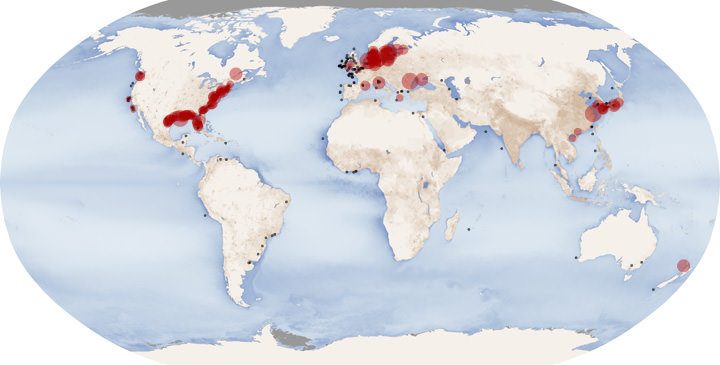
The Mississippi is not the only river that carries the nutrients necessary to cause a dead zone. Rivers that drain regions where human population density is high and where crops are grown create dead zones all over the world (Figurebelow).
Dead zones off the coasts. Red dots show the location and size of the dead zone; black circles show the location but the size is unknown. Darker blue regions of the oceans indicate that organic particulates are high and may lead to a dead zone.
Summary
Most ocean pollution comes from land and much congregates in the coastal regions.
Excess fertilizer travels in rivers to the sea and causes algae to bloom. These algae die and decomposition uses up the oxygen in an area, causing a dead zone.
The dead zone in the Gulf of Mexico from Mississippi River runoff is getting larger each year.
Review
What are the consequences of coastal pollution?
What are the sources of coastal pollution?
What sequence of events causes a dead zone?
Explore More
Use these resources to answer the questions that follow.
Why does the US Coast Guard do vehicle patrols?
Why are storm drains under US Coast Guard jurisdiction?
What is the purpose of the pollution fines?
What typically makes a beach unfit for swimming?
What percent of samples violated public health standards for the year this video was made?
What is the danger of swimming in contaminated water?
What is the danger of digging in the sand?
Notes/Highlights
Color
Highlighted Text
Notes
Please Sign In to create your own Highlights / Notes


 FlexiA FREE Digital Tutor for Every Student
 FlexBooks 2.0Customizable, digital textbooks in a new, interactive platform
 FlexBooksCustomizable, digital textbooks
 SchoolsFlexBooks from schools and districts near you
 Study GuidesQuick review with key information for each concept
 Adaptive PracticeBuilding knowledge at each student’s skill level
 SimulationsInteractive Physics & Chemistry Simulations
 PLIXPlay. Learn. Interact. eXplore.
 CCSS MathConcepts and FlexBooks aligned to Common Core
 NGSSConcepts aligned to Next Generation Science Standards
 Certified EducatorStand out as an educator. Become CK-12 Certified.
 WebinarsLive and archived sessions to learn about CK-12