Wars have been fought over oil, but many people predict that the next war will be fought over water. Certainly, water is becoming scarcer.
Water Distribution
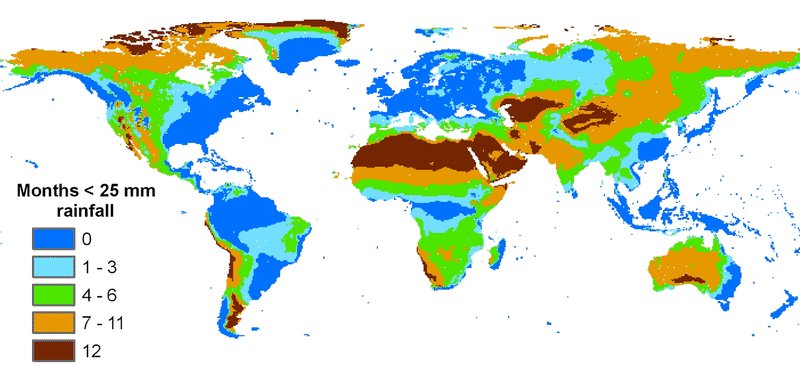
Water is unevenly distributed around the world. Large portions of the world, such as much of northern Africa, receive very little water relative to their population (Figurebelow). The map shows the number of months in which there is little rainfall in each region. In developed nations, water is stored, but in underdeveloped nations, water storage may be minimal.
Some regions have very little rainfall per month.
Over time, as population grows, rainfall totals will change, resulting in less water per person in some regions. In 2025, many nations, even developed nations, are projected to have less water per person than now
Water Shortages
Water scarcity is a problem now and will become an even larger problem in the future as water sources are reduced or polluted and population grows. In 1995, about 40% of the world’s population faced water scarcity. Scientists estimate that by the year 2025, nearly half of the world’s people won’t have enough water to meet their daily needs. Nearly one-quarter of the world’s people will have less than 500 m3 of water to use in an entire year. That amount is less water in a year than some people in the United States use in one day.
Droughts
Droughts occur when a region experiences unusually low precipitation for months or years (Figurebelow). Periods of drought may create or worsen water shortages.
Human activities can contribute to the frequency and duration of droughts. For example, deforestation keeps trees from returning water to the atmosphere by transpiration; part of the water cycle becomes broken. Because it is difficult to predict when droughts will happen, it is difficult for countries to predict how serious water shortages will be each year.
Extended periods with lower than normal rainfall cause droughts.
Effect of Changing Climate
Global warming will change patterns of rainfall and water distribution. As the Earth warms, regions that currently receive an adequate supply of rain may shift. Regions that rely on snowmelt may find that there is less snow and the melt comes earlier and faster in the spring, causing the water to run off and not be available through the dry summers. A change in temperature and precipitation would completely change the types of plants and animals that can live successfully in that region.
Water Scarcity
Water scarcity can have dire consequences for the people, the economy, and the environment. Without adequate water, crops and livestock dwindle and people go hungry. Industry, construction, and economic development is halted, causing a nation to sink further into poverty. The risk of regional conflicts over scarce water resources rises. People die from diseases, thirst, or even in war over scarce resources.
California's population is growing by hundreds of thousands of people a year, but much of the state receives as much annual rainfall as Morocco. With fish populations crashing, global warming, and the demands of the country's largest agricultural industry, the pressures on our water supply are increasing.
Conflicts Over Water
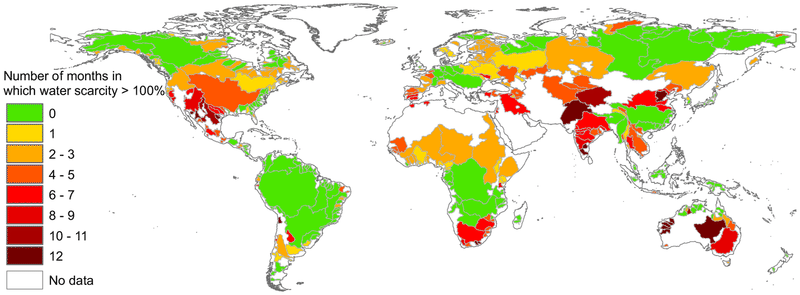
As water supplies become scarce, conflicts will arise between the individuals or nations that have enough clean water and those that do not (Figurebelow). Some of today’s greatest tensions are happening in places where water is scarce. Water disputes may add to tensions between countries where differing national interests and withdrawal rights have been in conflict. Just as with energy resources today, wars may erupt over water.
Many regions already experience water scarcity. This map shows the number of months in which the amount of water that is used exceeds the availability of water that can be used sustainably. This is projected to get worse as demand increases.
Water disputes are happening along 260 different river systems that cross national boundaries. Some of these disputes are potentially very serious. International water laws, such as the Helsinki Rules, help interpret water rights among countries.
Science Friday: Forecasting the Meltdown: The Aerial Snow Observatory
75% of Southern California's water supply comes from the snowpack in the Sierra Nevada Mountain Range. This video by Science Friday explains how NASA uses the Airborne Snow Observatory that uses specialized instrumentation to carefully measure the water content.
Summary
A lot of the problem with water is that it is not evenly distributed across the planet.
Many of the world's people live with water scarcity, and that percentage will increase as populations increase and climate changes.
Some people predict that, just as wars are fought over energy now, future wars will be fought over water.
Review
How will changing climate affect the availability and distribution of water?
How do human activities affect the occurrence of droughts?
How do so many people live with so little water?
Explore More
Use these resources to answer the questions that follow.
What does the water footprint of a product refer to?
What is the water footprint of developed nations, like the United States and southern Europe, per capita compared with developing nations? How about compared with the global average?
What is the water footprint of the United Kingdom and other northern European countries compared with the global average? How about with the developing nations?
What is used as the water footprint cap? Is that sustainable?
Besides living within the water footprint cap, what should governments do?
How can the issue of water equity be addressed?
NOTES / HIGHLIGHTS
Please Sign In to create your own Highlights / Notes
Notes/Highlights
Color
Highlighted Text
Notes
Please Sign In to create your own Highlights / Notes


 FlexiA FREE Digital Tutor for Every Student
 FlexBooks 2.0Customizable, digital textbooks in a new, interactive platform
 FlexBooksCustomizable, digital textbooks
 SchoolsFlexBooks from schools and districts near you
 Study GuidesQuick review with key information for each concept
 Adaptive PracticeBuilding knowledge at each student’s skill level
 SimulationsInteractive Physics & Chemistry Simulations
 PLIXPlay. Learn. Interact. eXplore.
 CCSS MathConcepts and FlexBooks aligned to Common Core
 NGSSConcepts aligned to Next Generation Science Standards
 Certified EducatorStand out as an educator. Become CK-12 Certified.
 WebinarsLive and archived sessions to learn about CK-12