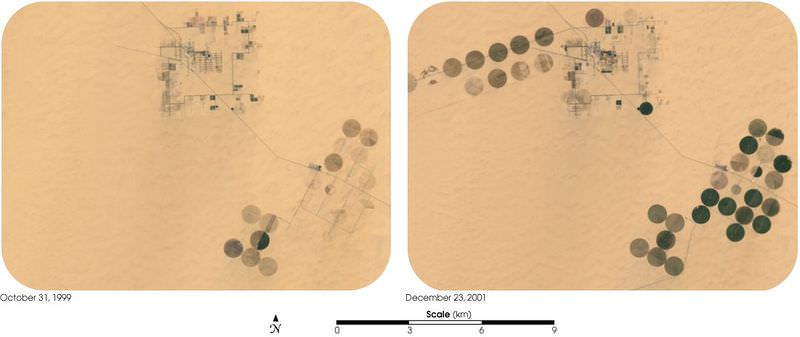
Many sunny, arid regions are good for growing crops as long as water can be added. Some of the increase in productivity is due to farming in regions that are technically too dry. Groundwater can be used to make the desert bloom, but at what cost? And for how long? Eventually the wells will run dry.
Groundwater Overuse
Some aquifers are overused; people pump out more water than is replaced. As the water is pumped out, the water table slowly falls, requiring wells to be dug deeper, which takes more money and energy. Wells may go completely dry if they are not deep enough to reach into the lowered water table.
Intense drought has reduced groundwater levels in the southern U.S., particularly in Texas and New Mexico.
Other problems may stem from groundwater overuse. Subsidence and saltwater intrusion are two of them.
Ogallala Aquifer
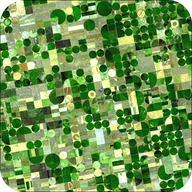
The Ogallala Aquifer supplies about one-third of the irrigation water in the United States. The Ogallala Aquifer is widely used by people for municipal and agricultural needs. (Figurebelow). The aquifer is found from 30 to 100 meters deep over an area of about 440,000 square kilometers!
The Ogallala Aquifer is found beneath eight states and is heavily used.
The water in the aquifer is mostly from the last ice age. About eight times more water is taken from the Ogallala Aquifer each year than is replenished. Much of the water is used for irrigation (Figurebelow).
Farms in Kansas use central pivot irrigation, which is more efficient since water falls directly on the crops instead of being shot in the air. These fields are between 800 and 1600 meters (0.5 and 1 mile) in diameter.
Subsidence
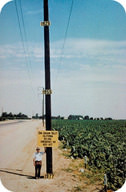
Lowering the water table may cause the ground surface to sink. Subsidence may occur beneath houses and other structures (Figurebelow).
The San Joaquin Valley of California is one of the world’s major agricultural areas. So much groundwater has been pumped that the land has subsided many tens of feet.
Salt Water Intrusion
When coastal aquifers are overused, salt water from the ocean may enter the aquifer, contaminating the aquifer and making it less useful for drinking and irrigation. Salt water incursion is a problem in developed coastal regions, such as on Hawaii.
Summary
When water is pumped from an aquifer, the water table declines and wells must be drilled deeper.
The Ogallala Aquifer was filled in the ice age but is being used to irrigate the farms of the Midwestern U.S. at a rate far greater than it is being replenished.
Ground subsidence and saltwater intrusion are two possible consequences of groundwater overuse.
Review
What are some of the problems that come from overuse of groundwater?
How does salt water enter an aquifer?
In a location where the ground has subsided due to the extraction of groundwater from an aquifer, what do you think would happen if people tried to pump water back into the aquifer?
Explore More
Use this resource to answer the questions that follow.
How has irrigation changed farming?
What is leading to people's demands for additional water?
What do scientists need to see to better plan for future water use?
What is the GRACE satellite doing?
How does GRACE find groundwater aquifers?
How people know the aquifers are being depleted?
What is happening in India? what will happen if the water continues to decline?
What is the future of water?
Vocabulary
termdefinition
subsidencesinking of the land surface because of the extraction of groundwater.
Notes/Highlights
Color
Highlighted Text
Notes
Please Sign In to create your own Highlights / Notes
Credit:Courtesy of Chris Poulsen, National Drought Mitigation Center at the University of Nebraska-Lincoln, NASA Goddard Space Flight Center, and the GRACE science team Source:http://earthobservatory.nasa.gov/IOTD/view.php?id=76575 License:Public Domain


 FlexiA FREE Digital Tutor for Every Student
 FlexBooks 2.0Customizable, digital textbooks in a new, interactive platform
 FlexBooksCustomizable, digital textbooks
 SchoolsFlexBooks from schools and districts near you
 Study GuidesQuick review with key information for each concept
 Adaptive PracticeBuilding knowledge at each student’s skill level
 SimulationsInteractive Physics & Chemistry Simulations
 PLIXPlay. Learn. Interact. eXplore.
 CCSS MathConcepts and FlexBooks aligned to Common Core
 NGSSConcepts aligned to Next Generation Science Standards
 Certified EducatorStand out as an educator. Become CK-12 Certified.
 WebinarsLive and archived sessions to learn about CK-12