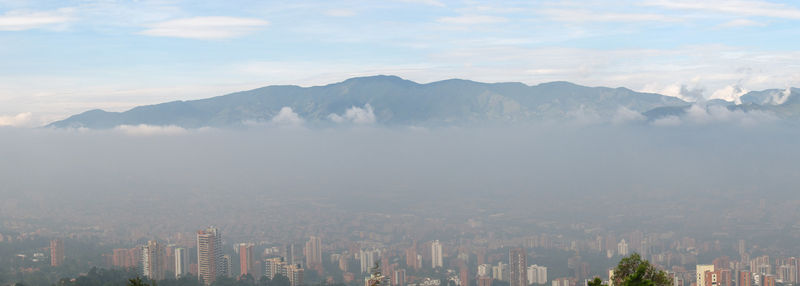
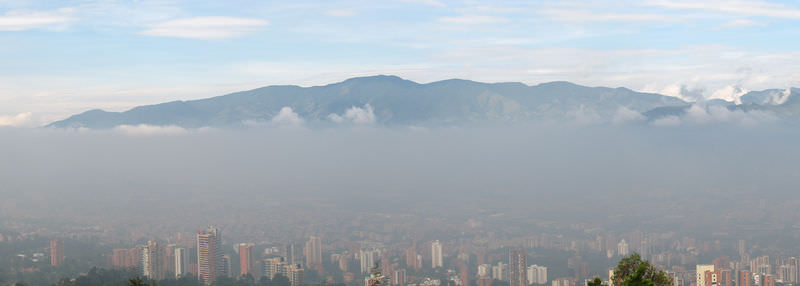
The gray smog pictured above is stuck between two layers of air. The bottom layer is more dense than the top layer, so there is no mixing between the two layers. In winter, an inversion traps all of the pollutants that are emitted into the air over a region.
Types of Air Pollution
The two types of air pollutants are primary pollutants, which enter the atmosphere directly, and secondary pollutants, which form from a chemical reaction.
Primary Pollutants
Some primary pollutants are natural, such as volcanic ash. Dust is natural but exacerbated by human activities; for example, when the ground is torn up for agriculture or development. Most primary pollutants are the result of human activities, the direct emissions from vehicles and smokestacks. Primary pollutants include:
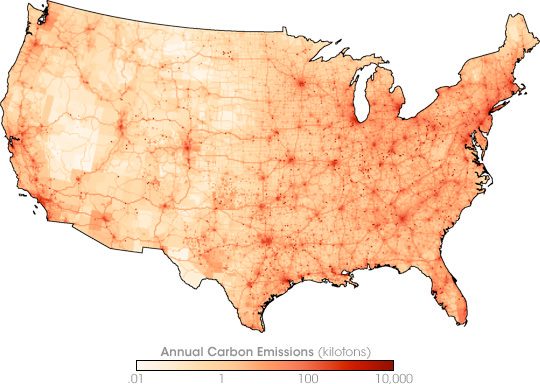
Carbon oxides include carbon monoxide (CO) and carbon dioxide (CO2) (Figurebelow). Both are colorless, odorless gases. CO is toxic to both plants and animals. CO and CO2 are both greenhouse gases.
High CO2 levels are found in major metropolitan areas and along the major interstate highways.
Nitrogen oxides are produced when nitrogen and oxygen from the atmosphere come together at high temperatures. This occurs in hot exhaust gas from vehicles, power plants, or factories. Nitrogen oxide (NO) and nitrogen dioxide (NO2) are greenhouse gases. Nitrogen oxides contribute to acid rain.
Sulfur oxides include sulfur dioxide (SO2) and sulfur trioxide (SO3). These form when sulfur from burning coal reaches the air. Sulfur oxides are components of acid rain.
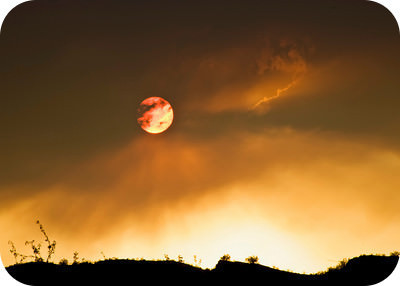
Particulates are solid particles, such as ash, dust, and fecal matter (Figurebelow). They are commonly formed from combustion of fossil fuels, and can produce smog. Particulates can contribute to asthma, heart disease, and some types of cancers.
Particulates from a brush fire give the sky a strange glow in Arizona.
Lead was once widely used in automobile fuels, paint, and pipes. This heavy metal can cause brain damage or blood poisoning.
Volatile organic compounds (VOCs) are mostly hydrocarbons. Important VOCs include methane (a naturally occurring greenhouse gas that is increasing because of human activities), chlorofluorocarbons (human-made compounds that are being phased out because of their effect on the ozone layer), and dioxin (a byproduct of chemical production that serves no useful purpose, but is harmful to humans and other organisms).
Secondary Pollutants
Any city can have photochemical smog, but it is most common in sunny, dry locations. A rise in the number of vehicles in cities worldwide has increased photochemical smog. Nitrogen oxides, ozone, and several other compounds are some of the components of this type of air pollution.
Photochemical smog forms when car exhaust is exposed to sunlight. Nitrogen oxide is created by gas combustion in cars and then into the air (Figurebelow). In the presence of sunshine, the NO2 splits and releases an oxygen ion (O). The O then combines with an oxygen molecule (O2) to form ozone (O3). This reaction can also go in reverse: Nitric oxide (NO) removes an oxygen atom from ozone to make it O2. The direction the reaction goes depends on how much NO2 and NO there is. If NO2 is three times more abundant than NO, ozone will be produced. If nitric oxide levels are high, ozone will not be created.
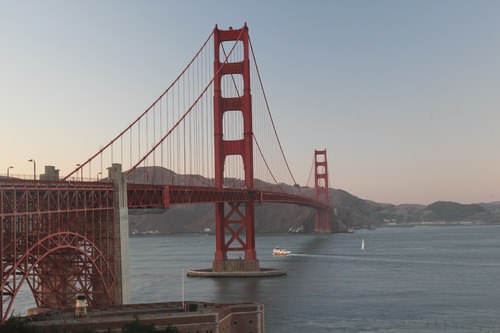
The brown color of the air behind the Golden Gate Bridge is typical of California cities, because of nitrogen oxides.
Ozone is one of the major secondary pollutants. It is created by a chemical reaction that takes place in exhaust and in the presence of sunlight. The gas is acrid-smelling and whitish. Warm, dry cities surrounded by mountains, such as Los Angeles, Phoenix, and Denver, are especially prone to photochemical smog. Photochemical smog peaks at midday on the hottest days of summer. Ozone is also a greenhouse gas.
Summary
There are many types of primary pollutants, including carbon oxides, nitrogen oxides, sulfur oxides, particulates, lead, and volatile organic compounds.
Secondary pollutants form from chemical reactions that occur when pollution is exposed to sunlight.
Ozone is a secondary pollutant that is also a greenhouse gas.
Review
How are primary and secondary pollutants different?
Explain how nitrogen oxide pollutants form.
What is ozone and how does it form as part of photochemical smog?
Explore More
Use this resource to answer the questions that follow.
Does pollution stay over the city where it originates?
What causes vehicle pollution? What can you do to reduce it?
What accounts for the majority of all air pollution? Is that source increasing or decreasing overall?
What else causes air pollution?
What is a major source of pollution in rural areas and why?
What are the sources of particulate matter?
What is particulate matter?
What colors the air on a smoggy day?
Why are particulates dangerous?
Why are very small particulates dangerous? Why are they more dangerous than larger particles?
What is making a difference?
Resources
Notes/Highlights
Color
Highlighted Text
Notes
Please Sign In to create your own Highlights / Notes


 FlexiA FREE Digital Tutor for Every Student
 FlexBooks 2.0Customizable, digital textbooks in a new, interactive platform
 FlexBooksCustomizable, digital textbooks
 SchoolsFlexBooks from schools and districts near you
 Study GuidesQuick review with key information for each concept
 Adaptive PracticeBuilding knowledge at each student’s skill level
 SimulationsInteractive Physics & Chemistry Simulations
 PLIXPlay. Learn. Interact. eXplore.
 CCSS MathConcepts and FlexBooks aligned to Common Core
 NGSSConcepts aligned to Next Generation Science Standards
 Certified EducatorStand out as an educator. Become CK-12 Certified.
 WebinarsLive and archived sessions to learn about CK-12