Why do astronauts need to wear such a funny suit? What would happen if they didn't? Just like space telescopes see more when they’re outside Earth’s atmosphere, astronauts can see and learn more from space, too. And to do that they need to surround themselves in a habitable environment. Despite a few setbacks, some of them tragic, the space program has made tremendous advances in our understanding of what lies beyond our planet. Space programs also advance technologies here on Earth.
Rockets
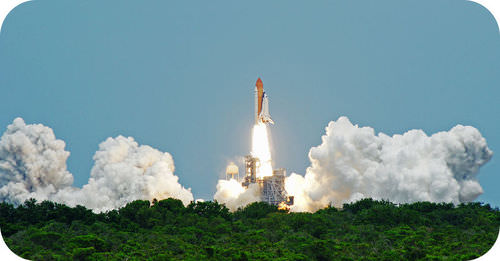
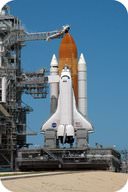
A rocket is propelled into space by particles flying out of one end at high speed (see Figurebelow). A rocket in space moves like a skater holding the fire extinguisher. Fuel is ignited in a chamber, which causes an explosion of gases. The explosion creates pressure that forces the gases out of the rocket. As these gases rush out the end, the rocket moves in the opposite direction, as predicted by Newton’s Third Law of Motion. The reaction force of the gases on the rocket pushes the rocket forward. The force pushing the rocket is called thrust. Nothing would get into space without being thrust upward by a rocket.
The space shuttle Atlantis being launched into orbit by a rocket on Cape Canaveral, Florida.
Satellites
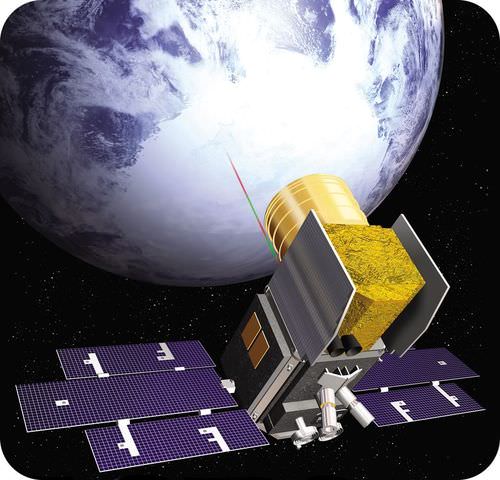
One of the first uses of rockets in space was to launch satellites. A satellite is an object that orbits a larger object. An orbit is a circular or elliptical path around an object. The Moon was Earth’s first satellite, but now many human-made "artificial satellites" orbit the planet. Thousands of artificial satellites have been put into orbit around Earth (Figurebelow). We have even put satellites into orbit around the Moon, the Sun, Venus, Mars, Jupiter, and Saturn.
There are four main types of satellites.
Imaging satellites take pictures of Earth’s surface for military or scientific purposes. Imaging satellites study the Moon and other planets.
Communications satellites receive and send signals for telephone, television, or other types of communications.
Navigational satellites are used for navigation systems, such as the Global Positioning System (GPS).
The International Space Station, the largest artificial satellite, is designed for humans to live in space while conducting scientific research.
Satellites operate with solar panels for energy.
Space Stations
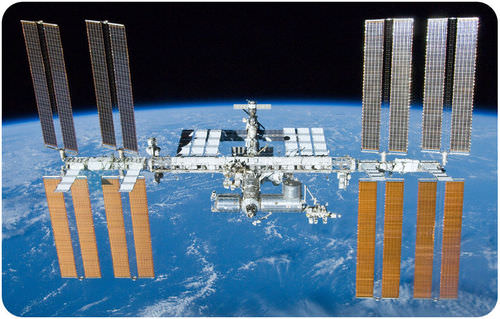
Humans have a presence in space at the International Space Station (ISS) (pictured in Figurebelow). Modern space stations are constructed piece by piece to create a modular system. The primary purpose of the ISS is scientific research, especially in medicine, biology, and physics.
A photograph of the International Space Station was taken from the space shuttle Atlantis in June 2007. Construction of the station was completed in 2011, but new pieces and experiments continue to be added.
Space Shuttles
Craft designed for human spaceflight, like the Apollo missions, were very successful, but were also very expensive, could not carry much cargo, and could be used only once. To outfit the ISS, NASA needed a space vehicle that was reusable and able to carry large pieces of equipment, such as satellites, space telescopes, or sections of a space station. The resulting spacecraft was a space shuttle, shown in (Figurebelow).
Atlantis on the launch pad in 2006. Since 1981, the space shuttle has been the United States’ primary vehicle for carrying people and large equipment into space.
A space shuttle has three main parts. The part you are probably most familiar with is the orbiter, with wings like an airplane. When a space shuttle launches, the orbiter is attached to a huge fuel tank that contains liquid fuel. On the sides of the fuel tank are two large "booster rockets." All of this is needed to get the orbiter out of Earth’s atmosphere. Once in space, the orbiter can be used to release equipment (such as a satellite or supplies for the International Space Station), to repair existing equipment such as the Hubble Space Telescope, or to do experiments directly on board the orbiter.
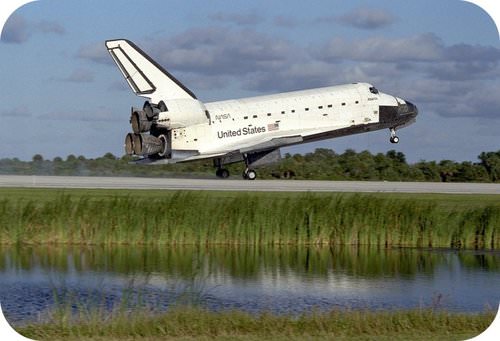
When the mission is complete, the orbiter re-enters Earth’s atmosphere and flies back to Earth more like a glider than an airplane. The Space Shuttle program did 135 missions between 1981 and 2011, when the remaining shuttles were retired. The ISS is now serviced by Russian Soyuz spacecraft.
The space shuttle orbiter Atlantis touches down at the Kennedy Space Center in Florida.
ScienceFriday: How A LEGO Shuttle Got To Space
How would you get a LEGO shuttle to space? In this video by ScienceFriday, Raul Oaida, 18-years-old, attached a LEGO shuttle, a video camera and a GPS tracker, to a huge helium balloon and sent them into space. The shuttle reached an altitude of 115,000 feet before heading back to Earth.
Summary
Rockets are propelled into space by particles flying out one end at high speed. Nothing would get into space without them.
Thousands of artificial satellites orbit Earth. Satellites are used for imaging, communications, navigation, and human habitation.
Space stations are continuously inhabited by humans and are used for scientific research.
Review
How does a rocket work?
Why are there so many satellites orbiting Earth at this time?
Would you like to spend months in the International Space Station? If so, what would you be interested in studying? If not, why not?
Explore More
Use these resources to answer the questions that follow.
1. What are satellites used for?
2. Explain how geostationary orbit works.
3. How far are geostationary orbits above the earth?
4. What is orbital position?
5. What determines satellite life?
6. What is a geostationary satellite and what are its characteristics?
7. What is a polar satellite and what are its characteristics
8. How do astronauts get to the ISS?
9. List your observations about the ISS.
10. Does it look like fun to be on the ISS?
Vocabulary
termdefinition
orbiterthe main part of the space shuttle that has wings like an airplane.
rocketa device propelled by particles flying out one end at high speed.
satellitean object, either natural or human made, that orbits a larger object.
space shuttlea reusable spacecraft capable of carrying large pieces of equipment or a space station.
space stationa large spacecraft in space on which humans can live for an extended period of time.
thrustthe forward force produced by gases escaping from a rocket engine.
Notes/Highlights
Color
Highlighted Text
Notes
Please Sign In to create your own Highlights / Notes


 FlexiA FREE Digital Tutor for Every Student
 FlexBooks 2.0Customizable, digital textbooks in a new, interactive platform
 FlexBooksCustomizable, digital textbooks
 SchoolsFlexBooks from schools and districts near you
 Study GuidesQuick review with key information for each concept
 Adaptive PracticeBuilding knowledge at each student’s skill level
 SimulationsInteractive Physics & Chemistry Simulations
 PLIXPlay. Learn. Interact. eXplore.
 CCSS MathConcepts and FlexBooks aligned to Common Core
 NGSSConcepts aligned to Next Generation Science Standards
 Certified EducatorStand out as an educator. Become CK-12 Certified.
 WebinarsLive and archived sessions to learn about CK-12