Is a shooting star really a star flying across the sky?
When a meteor shoots through the atmosphere it burns and glows. When we look up and see one, we call it a shooting star. When Earth travels through the debris left by a comet's tail, we see a meteor shower.
Meteors
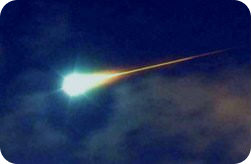
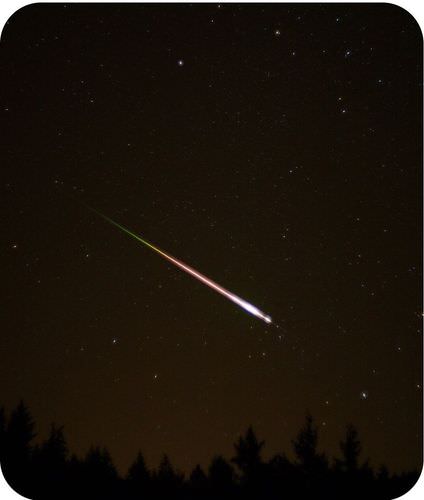
A meteor, such as in Figurebelow, is a streak of light across the sky. People call them shooting stars but they are actually small pieces of matter burning up as they enter Earth’s atmosphere from space.
A meteor streaks across the sky.
Meteors are called meteoroids before they reach Earth’s atmosphere. Meteoroids are smaller than asteroids and range from the size of boulders down to the size of tiny sand grains. Still smaller objects are called interplanetary dust. When Earth passes through a cluster of meteoroids, there is a meteor shower. These clusters are often remnants left behind by comet tails.
Meteorites
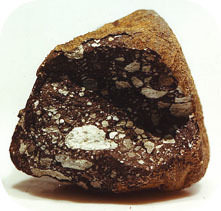
Although most meteors burn up in the atmosphere, larger meteoroids may strike the Earth’s surface to create a meteorite. Meteorites are valuable to scientists because they provide clues about our solar system. Many meteorites are from asteroids that formed when the solar system formed (Figurebelow). A few meteorites are made of rocky material that is thought to have come from Mars when an asteroid impact shot material off the Martian surface and into space.
A lunar meteorite originates on the Moon and strikes Earth.
Summary
A meteor that strikes Earth's surface is a meteorite.
Many meteorites are remnants of the earliest material that formed in the solar system.
Shooting stars are meteors that burn up in Earth's atmosphere.
Review
The Perseid meteor shower appears every August. Why is the shower so regular in its appearance?
What are the similarities and differences between meteors, meteoroids, and meteorites?
Why are meteors known as shooting stars?
Vocabulary
termdefinition
meteormaterial from outer space that burns up as it enters Earth's atmosphere.
meteor showeran area of frequent meteors appearing to originate in a particular part of the sky.
meteoroida small rock in interplanetary space that has not yet entered Earth's atmosphere.
meteoritefragments of planetary bodies such as moons, planets, asteroids, and comets that strike Earth.
Notes/Highlights
Color
Highlighted Text
Notes
Please Sign In to create your own Highlights / Notes


 FlexiA FREE Digital Tutor for Every Student
 FlexBooks 2.0Customizable, digital textbooks in a new, interactive platform
 FlexBooksCustomizable, digital textbooks
 SchoolsFlexBooks from schools and districts near you
 Study GuidesQuick review with key information for each concept
 Adaptive PracticeBuilding knowledge at each student’s skill level
 SimulationsInteractive Physics & Chemistry Simulations
 PLIXPlay. Learn. Interact. eXplore.
 CCSS MathConcepts and FlexBooks aligned to Common Core
 NGSSConcepts aligned to Next Generation Science Standards
 Certified EducatorStand out as an educator. Become CK-12 Certified.
 WebinarsLive and archived sessions to learn about CK-12