Everything you can see, touch, smell, feel, and taste is made of atoms. Atoms are the basic building-block of all matter (including you and me, and everyone else you'll ever meet), so if we want to know about what Earth is made of, then we have to know a few things about these incredibly small objects.
Atoms
Everyday experience should convince you that matter is found in myriad forms, yet all the matter you have ever seen is made of atoms, or atoms stuck together in configurations of dizzying complexity. A chemical element is a substance that cannot be made into a simpler form by ordinary chemical means. The smallest unit of a chemical element is an atom, and all atoms of a particular element are identical.
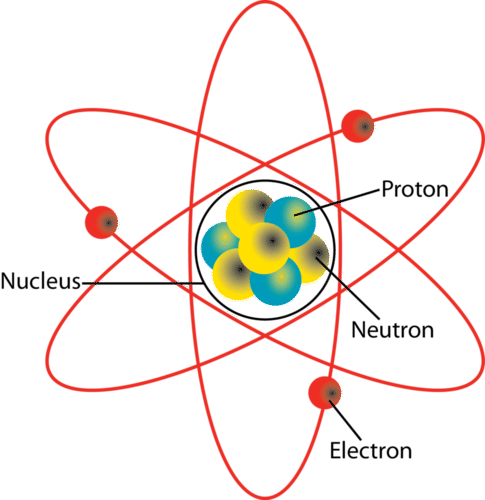
At the center of an atom is a nucleus made up of two types of particles called protons and neutrons.
Protons have a positive electrical charge. The number of protons in the nucleus determines what element the atom is.
Neutrons are about the size of protons but have no charge.
Electrons, much smaller than protons or neutrons, have a negative electrical charge, move at nearly the speed of light, and orbit the nucleus at exact distances, depending on their energy.
Major parts of an atom. What chemical element is this? (Hint: 3 protons, 3 electrons)
Atomic Mass
Because electrons are minuscule compared with protons and neutrons, the number of protons plus neutrons gives the atom its atomic mass. All atoms of a given element always have the same number of protons, but may differ in the number of neutrons found in the nucleus.
Isotopes
Atoms with the same number of protons of an element with differing numbers of neutrons are called isotopes. For example, carbon always has 6 protons but may have 6, 7, or 8 neutrons. This means there are three isotopes of carbon: carbon-12, carbon-13, and carbon-14, however, carbon-12 is by far the most abundant.
Ions
Atoms are stable when they have a full outermost electron energy level. To fill its outermost shell, an atom will give, take, or share electrons. When an atom either gains or loses electrons, this creates an ion. Ions have either a positive or a negative electrical charge. What is the charge of an ion if the atom loses an electron? An atom with the same number of protons and electrons has no overall charge, so if an atom loses the negatively charged electron, it has a positive charge. What is the charge of an ion if the atom gains an electron? If the atom gains an electron, it has a negative charge.
Molecules
In the previous section we said that many atoms are more stable when they have a net charge: they are more stable as ions. When a cation gets close to an anion, they link up because of their different net charges — positive charges attract negative charges and vice versa. When two or more atoms link up, they create a molecule. A molecule of water is made of two atoms of hydrogen (H) and one atom of oxygen (O). The molecular mass is the sum of the masses of all the atoms in the molecule. A collection of molecules is called a compound.
Summary
An atom has negatively-charged electrons in orbit around its nucleus, which is composed of positively-charged protons and neutrons, which have no charge.
Isotopes of an element must have a given number of protons but may have variety of numbers of neutrons.
An atom that gains or loses electrons is an ion.
Review
If an atom has 8 protons, 8 neutrons, and 8 electrons and then loses an electron, what is it? What is its charge?
What charge(s) does an ion have, positive, negative, or neutral?
What is a molecule made of and what is its molecular mass?
Explore More
Use the resource below to answer the questions that follow.
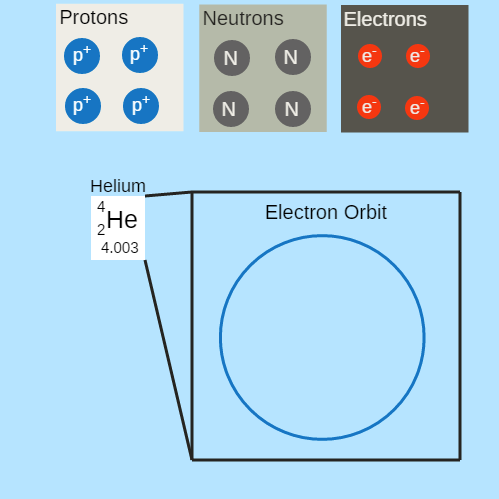
What is found at the center of an atom?
What makes up the nucleus?
What is the charge on the nucleus?
What is equal in neutral atoms?
List the parts of an atom and identify the charge of each.
NOTES / HIGHLIGHTS
Please Sign In to create your own Highlights / Notes
Vocabulary
termdefinition
atomsmallest particle of an element that still has the element’s properties.
atomic massthe weighted average of the atomic masses of the naturally occurring isotopes of that element.
electronnegatively charged subatomic particle moving outside the nucleus of all atoms; exhibit properties of both particles and waves.
elementthe simplest form of matter that has a unique set of properties.
isotopeatoms of an element that have a different number of neutrons.
molecular massthe mass of all the atoms in a molecule.
moleculesmallest particle of a compound that still has that compound’s properties.
neutrona neutral particle in the nucleus of an atom.
nucleusorganelle inside eukaryotic cells that contains most of the cell’s DNA and acts as the control center of the cell.
protona positively charged subatomic particle present in the nucleus of all atoms.
Notes/Highlights
Color
Highlighted Text
Notes
Please Sign In to create your own Highlights / Notes


 FlexiA FREE Digital Tutor for Every Student
 FlexBooks 2.0Customizable, digital textbooks in a new, interactive platform
 FlexBooksCustomizable, digital textbooks
 SchoolsFlexBooks from schools and districts near you
 Study GuidesQuick review with key information for each concept
 Adaptive PracticeBuilding knowledge at each student’s skill level
 SimulationsInteractive Physics & Chemistry Simulations
 PLIXPlay. Learn. Interact. eXplore.
 CCSS MathConcepts and FlexBooks aligned to Common Core
 NGSSConcepts aligned to Next Generation Science Standards
 Certified EducatorStand out as an educator. Become CK-12 Certified.
 WebinarsLive and archived sessions to learn about CK-12