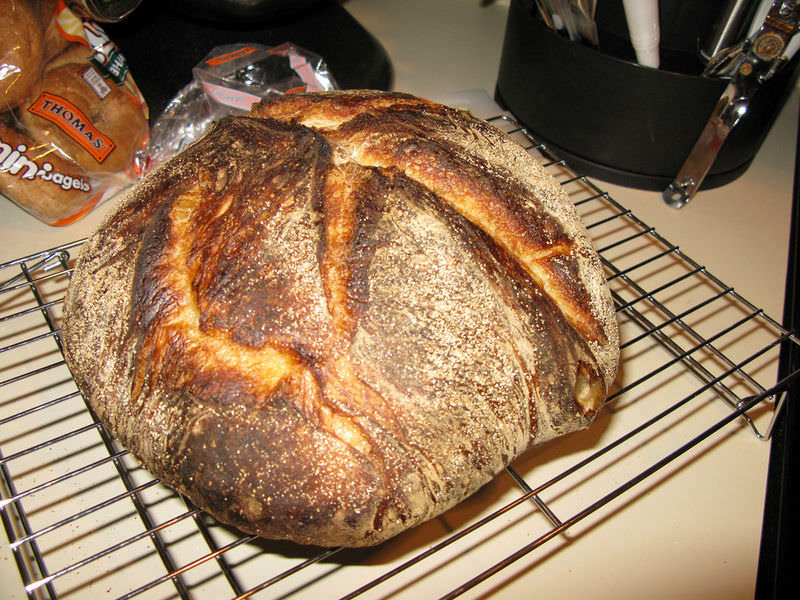
A loaf of homemade bread could almost resemble Earth. The raised parts of the crust are the continents and the depressed parts are the oceans. The inside is gooier than the brittle exterior, but it's still solid. How is a loaf of bread not like Earth?
Crust
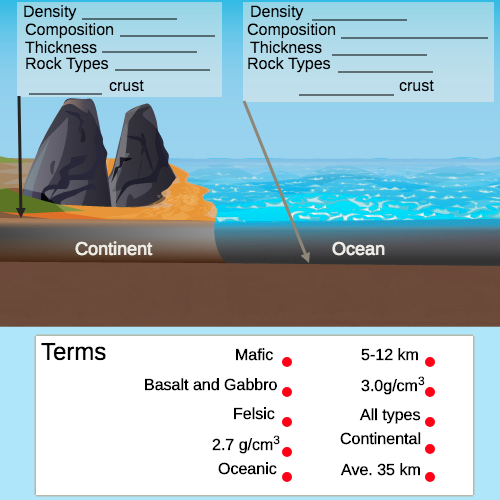
Earth’s outer surface is its crust, a cold, thin, brittle outer shell made of rock. The crust is very thin relative to the radius of the planet. There are two very different types of crust, each with its own distinctive physical and chemical properties, which are summarized in Tablebelow.
Crust
Thickness
Density
Composition
Rock types
Oceanic
5-12 km (3-8 mi)
3.0 g/cm3
Mafic
Basalt and gabbro
Continental
Avg. 35 km (22 mi)
2.7 g/cm3
Felsic
All types
Oceanic Crust
Oceanic crust is composed of mafic magma that erupts on the seafloor to create basalt lava flows or cools deeper down to create the intrusive igneous rock gabbro (Figurebelow).
Gabbro from ocean crust. The gabbro is deformed because of intense faulting at the eruption site.
Sediments, primarily mud and the shells of tiny sea creatures, coat the seafloor. Sediment is thickest near the shore, where it comes off the continents in rivers and on wind currents.
The oceanic crust is relatively thin and lies above the mantle. The cross section of oceanic crust in the Figurebelow shows the layers that grade from sediments at the top to extrusive basalt lava, to the sheeted dikes that feed lava to the surface, to deeper intrusive gabbro, and finally to the mantle.
A cross-section of oceanic crust.
Continental Crust
Continental crust is made up of many different types of igneous, metamorphic, and sedimentary rocks. The average composition is granite, which is much less dense than the mafic rocks of the oceanic crust (Figurebelow). Because it is thick and has relatively low density, continental crust rises higher on the mantle than oceanic crust, which sinks into the mantle to form basins. When filled with water, these basins form the planet’s oceans.
This granite from Missouri is more than 1 billion years old.
Summary
Oceanic crust is thinner and denser than continental crust.
Oceanic crust is more mafic, continental crust is more felsic.
Crust is very thin relative to Earth's radius.
Review
Describe the properties of oceanic crust.
Describe the properties of continental crust.
What type of rock makes up each of the types of crust?
Vocabulary
termdefinition
continental crustthe crust that makes up the continents; thicker and less dense than oceanic crust.
oceanic crustthe crust that underlies the oceans; thinner and denser than continental crust.
Notes/Highlights
Color
Highlighted Text
Notes
Please Sign In to create your own Highlights / Notes


 FlexiA FREE Digital Tutor for Every Student
 FlexBooks 2.0Customizable, digital textbooks in a new, interactive platform
 FlexBooksCustomizable, digital textbooks
 SchoolsFlexBooks from schools and districts near you
 Study GuidesQuick review with key information for each concept
 Adaptive PracticeBuilding knowledge at each student’s skill level
 SimulationsInteractive Physics & Chemistry Simulations
 PLIXPlay. Learn. Interact. eXplore.
 CCSS MathConcepts and FlexBooks aligned to Common Core
 NGSSConcepts aligned to Next Generation Science Standards
 Certified EducatorStand out as an educator. Become CK-12 Certified.
 WebinarsLive and archived sessions to learn about CK-12