If science weren't around to tell you what it is, would an eclipse scare you?
Ancient people could not predict eclipses and didn't know when one would end or even that it would end. Rituals to persuade the Sun or Moon to return to its normal state were developed. And they worked! The heavens always return to normal after an eclipse.
Solar Eclipses
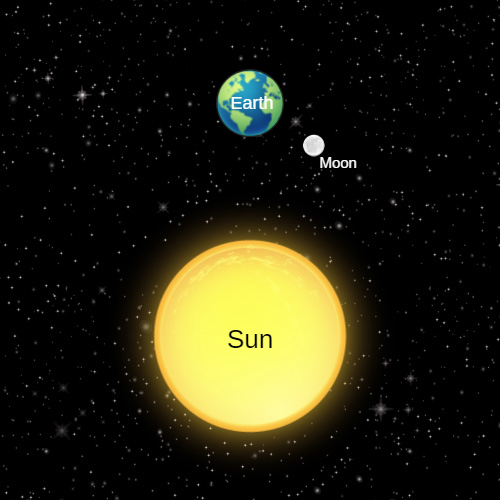
A solar eclipse occurs when the new Moon passes directly between the Earth and the Sun (Figurebelow). This casts a shadow on the Earth and blocks Earth’s view of the Sun.
A solar eclipse, not to scale.
A total solar eclipse occurs when the Moon’s shadow completely blocks the Sun (Figurebelow). When only a portion of the Sun is out of view, it is called a partial solar eclipse.
A solar eclipse shown as a series of photos.
Solar eclipses are rare and usually only last a few minutes because the Moon casts only a small shadow (Figurebelow).
The Moon’s shadow in a solar eclipse covers a very small area.
As the Sun is covered by the Moon’s shadow, it will actually get cooler outside. Birds may begin to sing, and stars will become visible in the sky. During a solar eclipse, the corona and solar prominences can be seen.
A solar eclipse occurs when the Moon passes between Earth and the Sun in such a way that the Sun is either partially or totally hidden from view. Some people, including some scientists, chase eclipses all over the world to learn or just observe this amazing phenomenon.
Lunar Eclipse
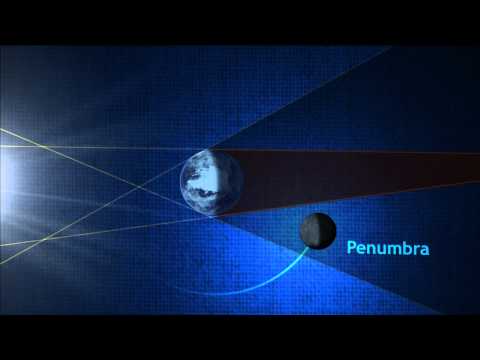
A lunar eclipse occurs when the full moon moves through Earth’s shadow, which only happens when Earth is between the Moon and the Sun and all three are lined up in the same plane, called the ecliptic (Figurebelow). In an eclipse, Earth’s shadow has two distinct parts: the umbra and the penumbra. The umbra is the inner, cone-shaped part of the shadow, in which all of the light has been blocked. The penumbra is the outer part of Earth’s shadow where only part of the light is blocked. In the penumbra, the light is dimmed but not totally absent.
A lunar eclipse.
A total lunar eclipse occurs when the Moon travels completely in Earth’s umbra. During a partial lunar eclipse, only a portion of the Moon enters Earth’s umbra. Earth’s shadow is large enough that a lunar eclipse lasts for hours and can be seen by any part of Earth with a view of the Moon at the time of the eclipse (Figurebelow). A lunar eclipse does not occur every month because Moon's orbit is inclined 5-degrees to Earth's orbit, so the two bodies are not in the same plane every month.
Partial lunar eclipses occur at least twice a year, but total lunar eclipses are less common.
Summary
During a solar eclipse, the new Moon passes between Earth and Sun.
During a lunar eclipse, the full Moon moves through Earth's shadow.
The umbra is the part of the shadow in which light is completely blocked and the penumbra is the part of the shadow that is partially lit.
Review
What happens during a solar eclipse?
What happens during a lunar eclipse?
Why do we not see lunar eclipses every month?
Explore More
Use this resource to answer the questions that follow.
About how often does a lunar eclipse take place?
When does a lunar eclipse occur? When does a solar eclipse occur?
Why don't eclipses happen at every new and full moon?
What circumstances must be in place for there to be a lunar eclipse?
What is the name of the central part of Earth's shadow? What happens to the Moon when it is there and why?
Resources
Vocabulary
termdefinition
lunar eclipsean eclipse that occurs when the Moon moves through the shadow of the Earth and is blocked from view.
penumbraouter part of shadow that remains partially lit during an eclipse.
solar eclipseoccurs when moon passes directly between the Earth and Sun; the Moon’s shadow blocks the Sun from view.
umbrainner cone shaped part of a shadow when all light is blocked during an eclipse.
Notes/Highlights
Color
Highlighted Text
Notes
Please Sign In to create your own Highlights / Notes
Currently there are no resources to be displayed.
Description
How eclipses occur.
Learning Objectives
Describe the types of eclipses and explain why eclipses occur.


 FlexiA FREE Digital Tutor for Every Student
 FlexBooks 2.0Customizable, digital textbooks in a new, interactive platform
 FlexBooksCustomizable, digital textbooks
 SchoolsFlexBooks from schools and districts near you
 Study GuidesQuick review with key information for each concept
 Adaptive PracticeBuilding knowledge at each student’s skill level
 SimulationsInteractive Physics & Chemistry Simulations
 PLIXPlay. Learn. Interact. eXplore.
 CCSS MathConcepts and FlexBooks aligned to Common Core
 NGSSConcepts aligned to Next Generation Science Standards
 Certified EducatorStand out as an educator. Become CK-12 Certified.
 WebinarsLive and archived sessions to learn about CK-12