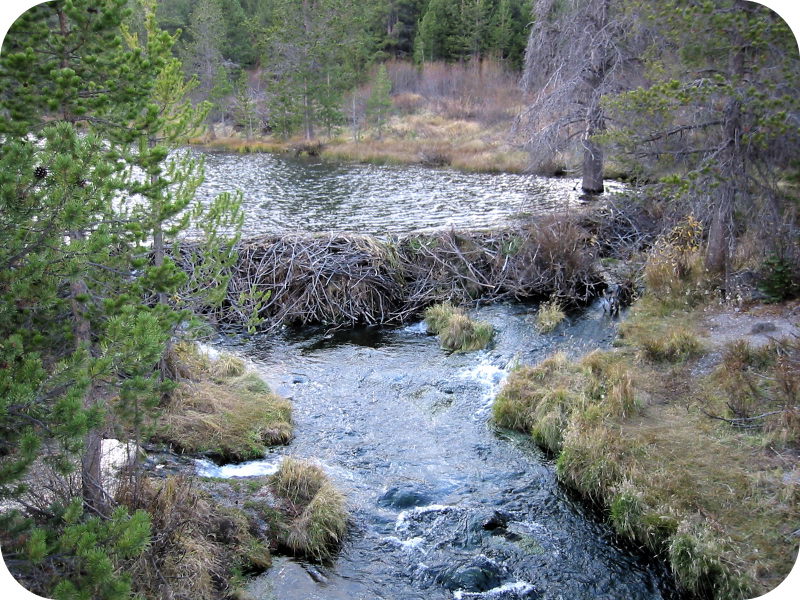
Beavers have been building dams for a long time, for food, for a home, and for protection from predators. They probably haven't realized that they can use a dam for hydroelectric power, although are we sure there aren't little TVs in those lodges?
Water Power
Water covers 70% of the planet’s surface, and water power (hydroelectric power) is the most widely used form of renewable energy in the world. Hydroelectric power from streams provides almost one fifth of the world’s electricity.
Hydroelectric Power
Remember that potential energy is the energy of an object waiting to fall. Water held behind a dam has a lot of potential energy.
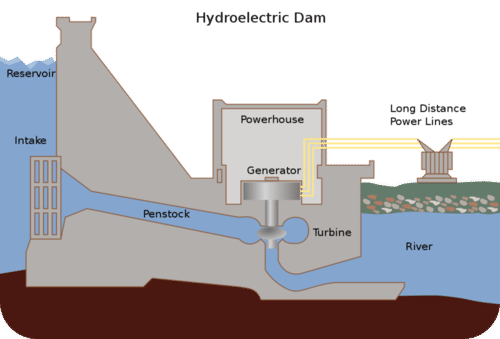
In a hydroelectric plant, a dam across a riverbed holds a stream to create a reservoir. Instead of flowing down its normal channel, the water is allowed to flow into a large turbine. As the water moves, it has kinetic energy, which makes the turbine spin. The turbine is connected to a generator, which makes electricity (Figure below).
A cross-section of a hydroelectric plant.
Most of the streams in the United States and elsewhere in the developed world that are suitable for hydroelectric power have already been dammed. In California, about 14.5% of the total electricity comes from hydropower. The state's nearly 400 hydropower plants are mostly located in the eastern mountain ranges, where large streams descend down a steep grade.
Consequences of Water Power Use
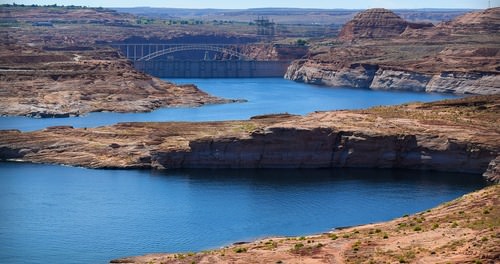
The major benefit of hydropower is that it generates power without releasing any pollution. Hydropower is also a renewable resource since the stream will keep on flowing. However, there are a limited number of suitable dam sites. Hydropower also has environmental problems. When a large dam disrupts a river’s flow, it changes the ecosystem upstream. As the land is flooded by rising water, plants and animals are displaced or killed. Many beautiful landscapes, villages, and archeological sites have been drowned by the water in a reservoir (Figurebelow).
Glen Canyon Dam in Arizona created Lake Powell. The dam was controversial because it flooded Glen Canyon, a beautiful desert canyon.
The dam and turbines also change the downstream environment for fish and other living things. Dams slow the release of silt so that downstream deltas retreat and seaside cities become dangerously exposed to storms and rising sea levels.
Ocean Water Power
The energy of waves and tides can be used to produce water power. Tidal power stations may need to close off a narrow bay or estuary. Wave power applications have to be able to withstand coastal storms and the corrosion of seawater. Because of the many problems with them, tide and wave power plants are not very common.
Although not yet widely used, many believe tidal power has more potential than wind or solar power for meeting alternative energy needs. Quest radio looks at plans for harnessing power from the sea by San Francisco and along the northern California coast.
Summary
Hydroelectric power is clean and is important in many regions of the world.
Hydropower has downsides like the changes dams make to a river's ecosystem.
Hydropower utilizes the energy of falling water.
Review
How does energy transition from one form to another as water moves from behind a dam to downstream of a dam?
Describe how hydroelectric energy is harnessed.
What are some of the downsides of using hydroelectric power?
Explore More
Use this resource to answer the questions that follow.
How does a hydropower facility generate electricity?
How much of the energy in the US is generated by hydropower?
What makes hydropower renewable?
How does an impoundment generate electricity?
How does a diversion generate electricity?
What is pumped storage hydropower?
What is new in hydropower technology?
NOTES / HIGHLIGHTS
Please Sign In to create your own Highlights / Notes
Notes/Highlights
Color
Highlighted Text
Notes
Please Sign In to create your own Highlights / Notes


 FlexiA FREE Digital Tutor for Every Student
 FlexBooks 2.0Customizable, digital textbooks in a new, interactive platform
 FlexBooksCustomizable, digital textbooks
 SchoolsFlexBooks from schools and districts near you
 Study GuidesQuick review with key information for each concept
 Adaptive PracticeBuilding knowledge at each student’s skill level
 SimulationsInteractive Physics & Chemistry Simulations
 PLIXPlay. Learn. Interact. eXplore.
 CCSS MathConcepts and FlexBooks aligned to Common Core
 NGSSConcepts aligned to Next Generation Science Standards
 Certified EducatorStand out as an educator. Become CK-12 Certified.
 WebinarsLive and archived sessions to learn about CK-12