Why is the football team in San Francisco named the 49ers?
Football team names sometimes reflect the history of a region. The San Francisco 49ers are a reference to the California Gold Rush, when immigrants from around the United States came to what would become The Golden State to mine placer deposits. What that has to do with football is anyone's guess!
Ore Deposits
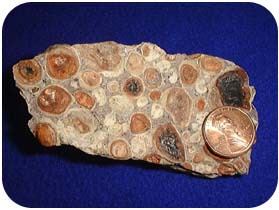
Some minerals are very useful. An ore is a rock that contains minerals with useful elements. Aluminum in bauxite ore (Figurebelow) is extracted from the ground and refined to be used in aluminum foil and many other products. The cost of creating a product from a mineral depends on how abundant the mineral is and how much the extraction and refining processes cost. Environmental damage from these processes is often not figured into a product’s cost. It is important to use mineral resources wisely.
Aluminum is made from the aluminum-bearing minerals in bauxite.
Finding and Mining Minerals
Geologic processes create and concentrate minerals that are valuable natural resources. Geologists study geological formations and then test the physical and chemical properties of soil and rocks to locate possible ores and determine their size and concentration.
A mineral deposit will only be mined if it is profitable. A concentration of minerals is only called an ore deposit if it is profitable to mine. There are many ways to mine ores.
Surface Mining
Surface mining allows extraction of ores that are close to Earth’s surface. Overlying rock is blasted and the rock that contains the valuable minerals is placed in a truck and taken to a refinery. As pictured in Figurebelow, surface mining includes open-pit mining and mountaintop removal. Other methods of surface mining include strip mining, placer mining, and dredging. Strip mining is like open pit mining but with material removed along a strip.
These different forms of surface mining are methods of extracting ores close to Earth's surface.
Placers are valuable minerals found in stream gravels. California’s nickname, the Golden State, can be traced back to the discovery of placer deposits of gold in 1848. The gold weathered out of hard metamorphic rock in the western Sierra Nevada, which also contains deposits of copper, lead, zinc, silver, chromite, and other valuable minerals. The gold traveled down rivers and then settled in gravel deposits. Currently, California has active mines for gold and silver and for non-metal minerals such as sand and gravel, which are used for construction.
Underground Mining
Underground mining is used to recover ores that are deeper into Earth’s surface. Miners blast and tunnel into rock to gain access to the ores. How underground mining is approached — from above, below, or sideways — depends on the placement of the ore body, its depth, the concentration of ore, and the strength of the surrounding rock.
Underground mining is very expensive and dangerous. Fresh air and lights must also be brought into the tunnels for the miners, and accidents are far too common.
Underground mine.
Ore Extraction
The ore’s journey to becoming a useable material is only just beginning when the ore leaves the mine (Figurebelow). Rocks are crushed so that the valuable minerals can be separated from the waste rock. Then the minerals are separated out of the ore. A few methods for extracting ore are:
heap leaching: the addition of chemicals, such as cyanide or acid, to remove ore.
flotation: the addition of a compound that attaches to the valuable mineral and floats.
smelting: roasting rock, causing it to segregate into layers so the mineral can be extracted.
Enormous trucks haul rock containing ore from a mine site to where the rock is processed.
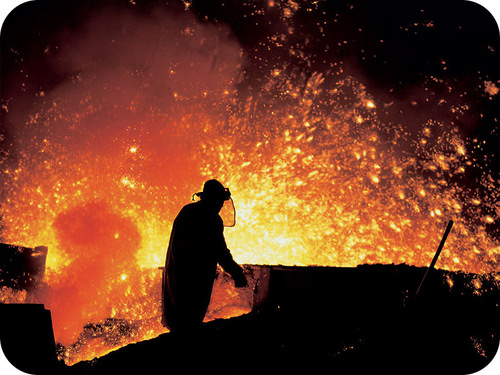
To extract the metal from the ore, the rock is melted at a temperature greater than 900oC, which requires a lot of energy. Extracting metal from rock is so energy-intensive that if you recycle just 40 aluminum cans, you will save the energy equivalent of one gallon of gasoline.
A steel mill.
Summary
An ore deposit must be profitable to mine by definition. If it is no longer profitable, it is no longer an ore deposit.
Surface mines are created for mineral deposits that are near the surface; underground mines are blasted into rock to get at deeper deposits.
Ore is extracted from rock by heap leaching, flotation or smelting.
Review
What sorts of changes can transform a deposit that is an ore into a deposit that is not an ore?
Why is the production of the metal to create your aluminum soda can energy-intensive?
How is ore taken from a rock and made into a metal like a copper wire?
Why should you recycle your aluminum cans?
Vocabulary
termdefinition
orea type of rock that contains useful minerals.
ore deposita mineral deposit that contains enough minerals to be mined for profit.
placervaluable metal found in modern or ancient stream gravels.
Notes/Highlights
Color
Highlighted Text
Notes
Please Sign In to create your own Highlights / Notes
Credit:Třinecké železárny Source:http://commons.wikimedia.org/wiki/File:VysokePece1.jpg License:The copyright holder of this file allows anyone to use it for any purpose provided that the copyright holder is properly attributed
Credit:Třinecké železárny Source:http://commons.wikimedia.org/wiki/File:VysokePece1.jpg License:The copyright holder of this file allows anyone to use it for any purpose provided that the copyright holder is properly attributed


 FlexiA FREE Digital Tutor for Every Student
 FlexBooks 2.0Customizable, digital textbooks in a new, interactive platform
 FlexBooksCustomizable, digital textbooks
 SchoolsFlexBooks from schools and districts near you
 Study GuidesQuick review with key information for each concept
 Adaptive PracticeBuilding knowledge at each student’s skill level
 SimulationsInteractive Physics & Chemistry Simulations
 PLIXPlay. Learn. Interact. eXplore.
 CCSS MathConcepts and FlexBooks aligned to Common Core
 NGSSConcepts aligned to Next Generation Science Standards
 Certified EducatorStand out as an educator. Become CK-12 Certified.
 WebinarsLive and archived sessions to learn about CK-12