There was an old ad suggesting that you put a tiger in your tank was referring to the strength and speed of these wild cats. But it might also have been referring to the use of organic material to power an engine. When your tank is full of gas, it doesn't have a tiger in it, but it does have ancient plants, plankton, and other formerly living creatures.
Formation of Fossil Fuels
Can you name some fossils? How about dinosaur bones or dinosaur footprints? Animal skeletons, teeth, shells, coprolites (otherwise known as feces), or any other remains or traces from a living creature that becomes rock is a fossil.
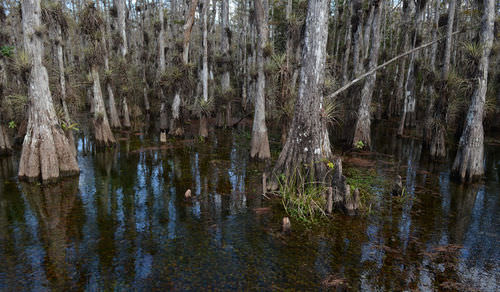
The same processes that formed these fossils also created some of our most important energy resources, fossil fuels. Coal, oil, and natural gas are fossil fuels. Fossil fuels come from living matter starting about 500 million years ago. Millions of years ago, plants used energy from the Sun to form sugars, carbohydrates, and other energy-rich carbon compounds. As plants and animals died, their remains settled on the ground on land and in swamps, lakes, and seas (Figurebelow).
This wetland may look something like an ancient coal-forming swamp.
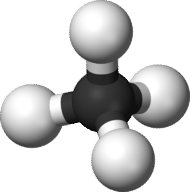
Over time, layer upon layer of these remains accumulated. Eventually, the layers were buried so deeply that they were crushed by an enormous mass of earth. The weight of this earth pressing down on these plant and animal remains created intense heat and pressure. After millions of years of heat and pressure, the material in these layers turned into chemicals called hydrocarbons (Figurebelow).
Hydrocarbons are made of carbon and hydrogen atoms. This molecule with one carbon and four hydrogen atoms is methane.
Hydrocarbons can be solid, liquid, or gaseous. The solid form is what we know as coal. The liquid form is petroleum, or crude oil. Natural gas is the gaseous form.
The solar energy stored in fossil fuels is a rich source of energy. Although fossil fuels provide very high quality energy, they are non-renewable.
Summary
Hydrocarbons are molecules made of one carbon and four hydrogen atoms.
Ancient living organisms are buried quickly and altered by intense heat and pressure to form fossil fuels.
Fossil fuels include solid coal, liquid petroleum, and liquid natural gas.
Review
Why are coal, petroleum, and natural gas called fossil fuels?
How do fossil fuels form?
What is the actual source of energy in a fossil fuel?
Explore More
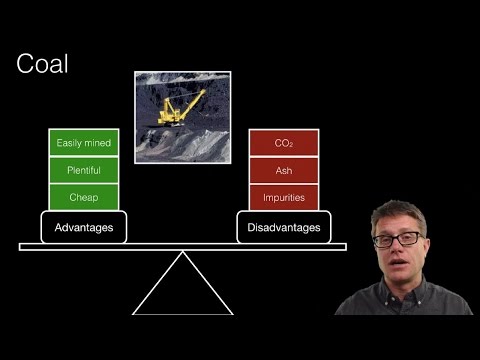
Use this resource to answer the questions that follow.
What are fossil fuels made from?
How long has it taken for these fuels to form?
What do these fuels contain that we need?
What are most of the plants that create fossil fuels and where do they live?
What happens next?
How does this turn into fossil fuel? What happens to the energy?
How are different fossil fuels created?
What makes coal? Oil? Natural gas?
Why are fossil fuels non-renewable?
What is the problem with fossil fuels?
Vocabulary
termdefinition
fossilpreserved remains or traces of organisms that lived in the past; can be things like bones or footprints.
fossil fuela hydrocarbon created from the remains of formerly living organisms that can be used for energy.
hydrocarbonan organic compound that is made up of only carbon and hydrogen.
Notes/Highlights
Color
Highlighted Text
Notes
Please Sign In to create your own Highlights / Notes


 FlexiA FREE Digital Tutor for Every Student
 FlexBooks 2.0Customizable, digital textbooks in a new, interactive platform
 FlexBooksCustomizable, digital textbooks
 SchoolsFlexBooks from schools and districts near you
 Study GuidesQuick review with key information for each concept
 Adaptive PracticeBuilding knowledge at each student’s skill level
 SimulationsInteractive Physics & Chemistry Simulations
 PLIXPlay. Learn. Interact. eXplore.
 CCSS MathConcepts and FlexBooks aligned to Common Core
 NGSSConcepts aligned to Next Generation Science Standards
 Certified EducatorStand out as an educator. Become CK-12 Certified.
 WebinarsLive and archived sessions to learn about CK-12