The answer to that question depends on what we as a society are willing to do to get fossil fuels. How much are we willing to damage the environment to extract and transport fossil fuels? How much are we willing to raise atmospheric greenhouse gas levels and further alter climate? The Keystone Pipeline would bring crude oil from tar sands to the U.S., but for the time being, that project is on hold.
Fossil Fuel Reserves
Fossil fuels provide about 85% of the world’s energy at this time. Worldwide fossil fuel usage has increased many times over in the past half century (coal – 2.6x, oil – 8x, natural gas – 14x) because of population increases, because of increases in the number of cars, televisions, and other fuel-consuming uses in the developed world, and because of lifestyle improvements in the developing world.
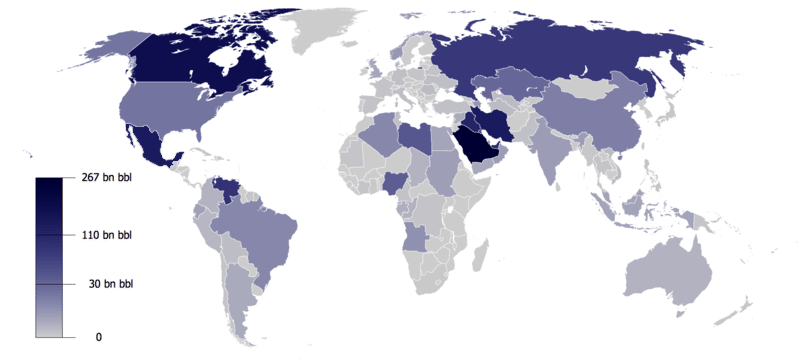
Worldwide oil reserves.
The amount of fossil fuels that remain untapped is unknown, but can likely be measured in decades for oil and natural gas and in a few centuries for coal (Figureabove).
Alternative Fossil Fuels
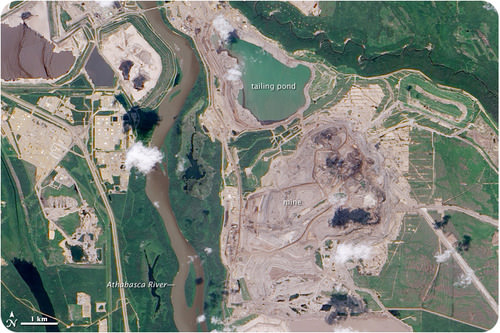
As the easy-to-reach fossil fuel sources are depleted, alternative sources of fossil fuels are increasingly being exploited (Figurebelow). These include oil shale and tar sands. Oil shale is rock that contains dispersed oil that has not collected in reservoirs. To extract the oil from the shale requires enormous amounts of hot water. Tar sands are rocky materials mixed with very thick oil. The tar is too thick to pump and so tar sands are strip-mined. Hot water and caustic soda are used to separate the oil from the rock.
A satellite image of an oil-sands mine in Canada.
The environmental consequences of mining these fuels, and of fossil fuel use in general, along with the fact that these fuels do not have a limitless supply, are prompting the development of alternative energy sources in some regions.
Summary
Easy to get at fossil fuels are running out, but there are other sources that are harder to get at that are still available.
Oil shales and tar sands are two of the alternative sources of fossil fuels that are much in the news.
The need for fossil fuels continues to grow as people in the developed work use more and more people in the developing world want them.
Review
What are oil shales and tar sands?
What do you think goes into calculations that try to determine how much fossil fuel energy is left? Why is this difficult to calculate?
Why is the need for fossil fuels increasing?
Explore More
Use this resource to answer the questions that follow.
Why is oil so great?
How long did it take for nature to make oil? How long did it take us to use the best of it?
What is peak oil?
What happened to world crude oil production? What were the consequences of that?
What does fracking do to this situation?
What is old and what is new? What is the effect of the new thing?
What is needed for fracking?
How does the economy respond to high oil prices?
What is inevitable? What should we do to prepare?
NOTES / HIGHLIGHTS
Please Sign In to create your own Highlights / Notes
Vocabulary
termdefinition
oil shalesedimentary rock rich in oil that can be mined using heat and enormous quantities of water.
tar sandssands mixed with oil that can be mined using water and caustic soda.
Notes/Highlights
Color
Highlighted Text
Notes
Please Sign In to create your own Highlights / Notes


 FlexiA FREE Digital Tutor for Every Student
 FlexBooks 2.0Customizable, digital textbooks in a new, interactive platform
 FlexBooksCustomizable, digital textbooks
 SchoolsFlexBooks from schools and districts near you
 Study GuidesQuick review with key information for each concept
 Adaptive PracticeBuilding knowledge at each student’s skill level
 SimulationsInteractive Physics & Chemistry Simulations
 PLIXPlay. Learn. Interact. eXplore.
 CCSS MathConcepts and FlexBooks aligned to Common Core
 NGSSConcepts aligned to Next Generation Science Standards
 Certified EducatorStand out as an educator. Become CK-12 Certified.
 WebinarsLive and archived sessions to learn about CK-12