6.3Magnetic Polarity Evidence for Continental Drift
Difficulty Level: At Grade | Created by: CK-12
Last Modified: Aug 02, 2016
"The Wegener hypothesis has been so stimulating and has such fundamental implications in geology..."
"...as to merit respectful and sympathetic interest from every geologist. Some striking arguments in his favor have been advanced, and it would be foolhardy indeed to reject any concept that offers a possible key to the solution of profound problems in the Earth's history.” - Chester R. Longwell, "Some Thoughts on the Evidence for Continental Drift," 1944
Wegener and his supporters did all they could do to find evidence to support continental drift. But without a mechanism the idea would not be accepted. What was needed was the development of technologies that would allow scientists to find more evidence for the idea and help them describe a mechanism. But first, they would find still more evidence that the continents had moved.
Magnetic Polarity Evidence
The next breakthrough in the development of the theory of plate tectonics came two decades after Wegener’s death. Magnetite crystals are shaped like a tiny bar magnet. As basalt lava cools, the magnetite crystals line up in the magnetic field like tiny magnets. When the lava is completely cooled, the crystals point in the direction of magnetic north pole at the time they form. How do you expect this would help scientists see whether continents had moved or not?
Magnetite crystals.
As a Wegener supporter, (and someone who is omniscient), you have just learned of a new tool that may help you. A magnetometer is a device capable of measuring the magnetic field intensity. This allows you to look at the magnetic properties of rocks in many locations. First, you’re going to look at rocks on land. Which rocks should you seek out for study?
Magnetic Polarity on the Same Continent with Rocks of Different Ages
Geologists noted important things about the magnetic polarity of different aged rocks on the same continent:
Magnetite crystals in fresh volcanic rocks point to the current magnetic north pole (Figurebelow) no matter what continent or where on the continent the rocks are located.
Earth’s current north magnetic pole is in northern Canada.
Older rocks that are the same age and are located on the same continent point to the same location, but that location is not the current north magnetic pole.
Older rocks that are of different ages do not point to the same locations or to the current magnetic north pole.
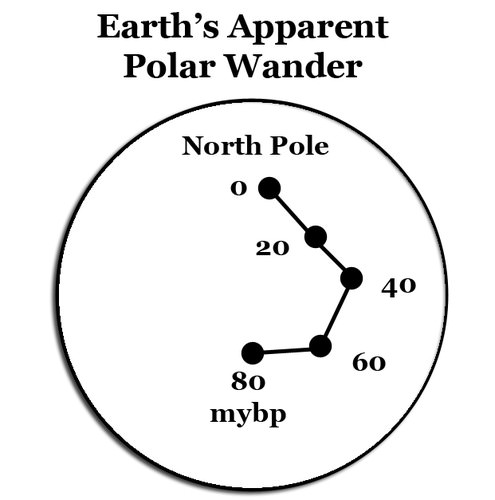
In other words, although the magnetite crystals were pointing to the magnetic north pole, the location of the pole seemed to wander. Scientists were amazed to find that the north magnetic pole changed location over time (Figurebelow).
The location of the north magnetic north pole 80 million years before present (mybp), then 60, 40, 20, and now.
Can you figure out the three possible explanations for this? They are:
The continents remained fixed and the north magnetic pole moved.
The north magnetic pole stood still and the continents moved.
Both the continents and the north pole moved.
Magnetic Polarity on Different Continents with Rocks of the Same Age
How do you figure out which of those three possibilities is correct? You decide to look at magnetic rocks on different continents. Geologists noted that for rocks of the same age but on different continents, the little magnets pointed to different magnetic north poles.
400 million-year-old magnetite in Europe pointed to a different north magnetic pole than magnetite of the same age in North America.
250 million years ago, the north poles were also different for the two continents.
Now look again at the three possible explanations. Only one can be correct. If the continents had remained fixed while the north magnetic pole moved, there must have been two separate north poles. Since there is only one north pole today, what is the best explanation? The only reasonable explanation is that the magnetic north pole has remained fixed but that the continents have moved.
Wegener Was Right!
How does this help you to provide evidence for continental drift? To test the idea that the pole remained fixed but the continents moved, geologists fitted the continents together as Wegener had done. It worked! There has only been one magnetic north pole and the continents have drifted (Figurebelow). They named the phenomenon of the magnetic pole that seemed to move but actually did not apparent polar wander.
On the left: The apparent north pole for Europe and North America if the continents were always in their current locations. The two paths merge into one if the continents are allowed to drift.
This evidence for continental drift gave geologists renewed interest in understanding how continents could move about on the planet’s surface.
Summary
Using magnetic evidence found on a single continent in the 1950s, scientists showed that either the north magnetic pole was in a different spot in Earth’s past or that the continents had moved.
When they added magnetic evidence from a second continent, they showed that in the past there had either been two magnetic north poles or the continents had moved.
Since there is only one magnetic north pole today, they concluded that the simplest explanation is that the continents have moved.
Review
What is apparent polar wander?
How does magnetic evidence from one continent show that either the north magnetic pole has moved or the continents have moved?
How does magnetic evidence from two continents show that the continents have moved?
NOTES / HIGHLIGHTS
Please Sign In to create your own Highlights / Notes
Vocabulary
termdefinition
apparent polar wanderpath on the globe showing where the magnetic pole appeared to move over time.
magnetitea magnetic mineral that takes on Earth's magnetic polarity as it crystallizes.
magnetometeran instrument that measures the magnetic field intensity.
Notes/Highlights
Color
Highlighted Text
Notes
Please Sign In to create your own Highlights / Notes

 FlexiA FREE Digital Tutor for Every Student
 FlexBooks 2.0Customizable, digital textbooks in a new, interactive platform
 FlexBooksCustomizable, digital textbooks
 SchoolsFlexBooks from schools and districts near you
 Study GuidesQuick review with key information for each concept
 Adaptive PracticeBuilding knowledge at each student’s skill level
 SimulationsInteractive Physics & Chemistry Simulations
 PLIXPlay. Learn. Interact. eXplore.
 CCSS MathConcepts and FlexBooks aligned to Common Core
 NGSSConcepts aligned to Next Generation Science Standards
 Certified EducatorStand out as an educator. Become CK-12 Certified.
 WebinarsLive and archived sessions to learn about CK-12