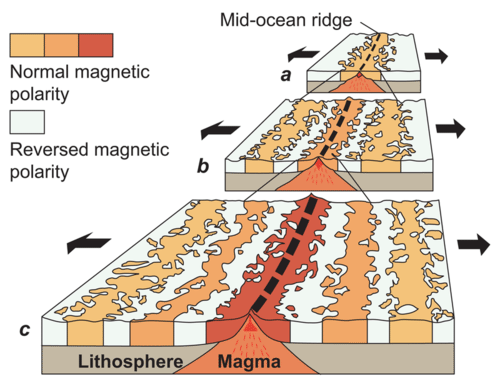
This pattern of stripes could represent what scientists see on the seafloor. Note that the stripes are symmetrical about the central dusky purple stripe. In the oceans, magnetic stripes are symmetrical about a mid-ocean ridge axis. What could cause this? What could it possibly mean?
Seafloor Magnetism
On our transit to the Mid-Atlantic ridge, we tow a magnetometer behind the ship. Shipboard magnetometers reveal the magnetic polarity of the rock beneath them. The practice of towing a magnetometer began during WWII when navy ships towed magnetometers to search for enemy submarines.
When scientists plotted the points of normal and reversed polarity on a seafloor map they made an astonishing discovery: the normal and reversed magnetic polarity of seafloor basalts creates a pattern.
Stripes of normal polarity and reversed polarity alternate across the ocean bottom.
Stripes form mirror images on either side of the mid-ocean ridges (Figurebelow).
Stripes end abruptly at the edges of continents, sometimes at a deep sea trench (Figurebelow).
Magnetic polarity is normal at the ridge crest but reversed in symmetrical patterns away from the ridge center. This normal and reversed pattern continues across the seafloor.
The magnetic stripes are what created the Figureabove. Research cruises today tow magnetometers to add detail to existing magnetic polarity data.
Seafloor Age
By combining magnetic polarity data from rocks on land and on the seafloor with radiometric age dating and fossil ages, scientists came up with a time scale for the magnetic reversals. The first four magnetic periods are:
Brunhes normal - present to 730,000 years ago.
Matuyama reverse - 730,000 years ago to 2.48 million years ago.
Gauss normal - 2.48 to 3.4 million years ago.
Gilbert reverse – 3.4 to 5.3 million years ago.
The scientists noticed that the rocks got older with distance from the mid-ocean ridges. The youngest rocks were located at the ridge crest and the oldest rocks were located the farthest away, abutting continents.
Scientists also noticed that the characteristics of the rocks and sediments changed with distance from the ridge axis as seen in the Tablebelow.
Rock ages
Sediment thickness
Crust thickness
Heat flow
At ridge axis
youngest
none
thinnest
hottest
With distance from axis
becomes older
becomes thicker
becomes thicker
becomes cooler
Away from the ridge crest, sediment becomes older and thicker, and the seafloor becomes thicker. Heat flow, which indicates the warmth of a region, is highest at the ridge crest.
The oldest seafloor is near the edges of continents or deep sea trenches and is less than 180 million years old (Figurebelow). Since the oldest ocean crust is so much younger than the oldest continental crust, scientists realized that something was happening to the older seafloor.
Seafloor is youngest at the mid-ocean ridges and becomes progressively older with distance from the ridge.
How can you explain the observations that scientists have made in the oceans? Why is rock younger at the ridge and oldest at the farthest points from the ridge? The scientists suggested that seafloor was being created at the ridge. Since the planet is not getting larger, they suggested that it is destroyed in a relatively short amount of geologic time.
Summary
Data from magnetometers dragged behind ships looking for enemy submarines in WWII discovered amazing magnetic patterns on the seafloor.
Rocks of normal and reversed polarity are found in stripes symmetrically about the mid-ocean ridge axis.
The age of seafloor rocks increases from the ridge crest to rocks the farthest from the ridges. Still, the rocks of the ocean basins are much younger than most of the rocks of the continents.
Review
Describe the pattern the magnetic stripes make in the ocean floor.
How does magnetic polarity reveal the age of a piece of seafloor?
What other indications do scientists have regarding the age of the seafloor in various locations?
Notes/Highlights
Color
Highlighted Text
Notes
Please Sign In to create your own Highlights / Notes


 FlexiA FREE Digital Tutor for Every Student
 FlexBooks 2.0Customizable, digital textbooks in a new, interactive platform
 FlexBooksCustomizable, digital textbooks
 SchoolsFlexBooks from schools and districts near you
 Study GuidesQuick review with key information for each concept
 Adaptive PracticeBuilding knowledge at each student’s skill level
 SimulationsInteractive Physics & Chemistry Simulations
 PLIXPlay. Learn. Interact. eXplore.
 CCSS MathConcepts and FlexBooks aligned to Common Core
 NGSSConcepts aligned to Next Generation Science Standards
 Certified EducatorStand out as an educator. Become CK-12 Certified.
 WebinarsLive and archived sessions to learn about CK-12