When people have too much stress they may break. What happens if a rock gets too much stress?
With all the movement occurring on Earth's surface — slabs of crust smashing into each other, sideways movements along faults, magma rising through solid rock — it's no wonder that rocks experience stress. Rocks respond differently to different types of stress and under different conditions.
Causes and Types of Stress
Stress is the force applied to an object. In geology, stress is the force per unit area that is placed on a rock. Four types of stresses act on materials.
A deeply buried rock is pushed down by the weight of all the material above it. Since the rock cannot move, it cannot deform. This is called confining stress.
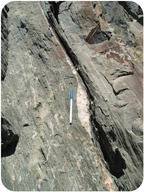
Compression squeezes rocks together, causing rocks to fold or fracture (break) (Figurebelow). Compression is the most common stress at convergent plate boundaries.
Stress caused these rocks to fracture.
Rocks that are pulled apart are under tension. Rocks under tension lengthen or break apart. Tension is the major type of stress at divergent plate boundaries.
When forces are parallel but moving in opposite directions, the stress is called shear (Figurebelow). Shear stress is the most common stress at transform plate boundaries.
Shearing in rocks. The white quartz vein has been elongated by shear.
When stress causes a material to change shape, it has undergone strain or deformation. Deformed rocks are common in geologically active areas.
A rock’s response to stress depends on the rock type, the surrounding temperature, the pressure conditions the rock is under, the length of time the rock is under stress, and the type of stress.
Responses to Stress
Rocks have three possible responses to increasing stress (illustrated in Figurebelow):
elastic deformation: the rock returns to its original shape when the stress is removed.
plastic deformation: the rock does not return to its original shape when the stress is removed.
fracture: the rock breaks.
With increasing stress, the rock undergoes: (1) elastic deformation, (2) plastic deformation, and (3) fracture.
Under what conditions do you think a rock is more likely to fracture? Is it more likely to break deep within Earth’s crust or at the surface? What if the stress applied is sharp rather than gradual?
At the Earth's surface, rocks usually break quite quickly, but deeper in the crust, where temperatures and pressures are higher, rocks are more likely to deform plastically.
Sudden stress, such as a hit with a hammer, is more likely to make a rock break. Stress applied over time often leads to plastic deformation.
Summary
Stress is the force applied to an object. Stresses can be confining, compression, tension, or shear.
Rocks under stress may show strain or deformation. Deformation can be elastic or plastic, or the rock may fracture.
Rocks respond to stress differently under different conditions.
Review
What type of stress would you find at a transform fault? At a subduction zone? What type of stress at a continental rift zone?
Compare and contrast fracture, plastic deformation, and elastic deformation.
What do you think happens with stressed rocks in an earthquake zone?
Explore More
Use this resource to answer the questions that follow.
What is stress defined as?
What are body forces and what are they proportional to?
What are surface forces?
Why does stress need to be studied in vector components?
In what direction do the forces go in normal stress? What about in shear stress?
What is strain?
Vocabulary
termdefinition
compressionstresses that push toward each other, causing a decrease in the space a rock takes up.
confining stressstress from the weight of material above a buried object; this reduces the volume but does not cause deformation.
deformationthe change of shape that a rock undergoes when it has been altered by stresses.
elastic deformationstrain that alters the shape of a rock but that is not permanent.
plastic deformationstrain in which the rock deforms but does not return to its original shape when the strain is removed.
shearparallel stresses that move past each other in opposite directions.
straindeformation in a rock because of a stress that exceeds the rock's internal strength.
stressforce per unit area in a rock.
tensiontype of stress that pulls material in opposite directions, so that it is pulled apart.
fracturethe way a mineral breaks when it is not broken along a cleavage plane (mineralogy); a break in rock caused by stresses, with or without movement of material (structural geology).
Notes/Highlights
Color
Highlighted Text
Notes
Please Sign In to create your own Highlights / Notes


 FlexiA FREE Digital Tutor for Every Student
 FlexBooks 2.0Customizable, digital textbooks in a new, interactive platform
 FlexBooksCustomizable, digital textbooks
 SchoolsFlexBooks from schools and districts near you
 Study GuidesQuick review with key information for each concept
 Adaptive PracticeBuilding knowledge at each student’s skill level
 SimulationsInteractive Physics & Chemistry Simulations
 PLIXPlay. Learn. Interact. eXplore.
 CCSS MathConcepts and FlexBooks aligned to Common Core
 NGSSConcepts aligned to Next Generation Science Standards
 Certified EducatorStand out as an educator. Become CK-12 Certified.
 WebinarsLive and archived sessions to learn about CK-12