What would make a good prediction? Knowing where, when, and the magnitude of the quake would make it possible for people to evacuate.
A Good Prediction
Scientists are a long way from being able to predict earthquakes. A good prediction must be detailed and accurate. Where will the earthquake occur? When will it occur? What will be the magnitude of the quake? With a good prediction authorities could get people to evacuate. An unnecessary evacuation is expensive and causes people not to believe authorities the next time an evacuation is ordered.
Where?
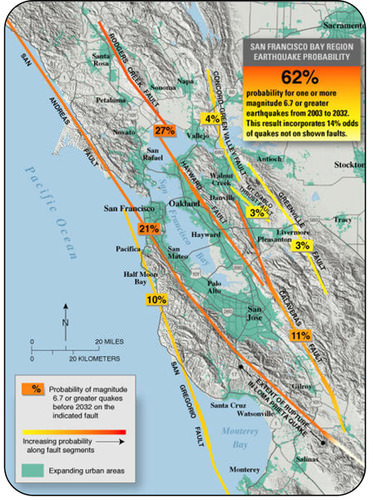
The probabilities of earthquakes striking along various faults in the San Francisco area between 2003 (when the work was done) and 2032.
Where an earthquake will occur is the easiest feature to predict. How would you predict this? Scientists know that earthquakes take place at plate boundaries and tend to happen where they’ve occurred before (Figureabove). Fault segments behave consistently. A segment with frequent small earthquakes or one with infrequent huge earthquakes will likely do the same thing in the future.
When?
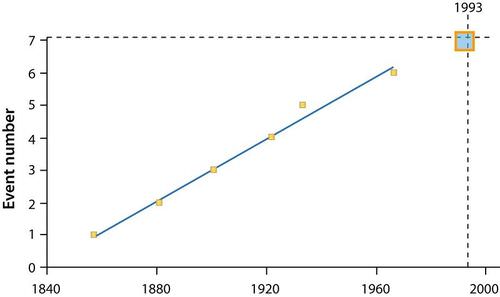
When an earthquake will occur is much more difficult to predict. Since stress on a fault builds up at the same rate over time, earthquakes should occur at regular intervals (Figurebelow). But so far scientists cannot predict when quakes will occur even to within a few years.
Around Parkfield, California, an earthquake of magnitude 6.0 or higher occurs about every 22 years. So seismologists predicted that one would strike in 1993, but that quake came in 2004 - 11 years late.
Earthquake Signs
Signs sometimes come before a large earthquake. Small quakes, called foreshocks, sometimes occur a few seconds to a few weeks before a major quake. However, many earthquakes do not have foreshocks, and small earthquakes are not necessarily followed by a large earthquake. Ground tilting, caused by the buildup of stress in the rocks, may precede a large earthquake, but not always. Water levels in wells fluctuate as water moves into or out of fractures before an earthquake. This is also an uncertain predictor of large earthquakes. The relative arrival times of P-waves and S-waves also decreases just before an earthquake occurs.
Folklore tells of animals behaving erratically just before an earthquake. Mostly, these anecdotes are told after the earthquake. If indeed animals sense danger from earthquakes or tsunami, scientists do not know what it is they could be sensing, but they would like to find out.
Earthquake prediction is very difficult and not very successful, but scientists are looking for a variety of clues in a variety of locations and to try to advance the field.
Summary
A good prediction must indicate when and where an earthquake will take place with detail and accuracy.
Fault segments tend to behave the same way over time.
Signs that an earthquakes may occur include foreshocks, ground tilting, water levels in wells and the relative arrival times of P and S waves.
Review
Why are earthquakes so hard to predict?
Why is it easier to predict where a quake will occur than when?
Describe some of the signs that scientists use to predict earthquakes.
It's now more than a decade after the map of earthquake probabilities in the San Francisco Bay area was made. What do you think the fact that no large earthquakes have struck those faults yet does to the probability that one will strike by 2032?
Vocabulary
termdefinition
foreshockone or more small earthquakes that come before a large earthquake.
Notes/Highlights
Color
Highlighted Text
Notes
Please Sign In to create your own Highlights / Notes


 FlexiA FREE Digital Tutor for Every Student
 FlexBooks 2.0Customizable, digital textbooks in a new, interactive platform
 FlexBooksCustomizable, digital textbooks
 SchoolsFlexBooks from schools and districts near you
 Study GuidesQuick review with key information for each concept
 Adaptive PracticeBuilding knowledge at each student’s skill level
 SimulationsInteractive Physics & Chemistry Simulations
 PLIXPlay. Learn. Interact. eXplore.
 CCSS MathConcepts and FlexBooks aligned to Common Core
 NGSSConcepts aligned to Next Generation Science Standards
 Certified EducatorStand out as an educator. Become CK-12 Certified.
 WebinarsLive and archived sessions to learn about CK-12