Why is California Memorial Stadium called a "tectonic time bomb"?
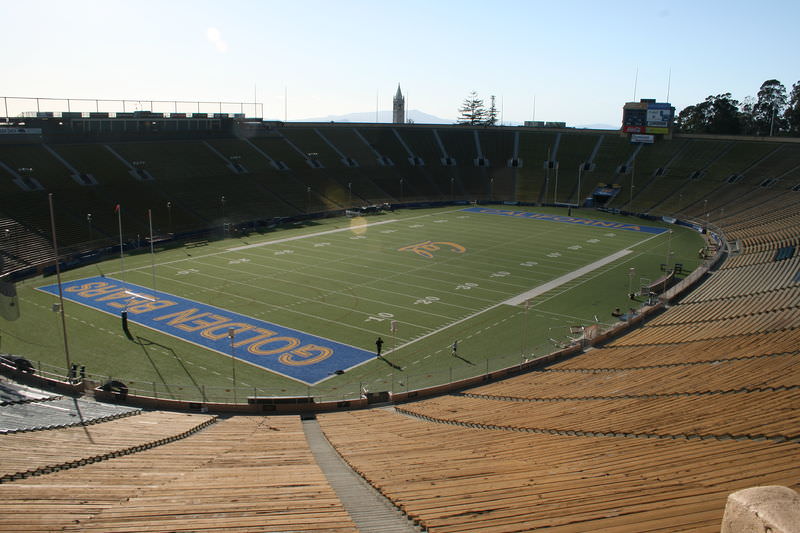
The Hayward Fault passes directly beneath both end zones at California Memorial Stadium, the home of football at the University of California, Berkeley. The site probably looked flat and easy to build on in 1922 before knowledge of earthquake faults was very advanced. Now, in the over-built East Bay, the land is worth an incredible amount of money. To make the stadium safe for workers, players, and fans, the stadium is being renovated in a $321 million project involving 10 miles of steel cables, silicone fluid-filled shock absorbers, concrete piers, 3 feet of sand, plastic sheeting, and stone columns. Go Bears!
New Construction
New construction can be made safer in many ways:
Skyscrapers and other large structures built on soft ground must be anchored to bedrock, even if it lies hundreds of meters below the ground surface.
The correct building materials must be used. Houses should bend and sway. Wood and steel are better than brick, stone, and adobe, which are brittle and will break.
Larger buildings must sway, but not so much that they touch nearby buildings. Counterweights and diagonal steel beams are used to hold down sway.
Large buildings can be placed on rollers so that they move with the ground.
Buildings may be placed on layers of steel and rubber to absorb the shock of the waves.
Connections, such as where the walls meet the foundation, must be made strong.
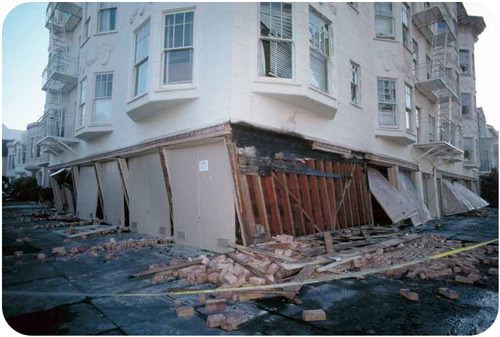
In a multi-story building, the first story must be well supported (Figurebelow).
The first floor of this San Francisco building is collapsing after the 1989 Loma Prieta earthquake.
Retrofitting
To make older buildings more earthquake safe, retrofitting with steel or wood can reinforce a building's structure and its connections. Elevated freeways and bridges can also be retrofitted so that they do not collapse.
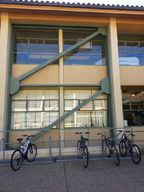
Steel trusses were built diagonally and horizontally across windows to retrofit a building at Stanford University in Palo Alto, California. The San Andreas Fault passes just west of the university.
Preventing Fire Damage
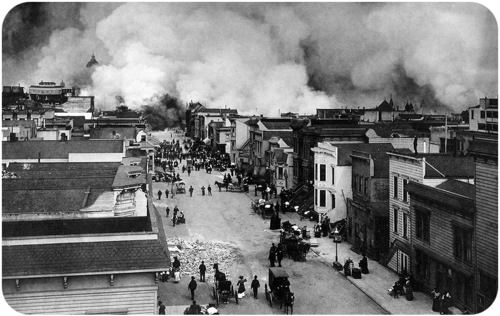
Fires often cause more damage than the earthquake. Fires start because seismic waves rupture gas and electrical lines, and breaks in water mains make it difficult to fight the fires (Figurebelow). Builders zigzag pipes so that they bend and flex when the ground shakes. In San Francisco, water and gas pipelines are separated by valves so that areas can be isolated if one segment breaks.
In the 1906 San Francisco earthquake, fire was much more destructive than the ground shaking.
Cost Considerations
Why aren’t all structures in earthquakes zones constructed for maximum safety? Cost, of course. More sturdy structures are much more expensive to build. So communities must weigh how great the hazard is, what different building strategies cost, and make an informed decision.
In 1868 marked the Hayward Fault erupted in what would be a disastrous earthquake today. Since the fault erupts every 140 years on average, East Bay residents and geologists are working to prepare for the inevitable event.
Summary
New structures that are built to meet earthquake safety codes do much better in earthquakes.
Old buildings can be retrofitted for better safety.
Cost is an important factor in deciding how safe to make the structures in an area.
Review
Why do people build structures in earthquake-prone areas like the San Francisco or Los Angeles areas?
Why do fires do so much damage after an earthquake?
How do people weigh the costs and benefits to determining how earthquake safe to make structures in an area?
Explore More
Use this resource to answer the questions that follow.
What is the goal of the scientists & engineers from the three universities?
What do they use as examples of these types of structures?
What is pre-cast concrete?
Why do builders use pre-cast concrete?
What are the tests designed to do to make the concrete structures more earthquake safe?
What is one thing the building will do to release energy?
How is this research useful to society?
What happened in past earthquakes that they want to avoid?
Vocabulary
termdefinition
retrofitadding new technology to older systems.
Notes/Highlights
Color
Highlighted Text
Notes
Please Sign In to create your own Highlights / Notes


 FlexiA FREE Digital Tutor for Every Student
 FlexBooks 2.0Customizable, digital textbooks in a new, interactive platform
 FlexBooksCustomizable, digital textbooks
 SchoolsFlexBooks from schools and districts near you
 Study GuidesQuick review with key information for each concept
 Adaptive PracticeBuilding knowledge at each student’s skill level
 SimulationsInteractive Physics & Chemistry Simulations
 PLIXPlay. Learn. Interact. eXplore.
 CCSS MathConcepts and FlexBooks aligned to Common Core
 NGSSConcepts aligned to Next Generation Science Standards
 Certified EducatorStand out as an educator. Become CK-12 Certified.
 WebinarsLive and archived sessions to learn about CK-12