Does ground shaking cause the greatest damage in an earthquake?
This photo shows the Mission District of San Francisco burning after the 1906 earthquake. The greatest damage in earthquakes is often not from the ground shaking but from the effects of that shaking. In this earthquake, the shaking broke the gas mains and the water pipes so that when the gas caught fire there was no way to put it out. Do you wonder why the people standing in the street are looking toward the fire rather than running in the opposite direction?
Earthquake!
An earthquake is sudden ground movement caused by the sudden release of energy stored in rocks. Earthquakes happen when so much stress builds up in the rocks that the rocks rupture. The energy is transmitted by seismic waves. Earthquakes can be so small they go completely unnoticed, or so large that it can take years for a region to recover.
Elastic Rebound Theory
The description of how earthquakes occur is called elastic rebound theory (Figurebelow).
Elastic rebound theory. Stresses build on both sides of a fault, causing the rocks to deform plastically (Time 2). When the stresses become too great, the rocks break and end up in a different location (Time 3). This releases the built up energy and creates an earthquake.
Focus and Epicenter
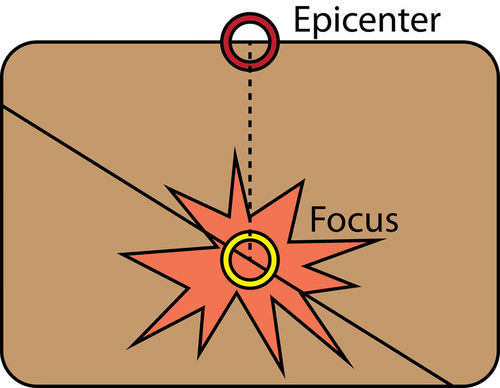
In an earthquake, the initial point where the rocks rupture in the crust is called the focus. The epicenter is the point on the land surface that is directly above the focus (Figurebelow).
In the vertical cross section of crust, there are two features labeled - the focus and the epicenter, which is directly above the focus.
In about 75% of earthquakes, the focus is in the top 10 to 15 kilometers (6 to 9 miles) of the crust. Shallow earthquakes cause the most damage because the focus is near where people live. However, it is the epicenter of an earthquake that is reported by scientists and the media.
Summary
A sudden release of energy stored in rocks causes an earthquake.
The focus is where the rocks rupture. The epicenter is the point on the ground directly above the focus.
Most earthquakes are shallow; these do the most damage.
Review
How does elastic rebound theory describe how an earthquake takes place?
Where is an earthquake's focus? Where is its epicenter?
Why do shallow earthquakes cause the most damage?
Explore More
Use this resource to answer the questions that follow.
What is the San Andreas Fault?
What is the speed that this process along the San Andreas is happening?
What did Harry Fielding Reid base his elastic rebound theory on?
What is elastic rebound theory?
What happens at the time of the earthquake?
What happens in an earthquake that's large?
How likely is a large earthquake to happen in the Bay Area in the next 30 years?
Vocabulary
termdefinition
earthquakeground shaking caused by the release of energy stored in the crust.
elastic rebound theorytheory of how earthquakes are generated; stresses cause strain to build up in rocks until they can no longer bend elastically and they break, causing an earthquake.
epicenterthe point on the Earth's surface directly above the focus of the earthquake.
focusthe point under Earth's surface where rocks rupture during an earthquake.
Notes/Highlights
Color
Highlighted Text
Notes
Please Sign In to create your own Highlights / Notes

 FlexiA FREE Digital Tutor for Every Student
 FlexBooks 2.0Customizable, digital textbooks in a new, interactive platform
 FlexBooksCustomizable, digital textbooks
 SchoolsFlexBooks from schools and districts near you
 Study GuidesQuick review with key information for each concept
 Adaptive PracticeBuilding knowledge at each student’s skill level
 SimulationsInteractive Physics & Chemistry Simulations
 PLIXPlay. Learn. Interact. eXplore.
 CCSS MathConcepts and FlexBooks aligned to Common Core
 NGSSConcepts aligned to Next Generation Science Standards
 Certified EducatorStand out as an educator. Become CK-12 Certified.
 WebinarsLive and archived sessions to learn about CK-12