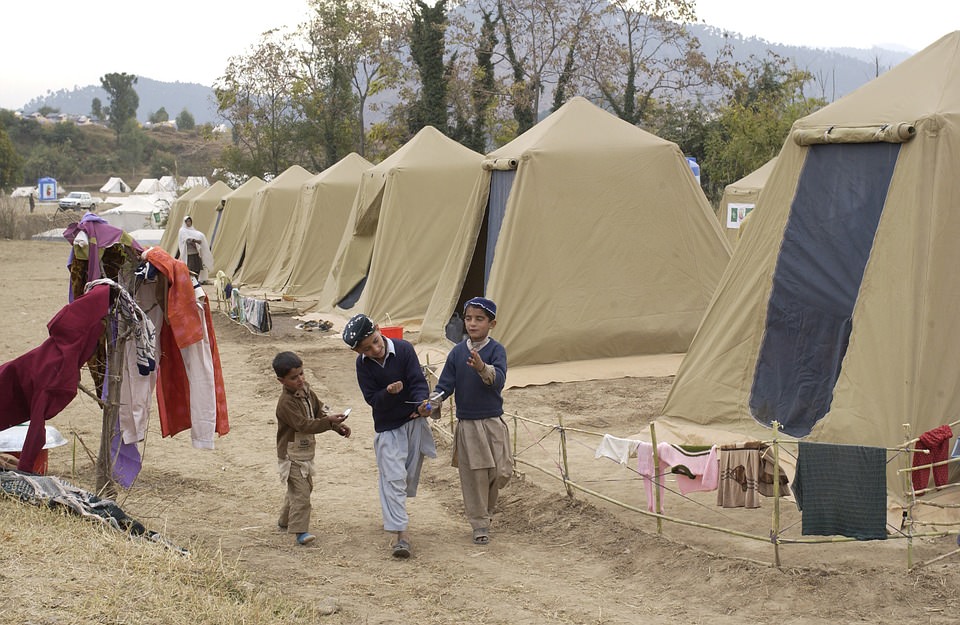
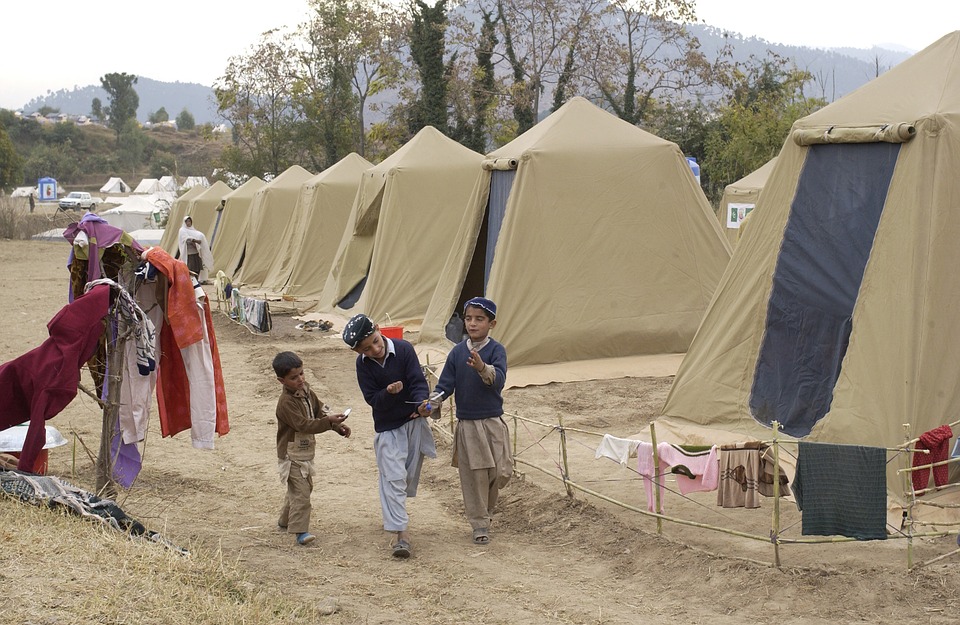
People who've lost their homes in a large earthquake in Pakistan live in a refugee camp, which appears as tents in the photo. Despite suffering the loss of their homes, material possessions, and sometimes loved ones, refugees are often most damaged by the fear that another earthquake could strike. With many people, each aftershock brings renewed terror.
Convergent Plate Boundaries
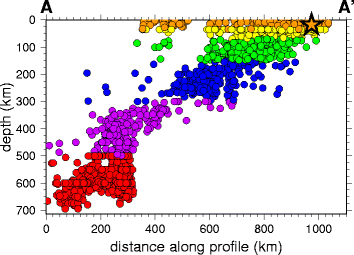
Earthquakes at convergent plate boundaries mark the motions of subducting lithosphere as it plunges through the mantle (Figurebelow). Eventually the plate heats up enough deform plastically and earthquakes stop.
This cross section of earthquake epicenters with depth outlines the subducting plate with shallow, intermediate, and deep earthquakes.
Convergent plate boundaries produce earthquakes all around the Pacific Ocean basin.
Ocean-Ocean: Japan
Earthquakes in Japan are caused by ocean-ocean convergence. The Philippine Plate and the Pacific Plate subduct beneath oceanic crust on the North American or Eurasian plates. This complex plate tectonics situation creates a chain of volcanoes, the Japanese islands, and as many as 1,500 earthquakes annually.
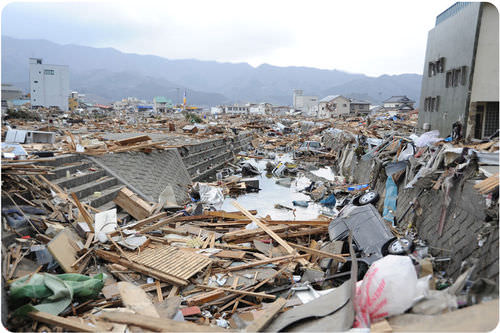
In March 2011 an enormous 9.0 earthquake struck off of Sendai in northeastern Japan. This quake, called the 2011 Tōhoku earthquake, was the most powerful ever to strike Japan and one of the top five known in the world. Damage from the earthquake was nearly overshadowed by the tsunami it generated, which wiped out coastal cities and towns (Figurebelow). Several months after the earthquake, about 22,000 people were dead or missing, and 190,000 buildings had been damaged or destroyed. Aftershocks, some as large as major earthquakes, have continued to rock the region.
Destruction in Ofunato, Japan, from the 2011 Tōhoku Earthquake.
Ocean-Continent: Cascades
The Pacific Northwest of the United States is at risk from a potentially massive earthquake that could strike any time. The subduction of three small plates beneath North America produces active volcanoes, the Cascades. As with an active subduction zone, there are also earthquakes. Surprisingly, large earthquakes only hit every 300 to 600 years. The last was in 1700, with an estimated magnitude of around 9. A quake of that magnitude today could produce an incredible amount of destruction and untold fatalities.
Continent-Continent: Asia
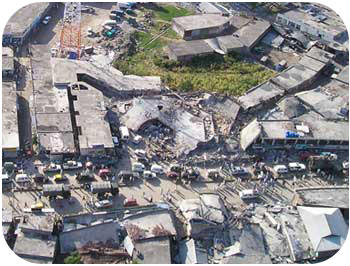
Massive earthquakes are the hallmark of the thrust faulting and folding when two continental plates converge (Figurebelow). The 2001 Gujarat earthquake in India was responsible for about 20,000 deaths, and many more people became injured or homeless.
Damage from the 2005 Kashmir earthquake.
Summary
Earthquakes occur all along the subducting plate as it plunges into the mantle.
All three types of convergent plate boundaries produce massive earthquakes.
Subduction zones around the Pacific Rim are responsible for many of the world's earthquakes.
Review
Why does a subducting plate produce so many earthquakes and what type of quakes does it produce?
What caused the most destruction from the 2011 Japan earthquake and why?
Why do you think the Pacific Northwest has such infrequent but exceptionally massive earthquakes? There are several possible reasons.
Notes/Highlights
Color
Highlighted Text
Notes
Please Sign In to create your own Highlights / Notes


 FlexiA FREE Digital Tutor for Every Student
 FlexBooks 2.0Customizable, digital textbooks in a new, interactive platform
 FlexBooksCustomizable, digital textbooks
 SchoolsFlexBooks from schools and districts near you
 Study GuidesQuick review with key information for each concept
 Adaptive PracticeBuilding knowledge at each student’s skill level
 SimulationsInteractive Physics & Chemistry Simulations
 PLIXPlay. Learn. Interact. eXplore.
 CCSS MathConcepts and FlexBooks aligned to Common Core
 NGSSConcepts aligned to Next Generation Science Standards
 Certified EducatorStand out as an educator. Become CK-12 Certified.
 WebinarsLive and archived sessions to learn about CK-12