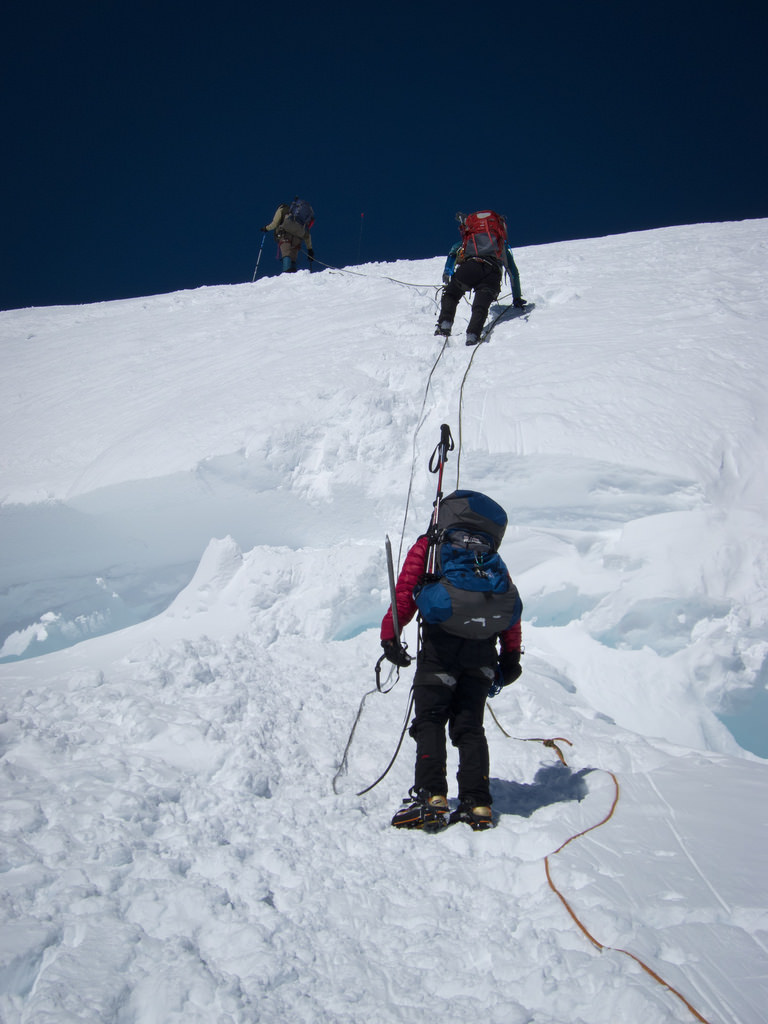
Volcanoes are fun (and difficult) to climb. Climbing in the Cascades ranges in difficulty from a non-technical hike, like on South Sister, to a technical climb on Mount Baker in which an ice axe, crampons, and experience are needed.
Convergent Plate Boundaries
Converging plates can be oceanic, continental, or one of each. If both are continental they will smash together and form a mountain range. If at least one is oceanic, it will subduct. A subducting plate creates volcanoes.
In the Plate Tectonics, Earthquakes, and Volcanoes chapter we moved up western North America to visit the different types of plate boundaries there. Locations with converging in which at least one plate is oceanic at the boundary have volcanoes.
Melting
Melting at convergent plate boundaries has many causes. The subducting plate heats up as it sinks into the mantle. Also, water is mixed in with the sediments lying on top of the subducting plate. As the sediments subduct, the water rises into the overlying mantle material and lowers its melting point. Melting in the mantle above the subducting plate leads to volcanoes within an island or continental arc.
Pacific Rim
Volcanoes at convergent plate boundaries are found all along the Pacific Ocean basin, primarily at the edges of the Pacific, Cocos, and Nazca plates. Trenches mark subduction zones, although only the Aleutian Trench and the Java Trench appear on the map in the previous concept, "Volcano Characteristics."
The Cascades are a chain of volcanoes at a convergent boundary where an oceanic plate is subducting beneath a continental plate. Specifically the volcanoes are the result of subduction of the Juan de Fuca, Gorda, and Explorer Plates beneath North America. The volcanoes are located just above where the subducting plate is at the right depth in the mantle for there to be melting (Figurebelow).
The Cascade Range is formed by volcanoes created from subduction of oceanic crust beneath the North American continent.
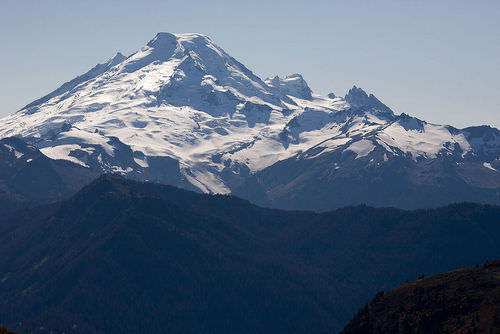
The Cascades have been active for 27 million years, although the current peaks are no more than 2 million years old. The volcanoes are far enough north and are in a region where storms are common, so many are covered by glaciers.
Mt. Baker, Washington.
Divergent Plate Boundaries
At divergent plate boundaries hot mantle rock rises into the space where the plates are moving apart. As the hot mantle rock moves upwards, less material is pushing down on it and the pressure decreases. The rock is under lower pressure; this lowers the melting temperature of the rock and so it melts. Lava erupts through long cracks in the ground, or fissures.
Mid-Ocean Ridges
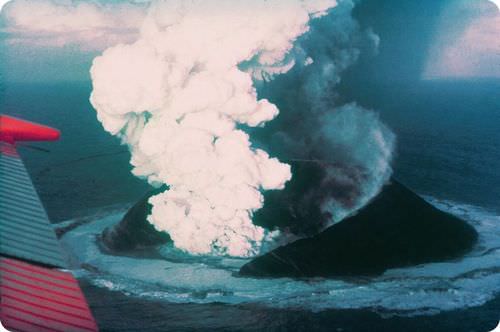
Volcanoes erupt at mid-ocean ridges, such as the Mid-Atlantic ridge, where seafloor spreading creates new seafloor in the rift valleys. Where a hotspot is located along the ridge, such as at Iceland, volcanoes grow high enough to create islands (Figurebelow).
A volcanic eruption at Surtsey, a small island near Iceland.
Continental Rifting
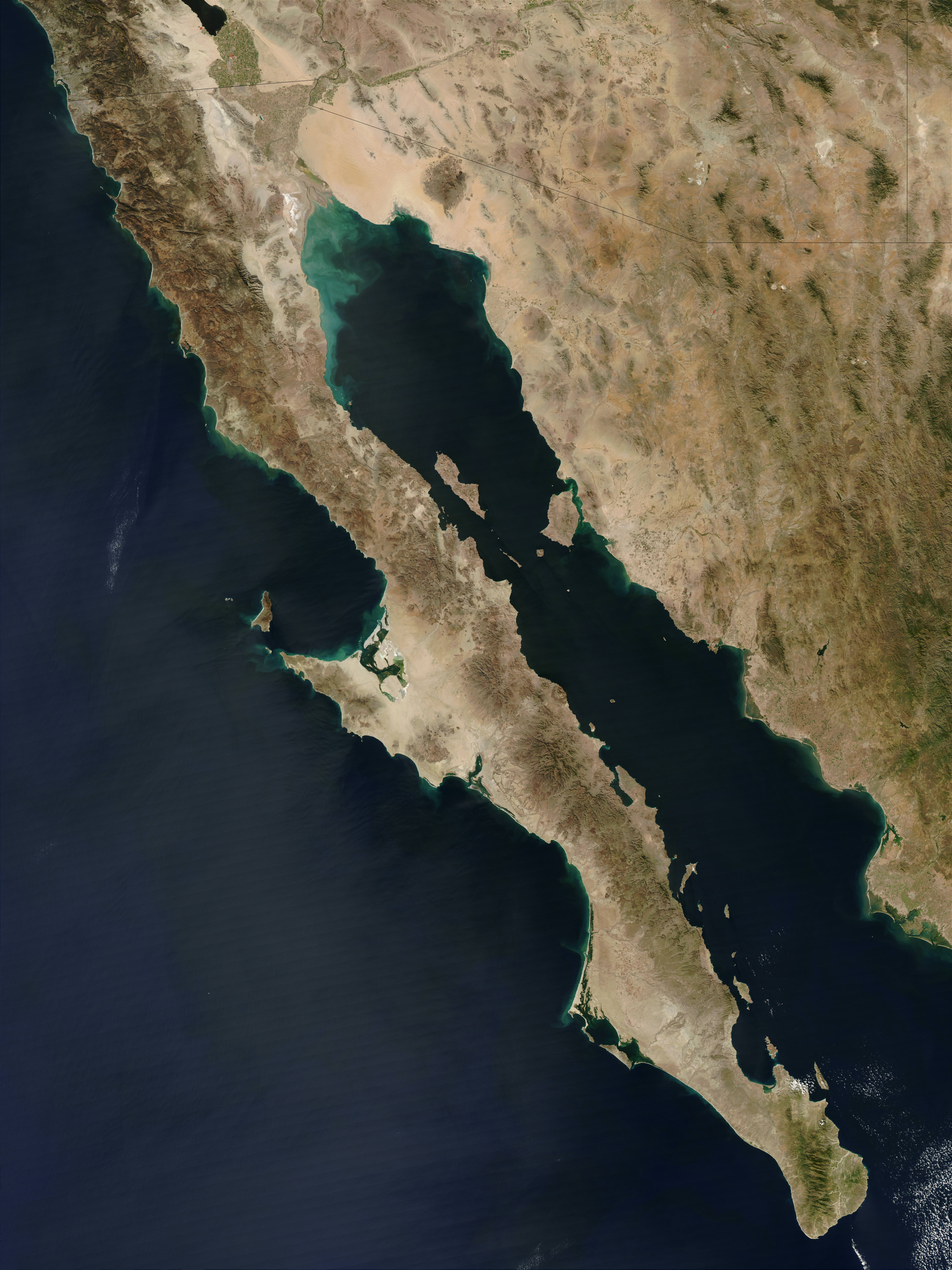
Eruptions are found at divergent plate boundaries as continents break apart. Many volcanoes form in the East African Rift between the African and Arabian plates. Remember from the Plate Tectonics section that Baja California (Figurebelow) is being broken apart from mainland Mexico as another example of continental rifting.
Baja California exists on the Pacific plate and is slowly separating from the rest of Mexico as the North American and Pacific plate move against each other.
Summary
Melting is common at convergent plate boundaries.
Convergent plate boundaries line the Pacific Ocean basin so that volcanic arcs line the region.
Melting at divergent plate boundaries is due to pressure release.
At mid-ocean ridges seafloor is pulled apart and new seafloor is created.
Review
What causes melting at convergent plate boundaries?
Why are there so many volcanoes around the Pacific Ocean basin?
What causes melting at divergent plate boundaries?
How does a rifting within a continent lead to seafloor spreading?
Explore More
Use this resourceto answer the questions that follow.
Where does the melted mantle rock rise?
What does spreading cause?
What happens where there is plate convergence?
How is carbon dioxide released from the rock?
How is carbon dioxide returned to the atmosphere?
NOTES / HIGHLIGHTS
Please Sign In to create your own Highlights / Notes
Vocabulary
termdefinition
fissurea crack in the ground that may be the site of a volcanic eruption.
Notes/Highlights
Color
Highlighted Text
Notes
Please Sign In to create your own Highlights / Notes


 FlexiA FREE Digital Tutor for Every Student
 FlexBooks 2.0Customizable, digital textbooks in a new, interactive platform
 FlexBooksCustomizable, digital textbooks
 SchoolsFlexBooks from schools and districts near you
 Study GuidesQuick review with key information for each concept
 Adaptive PracticeBuilding knowledge at each student’s skill level
 SimulationsInteractive Physics & Chemistry Simulations
 PLIXPlay. Learn. Interact. eXplore.
 CCSS MathConcepts and FlexBooks aligned to Common Core
 NGSSConcepts aligned to Next Generation Science Standards
 Certified EducatorStand out as an educator. Become CK-12 Certified.
 WebinarsLive and archived sessions to learn about CK-12