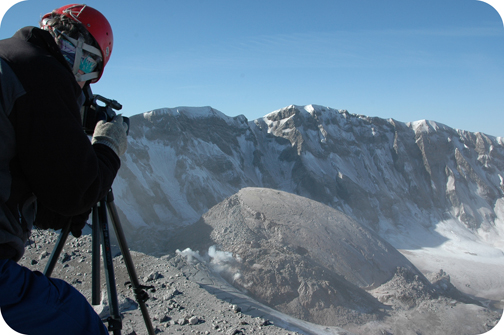
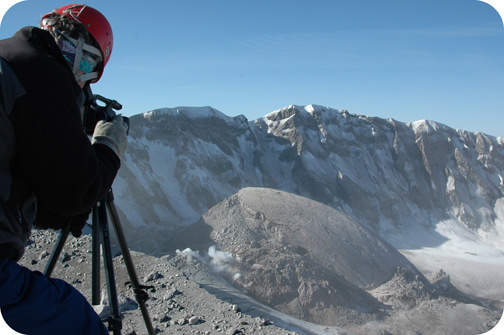
Climbing up Mount St. Helens and looking into the crater at the steaming dome is an incredible experience. The slope is steep and the landscape is like something from another planet. Nothing's alive up there, except maybe a bird. When you're standing on the top you can see off to others of the Cascades volcanoes: Mt. Adams, Rainier, Hood, Jefferson, and sometimes more.
Volcanoes
A volcano is a vent through which molten rock and gas escape from a magma chamber. Volcanoes differ in many features, such as height, shape, and slope steepness. Some volcanoes are tall cones and others are just cracks in the ground (Figurebelow). As you might expect, the shape of a volcano is related to the composition of its magma.
Mount St. Helens was a beautiful, classic, cone-shaped volcano. In May 1980 the volcano blew its top off in an explosive eruption, losing 1,300 feet off its summit.
Composite Volcanoes
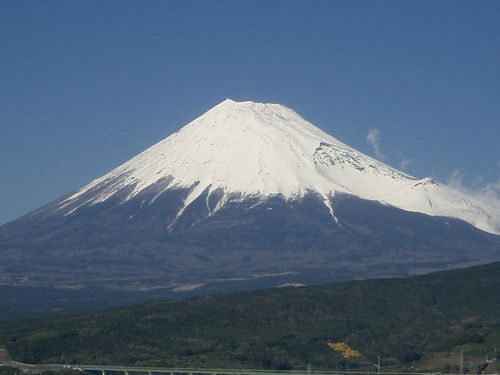
Composite volcanoes are constructed of felsic to intermediate rock. The viscosity of the lava means that eruptions at these volcanoes are often explosive.
Mt. Fuji in Japan is one of the world's most easily recognized composite volcanoes.
Eruptions at Composite Volcanoes
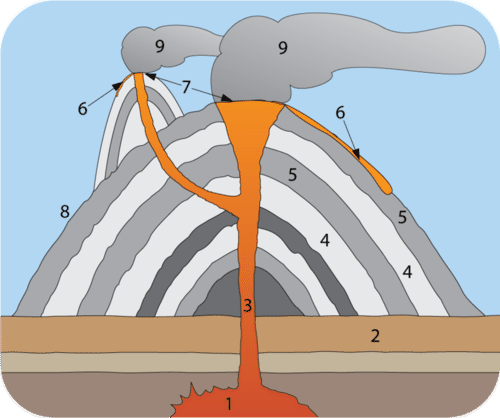
Viscous lava cannot travel far down the sides of the volcano before it solidifies, which creates the steep slopes of a composite volcano. In some eruptions the pressure builds up so much that the material explodes as ash and small rocks. The volcano is constructed layer by layer, as ash and lava solidify, one upon the other (Figurebelow). The result is the classic cone shape of composite volcanoes.
A cross section of a composite volcano reveals alternating layers of rock and ash: (1) magma chamber, (2) bedrock, (3) pipe, (4) ash layers, (5) lava layers, (6) lava flow, (7) vent, (8) lava, (9) ash cloud. Frequently there is a large crater at the top from the last eruption.
Shield Volcanoes
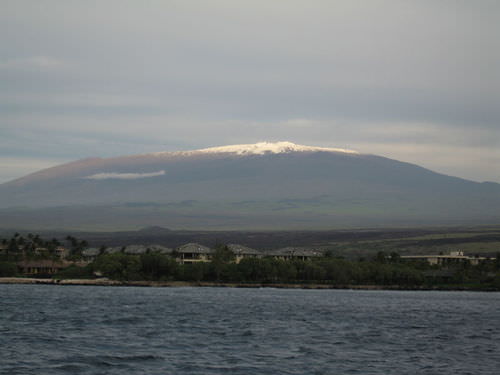
Shield volcanoes get their name from their shape. Although shield volcanoes are not steep, they may be very large. Shield volcanoes are common at spreading centers or intraplate hot spots (Figurebelow). Hawaii has some spectacular shield volcanoes including Mauna Kea, which is the largest mountain on Earth from base to top. The mountain stands 33,500 ft high, about 4,000 feet greater than the tallest mountain above sea level, Mt. Everest.
Mauna Kea on the Big Island of Hawaii is a classic shield volcano.
Eruptions at Shield Volcanoes
The lava that creates shield volcanoes is fluid and flows easily. The spreading lava creates the shield shape. Shield volcanoes are built by many layers over time and the layers are usually of very similar composition. The low viscosity also means that shield eruptions are non-explosive.
Cinder Cones
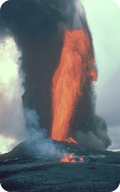
Cinder cones are the most common type of volcano. A cinder cone has a cone shape, but is much smaller than a composite volcano. Cinder cones rarely reach 300 meters in height, but they have steep sides. Cinder cones grow rapidly, usually from a single eruption cycle. These volcanoes usually flank shield or composite volcanoes. Many cinder cones are found in Hawaii.
A lava fountain erupts from Pu'u O'o, a cinder cone on Kilauea.
Eruptions at Cinder Cones
Cinder cones are composed of small fragments of rock, such as pumice, piled on top of one another. The rock shoots up in the air and doesn’t fall far from the vent. The exact composition of a cinder cone depends on the composition of the lava ejected from the volcano. Cinder cones usually have a crater at the summit. Most cinder cones are active only for a single eruption.
Summary
Magma composition determines both eruption type and volcano type.
Composite cones are built of felsic to intermediate lava and shield volcanoes of mafic lava.
Cinder cones are made of small fragments of a variety of compositions usually from a single eruption.
Review
Why do mafic lavas produce shield-shaped volcanoes and felsic lavas produce cone-shaped volcanoes?
From what does a composite volcano get its name?
Describe how a cinder cone forms.
Explore More
Use these resources to answer the questions that follow.
What determines the type of eruption a volcano will have?
Where are the most violent volcanoes formed?
What type of layering do these volcanoes have? What is their name?
What fuels the volcanoes at Hawaii?
What types of volcanoes are the result of non-explosive eruptions like at Hawaii?
What are cinder cones? How do they erupt?
What determines the shape of the cinder cone?
Resources
Vocabulary
termdefinition
cinder conea smaller volcano composed of small rock fragments that grows rapidly but only erupts over a short period of the time.
composite volcanoa volcano composed of alternating layers of ash and lava flows with a broad base, steep sides, and often a crater at the top; also called a stratovolcano.
shield volcanoa type of volcano built almost entirely of fluid lava flows, characterized by its large width and relatively low height.
Notes/Highlights
Color
Highlighted Text
Notes
Please Sign In to create your own Highlights / Notes

 FlexiA FREE Digital Tutor for Every Student
 FlexBooks 2.0Customizable, digital textbooks in a new, interactive platform
 FlexBooksCustomizable, digital textbooks
 SchoolsFlexBooks from schools and districts near you
 Study GuidesQuick review with key information for each concept
 Adaptive PracticeBuilding knowledge at each student’s skill level
 SimulationsInteractive Physics & Chemistry Simulations
 PLIXPlay. Learn. Interact. eXplore.
 CCSS MathConcepts and FlexBooks aligned to Common Core
 NGSSConcepts aligned to Next Generation Science Standards
 Certified EducatorStand out as an educator. Become CK-12 Certified.
 WebinarsLive and archived sessions to learn about CK-12