If you've ever been in a sand storm, you've felt the power of the wind carrying sand particles and blasting at your skin. Over time, this natural sand blasting can be a tremendous erosional force on rocks or buildings. Hopefully, you won't stay out long enough to experience permanent damage.
Transport of Particles by Wind
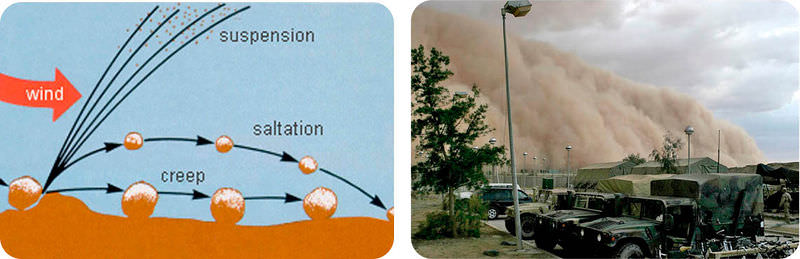
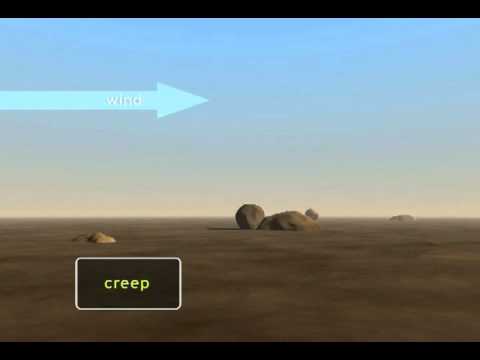
Wind transports small particles, such as silt and clay, over great distances, even halfway across a continent or an entire ocean basin. Particles may be suspended for days. Wind more easily picks up particles on ground that has been disturbed, such as a construction site or a sand dune. Just like flowing water, wind transports particles as both bed load and suspended load. For wind, bed load is made of sand-sized particles, many of which move by saltation (Figurebelow). The suspended load is very small particles of silt and clay.
(a) Wind transport is by suspension, saltation, and creep (bed load). (b) In a sandstorm, sand is usually within a meter of the ground. A dust storm's smaller particles can travel higher. A dust storm as it approaches Al Asad, Iraq.
Wind Erosion
Wind is a stronger erosional force in arid regions than it is in humid regions because winds are stronger. In humid areas, water and vegetation bind the soil so it is harder to pick up. In arid regions, small particles are selectively picked up and transported.
Deflation
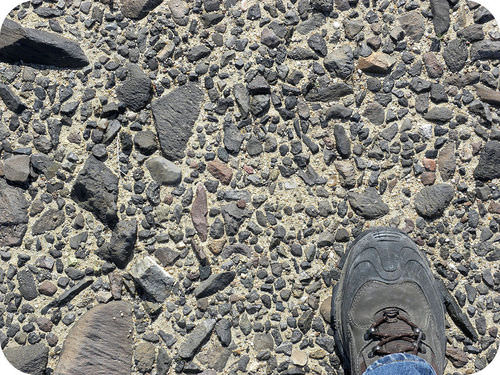
As small particles are removed, the ground surface gets lower and rockier, causing deflation. What is left is desert pavement (Figurebelow), a surface covered by gravel-sized particles that are not easily moved by wind.
This desert pavement formed in the Mojave Desert as a result of deflation.
Abrasion
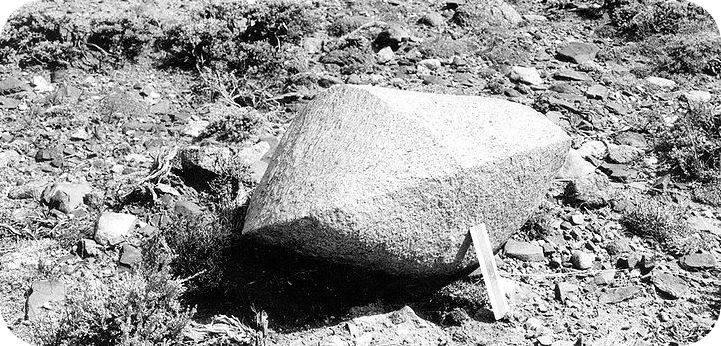
Particles moved by wind do the work of abrasion. As a grain strikes another grain or surface it erodes that surface. Abrasion by wind may polish natural or human-made surfaces, such as buildings. Stones that have become polished and faceted due to abrasion by sand particles are called ventifacts (Figurebelow).
As wind blows from different direction, polished flat surfaces create a ventifact.
Desert Varnish
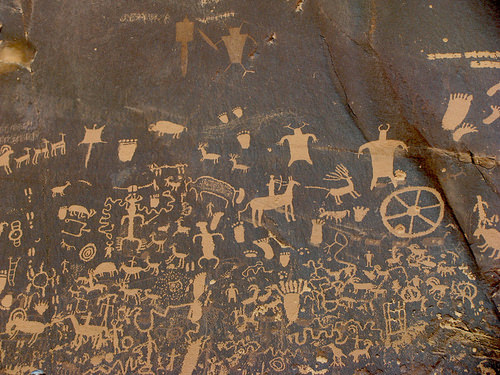
Exposed rocks in desert areas often develop a dark brown or black coating called desert varnish. Wind transports clay-sized particles that chemically react with other substances at high temperatures. The coating is formed of iron and manganese oxides (Figurebelow).
Ancient people carved these petroglyphs into desert varnish near Canyonlands National Park in Utah.
Wind Deposition
The main features deposited by wind are sand dunes. Loess are wind deposits of finer sediments.
Sand Dunes
Deserts and seashores sometimes have sand dunes (Figurebelow). Beach dunes are usually made of quartz because quartz is what's left in humid areas as other mineralsweather into clays. Sand dunes may be composed of calcium carbonate in tropical areas. But in deserts, sand dunes are composed of a variety of minerals because there is little weathering.
Dune sands are usually very uniform in size and shape. Larger particles are too heavy for the wind to transport by suspension and smaller particles can't be picked up. Particles are rounded, since rounded grains roll more easily than angular grains.
This sand dune in Death Valley, California shows secondary sand ripples along its slip face.
For sand dunes to form there must be an abundant supply of sand and steady winds. A strong wind slows down, often over some type of obstacle, such as a rock or some vegetation, and drops its sand. As the wind moves up and over the obstacle, it increases in speed. It carries the sand grains up the gently sloping, upwind side of the dune by saltation. As the wind passes over the dune, its speed decreases. Sand cascades down the crest, forming the slip face of the dune. The slip face is steep because it is at the angle of repose for dry sand, about 34o (Figurebelow).
Sand dunes slope gently in the upwind direction. Downwind, a steeper slip face forms.
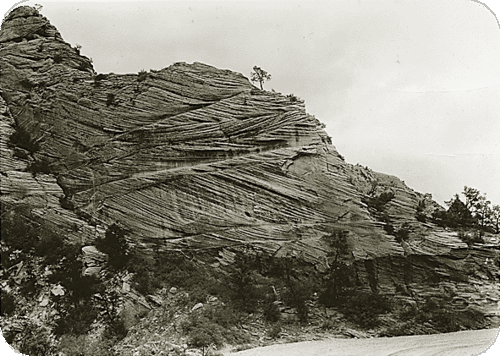
Wind deposits dune sands layer by layer. If the wind changes directions, cross beds form. Cross beds are named for the way each layer is formed at an angle to the ground (Figurebelow).
This sandstone in Zion National Park, Utah, shows crossbedding.
The type of sand dune that forms depends on the amount of sand available, the character and direction of the wind, and the type of ground the sand is moving over. Dunes may be crescent-shaped, star-shaped, parabolic, linear, or barchan.
Loess
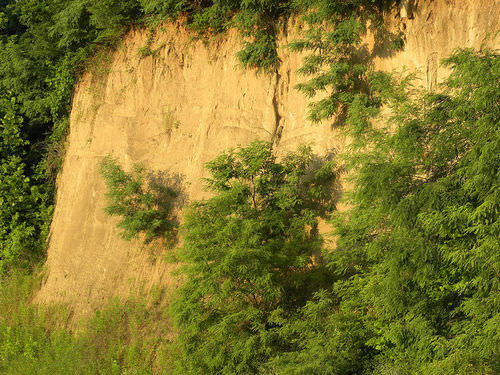
Windblown silt and clay deposited layer on layer over a large area form loess (Figurebelow). Loess deposits form downwind of glacial outwash or desert, where fine particles are available. Loess deposits make very fertile soils in many regions of the world.
Loess deposits form nearly vertical cliffs, without grains sliding down the face.
Seafloor Mud
Fine-grained mud in the deep ocean is formed from silts and clays brought from the land by wind. The particles are deposited on the sea surface, and along with the shells of tiny surface ocean creatures, slowly settle to the deep ocean floor, forming brown, greenish, or reddish clays. Volcanic ash may also settle on the seafloor.
Summary
In deserts, wind picks up small particles and leaves behind larger rocks to form desert pavement.
Moving sand may sand blast rocks and other features to create ventifacts.
The sand is transported until it is deposited in a sand dune.
Review
How does desert varnish form?
Describe how sand dunes form and move.
Why is loess a non-renewable resource?
Explore More
Use this resource to answer the questions that follow.
What size particles can wind move in a humid region? What size can wind move in an arid region? Why?
What is deflation?
How does desert pavement form?
What is a blowout?
How does sand move?
What sand makes up most of a sand dune and why?
How does a sand dune move?
What does cross bedding indicate?
Where is loess and what is it made of?
Vocabulary
termdefinition
deflationwind removes finer grains of silt and clay, causing the ground surface to subside.
desert pavementrocky, pebbled surface created as finer silts and clays are removed by wind.
desert varnishdark mineral coating that forms on exposed rock surfaces as windborne clays are deposited.
loessextremely fine-grained, wind-borne deposit of silts and clays; forms nearly vertical cliffs.
slip facesteeper, downwind side of a dune where sand grains fall down from the crest.
Notes/Highlights
Color
Highlighted Text
Notes
Please Sign In to create your own Highlights / Notes


 FlexiA FREE Digital Tutor for Every Student
 FlexBooks 2.0Customizable, digital textbooks in a new, interactive platform
 FlexBooksCustomizable, digital textbooks
 SchoolsFlexBooks from schools and districts near you
 Study GuidesQuick review with key information for each concept
 Adaptive PracticeBuilding knowledge at each student’s skill level
 SimulationsInteractive Physics & Chemistry Simulations
 PLIXPlay. Learn. Interact. eXplore.
 CCSS MathConcepts and FlexBooks aligned to Common Core
 NGSSConcepts aligned to Next Generation Science Standards
 Certified EducatorStand out as an educator. Become CK-12 Certified.
 WebinarsLive and archived sessions to learn about CK-12