What circumstances allow for the most intense weathering?
The rate and intensity of weathering depend on the climate of a region and the rocks materials that are being weathered. Material in Baraboo, Wisconsin weathers a lot more readily than similar material in Sedona, Arizona.
Rock and Mineral Type
Different rock types weather at different rates. Certain types of rock are very resistant to weathering. Igneous rocks, especially intrusive igneous rocks such as granite, weather slowly because it is hard for water to penetrate them. Other types of rock, such as limestone, are easily weathered because they dissolve in weak acids.
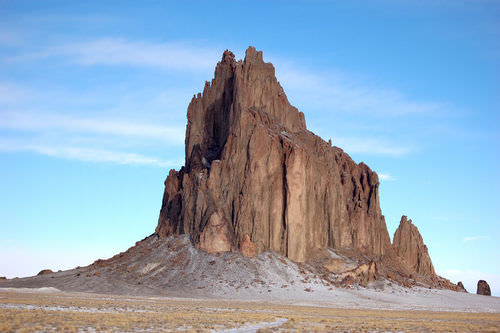
Rocks that resist weathering remain at the surface and form ridges or hills. Shiprock in New Mexico is the throat of a volcano that's left after the rest of the volcano eroded away. The rock that's left behind is magma that cooled relatively slowly and is harder than the rock that had surrounded it.
The Shiprock formation in northwest New Mexico is the central plug of resistant lava from which the surrounding rock weathered and eroded away.
Different minerals also weather at different rates. Some minerals in a rock might completely dissolve in water, but the more resistant minerals remain. In this case, the rock’s surface becomes pitted and rough. When a less resistant mineral dissolves, more resistant mineral grains are released from the rock. A beautiful example of this effect is the "Stone Forest" in China, see the video below:
Climate
A region’s climate strongly influences weathering. Climate is determined by the temperature of a region plus the amount of precipitation it receives. Climate is weather averaged over a long period of time. Chemical weathering increases as:
Temperature increases: Chemical reactions proceed more rapidly at higher temperatures. For each 10oC increase in average temperature, the rate of chemical reactions doubles.
Precipitation increases: More water allows more chemical reactions. Since water participates in both mechanical and chemical weathering, more water strongly increases weathering.
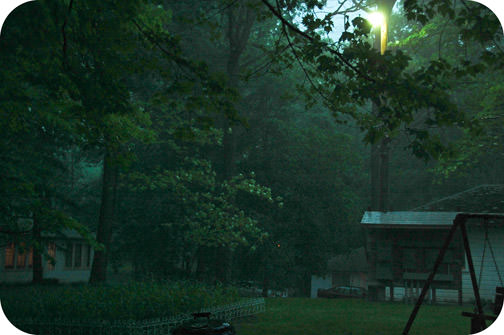
So how do different climates influence weathering? A cold, dry climate will produce the lowest rate of weathering. A warm, wet climate will produce the highest rate of weathering. The warmer a climate is, the more types of vegetation it will have and the greater the rate of biological weathering (Figurebelow). This happens because plants and bacteria grow and multiply faster in warmer temperatures.
Wet, warm tropical areas have the most weathering.
Resources from Weathering
Some resources are concentrated by weathering processes. In tropical climates, intense chemical weathering carries away all soluble minerals, leaving behind just the least soluble components. The aluminum oxide, bauxite, forms this way and is our main source of aluminum ore.
Summary
Different materials weather at different rates and intensities under the same conditions.
Different climate conditions cause the same materials to weather different intensities.
Review
What types of rocks weather most readily? What types weather least readily?
What climate types cause more intense weathering? What climate types cause less intense weathering?
How does the aluminum resource bauxite form?
Explore More
Use this resource to answer the questions that follow.
What type of rocks make up most of the Isle of Skye?
What other types of rocks are found on the island?
Why do the dikes on the hillside stick out of the hill?
What two processes shape the landscape of the island?
What are the primary sources of weathering on Skye?
How is scree produced?
How does weathering affect granite?
What is responsible for the topography of the island?
Which rocks are more resistant to weathering? How does that affect the topography?
Notes/Highlights
Color
Highlighted Text
Notes
Please Sign In to create your own Highlights / Notes


 FlexiA FREE Digital Tutor for Every Student
 FlexBooks 2.0Customizable, digital textbooks in a new, interactive platform
 FlexBooksCustomizable, digital textbooks
 SchoolsFlexBooks from schools and districts near you
 Study GuidesQuick review with key information for each concept
 Adaptive PracticeBuilding knowledge at each student’s skill level
 SimulationsInteractive Physics & Chemistry Simulations
 PLIXPlay. Learn. Interact. eXplore.
 CCSS MathConcepts and FlexBooks aligned to Common Core
 NGSSConcepts aligned to Next Generation Science Standards
 Certified EducatorStand out as an educator. Become CK-12 Certified.
 WebinarsLive and archived sessions to learn about CK-12