Organize arguments in a logical and persuasive order.
Provide appropriate support in the form of quotations, statistics, expert opinions, and commonly accepted facts
Clarify the meaning and significance of the main arguments.
Identify and refute relevant counterpoints.
Introduction
The main aim of a persuasive essay is to make an effective argument. Thus, persuasive essays are written as if the writer is attempting to convince his or her audience to adopt a new belief or behavior. While expository essays strive to explain or clarify a topic, persuasive papers take a stand on an issue. However, simply having an argument or opinion about a topic is not enough. In persuasive essays, writers must also support their opinions. Typically, persuasive essays support their arguments through the use of appropriate evidence, such as quotations, examples, expert opinions, or other facts. Nevertheless, simply having an opinion and supporting evidence is still not enough to write a strong persuasive essay. In addition to these two things, a writer must also have strong organization.
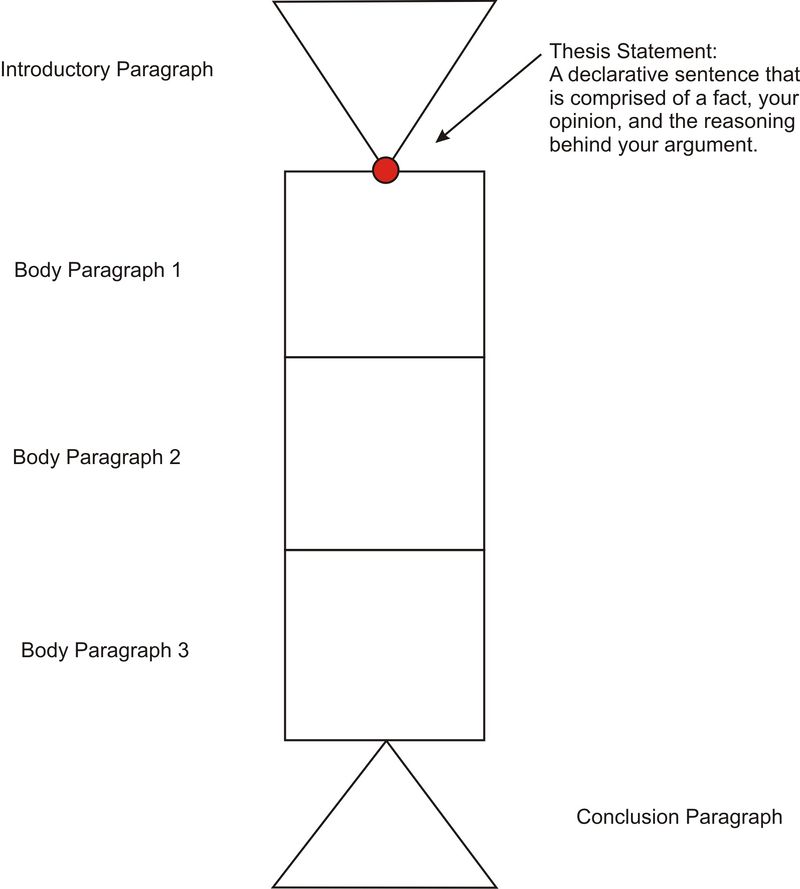
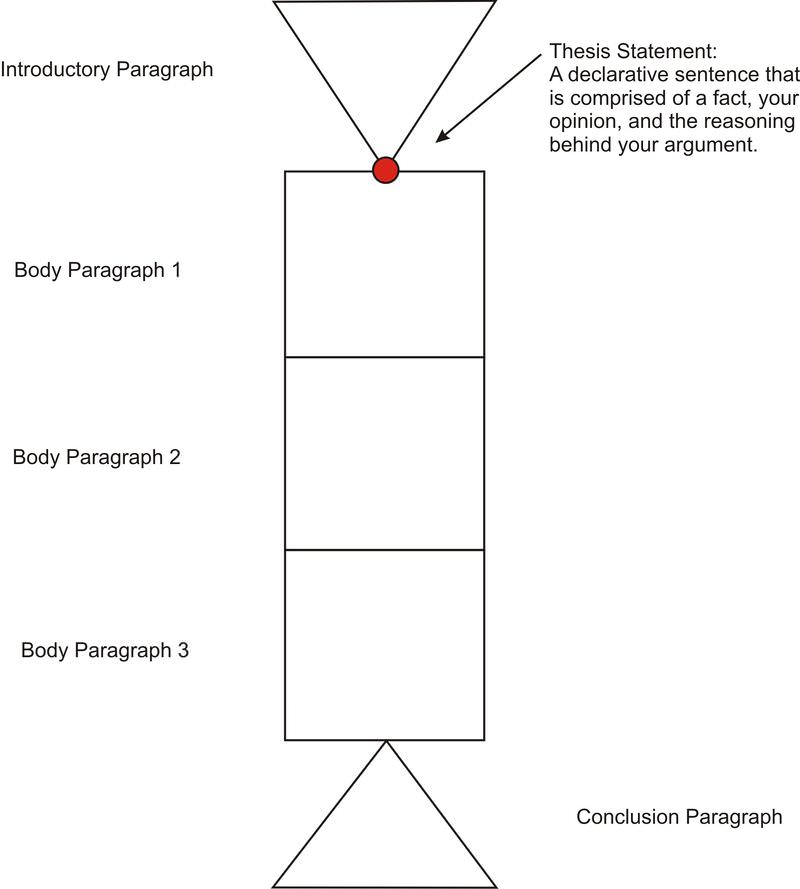
Organization is the key to any well-developed essay. When composing your essay, think of its organization as a set of blocks balanced between two triangles (see Figure 1a). Each block represents the main arguments of your essay, while the two triangles stand for your introductory and concluding paragraphs respectively. Just as the top triangle comes to a point before leading into the blocks, your introductory paragraph should conclude with your thesis before your essay jumps to the supporting paragraphs. These supporting paragraphs, as the blocks suggest, should be full of information and logically solid. Just as the stability and balance of the shape rests on the solidity of the blocks, the stability of the argument of the essay rests on the success of the body paragraphs. Much like the introductory paragraph that precedes it, your concluding paragraph should restate your thesis statement and the main points of your essay, allowing your essay to end on a firm base.
Representation of the organization of a persuasive essay.
While it is important to understand the general organization of a persuasive essay, it is also essential to know the organization of each element or component of a persuasive essay. Below is chart that identifies the major components of each part of a persuasive essay. Keep in mind that these guidelines are not meant to hinder your voice as a writer but rather to strengthen your effectiveness as a writer. Though you may sometimes feel constricted by this organizational framework, it is essential to compose an essay that contains all of these parts in order to make a strong argument. Plus, once you get acquainted with how to organize a persuasive essay, you will be able to use your creative juices in the actual writing of the paper. Rather than focusing on where to put an idea, you can focus on how to express or explain, which makes your job as a writer easier and more exciting.
Introductory Paragraph:
Introduce the issue.
Provide each of the arguments that will later appear in each body paragraph.
Refute any counterpoints to the argument.
Provide the thesis statement.
Body Paragraphs:
Begin with a topic sentence that reflects the argument of the thesis statement.
Support the argument with useful and informative quotes from sources such as books, journal articles, etc.
Provide 1-2 sentences explaining each quote.
Provide 1-3 sentences that indicate the significance of each quote.
Ensure that the information in these paragraphs is important to the thesis statement.
End each paragraph with a transition sentence which leads into the next body paragraph.
Concluding Paragraph:
Begin with a topic sentence that reflects the argument of the thesis statement.
Briefly summarize the main points of the paper.
Provide a strong and effective close for the paper.
Introductory Paragraphs
A strong introductory paragraph is crucial to the development of an effective persuasive essay. Without an introductory paragraph that properly introduces both the topic and the writer’s argument, persuasive essays fail to convince the reader of the validity of the argument. Since the introductory paragraph contains the thesis statement, or the core argument and purpose of the essay, introductory paragraphs are essential to the overall success of the paper.
Introductory Paragraph:
Introduce the issue.
Provide each of the arguments that will later appear in each body paragraph.
Refute any counterpoints to the argument.
Provide the thesis statement.
Since the success of the paper rests on the introductory paragraph, it is important to understand its essential components. Usually, persuasive papers fail to make a clear argument not because the writer’s ideas or opinions are wrong but rather because the argument is not properly explained in the introduction. One of the most important jobs of an introductory paragraph is that it introduces the topic or issue. Most arguments cannot be made without at least some background information. Thus, it is essential to provide a foundation for your topic before you begin explaining your argument. For instance, if you wanted to argue that the special effects in the movie Avatar are innovative, your introductory paragraph would first need to provide background information about movie special-effects. By doing so, you ensure that your audience is as informed about your topic as you are, and thus you make it easier for your audience to understand your argument.
Below is a table describing and explaining the main jobs of the introductory paragraph.
Introductory paragraphs introduce the topic and suggest why it is important.
Example:An analysis of the San José State University Writing Center survey answers reveal that a significant portion of tutees improved their writing skills, and this has correlated to an improvement on their essay scores.
This sentence tells the reader both that the topic of the paper will be the benefits of the Writing Center and that the significance of these benefits is the improvement of essay scores.
Introductory paragraphs outline the structure of the paper and highlight the main ideas.
Example:Considering the SAT average of high school juniors in California, it is apparent that schools are not addressing basic math skills such as fractions, percentages, and long division.
This sentence provides the main ideas of the essay and indicates the order in which they will be presented in the body paragraphs.
Introductory paragraphs state the thesis.
Example:San José State University should require all students to enroll in Creative Writing courses in order to better prepare them for employment.
This thesis statement indicates the argument of the paper.
In addition to introducing the topic of your paper, your introductory paragraph also needs to introduce each of the arguments you will cover in your body paragraphs. By providing your audience with an idea of the points or arguments you will make later in your paper, your introductory paragraph serves as a guide map, not only for your audience but also for you. Including your main sub-points in your introduction not only allows your audience to understand where your essay is headed but also helps you as a writer remember how you want to organize your paper. This is especially helpful if you are not writing your essay in one sitting as it allows you to leave and return to your essay without forgetting all of the important points you wanted to make.
Another common, though often forgotten, component of an introductory paragraph is the refutation of counterpoints. In order for your argument to appear strong, and in order for your audience to know that you considered the points against your claim, it is essential to refute, or disprove, counterpoints, or arguments against your thesis, in your introductory paragraph. The most common error a writer faces when dealing with counterpoints is to not refute them. Sometimes, a writer forgets to show how the counterpoints are wrong and how his or her opinion or argument is correct. To avoid this error, consider using the sentence constructions in the chart below that help refute counterpoints. By using words such as while, although, yet, or however in compound sentences, you can be sure that you are properly refuting any counterpoints to your argument while support your own claims.
In the examples listed below, X is the counterargument and Y is the writer’s argument.
While most people believe X,Y is true.
Although people argue X,Y is correct.
This expert claims X, yet this expert in the same field argues Y.
This book says X; however, this book indicates that Y is true.
There are also some important dos and don’ts when it comes to writing introductory paragraphs. It is crucial when writing your persuasive paper to avoid apologizing or using sweeping generalizations since both undermine your argument. If you continue to apologize in your paper, you make your argument seem weak, and thus your audience is unconvinced. Likewise, if you base your argument on a generalization or stereotype, something which your audience will likely disagree with, your entire argument will lose credit or validity. Also, it is important not to rely to heavily on dictionary definitions, especially in your thesis. A thesis must be composed of a fact and an opinion. Thus, if you base your argument on a definition, which is an irrefutable fact, your thesis is no longer an opinion but a truth.
Things to always do
Things to never do
Capture the interest of your reader.
Introduce the issue to the reader.
State the problem simply.
Write in an intelligible, concise manner.
Refute any counterpoints.
State the thesis, preferably in one arguable statement.
Provide each of the arguments that will be presented in each of the body paragraphs.
Apologize: Do not suggest that you are unfamiliar with the topic.
Example: “I cannot be certain, but...”
Use sweeping generalizations.
Example: “All men like football...”
Use a dictionary definition.
Example: “According to the dictionary, a humble person is...”
Announce your intentions: Do not directly state what you will be writing about.
Example: “In the paper I will...”
Most importantly, when writing an introductory paragraph, it is essential to remember that you must capture the interest of your reader. Thus, it is your job as the writer to make the introduction entertaining or intriguing. In order to do so, consider using a hook, or a quotation, a surprising or interesting fact, an anecdote, or a humorous story. While the quotation, story, or fact you include must be relevant to your paper, placing one of these at the beginning of your introduction helps you not only capture the attention or the reader but also introduce your topic and argument, making your introduction interesting to your audience and useful for your argument and essay. However, after using a hook, you must transition from the quote, fact, or story that used into the main topic of your paper. Often, writers include interesting hooks that they do not connect to their topic or argument. In these instances, the hook detracts from rather than supports the introductory paragraph.
Body Paragraphs
In a persuasive essay the body paragraphs are where the writer has the opportunity to argue his or her viewpoint. By the conclusion paragraph, the writer should convince the reader to agree with the argument of the essay. Regardless of a strong thesis, papers with weak body paragraphs fail to explain why the argument of the essay is both true and important. Body paragraphs of a persuasive essay are weak when no quotes or facts are used to support the thesis or when those used are not adequately explained. Occasionally, body paragraphs are also weak because the quotes used detract from rather than support the essay. Thus, it is essential to use appropriate support and to adequately explain your support within your body paragraphs.
In order to create a body paragraph that is properly supported and explained, it is important to understand the components that make up a strong body paragraph. The bullet points below indicate the essential components of a well-written, well-argued body paragraph.
Body Paragraph Components
Begin with a topic sentence that reflects the argument of the thesis statement.
Support the argument with useful and informative quotes from sources such as books, journal articles, expert opinions, etc.
Provide 1-2 sentences explaining each quote.
Provide 1-3 sentences that indicate the significance of each quote.
Ensure that the information provided is relevant to the thesis statement.
End with a transition sentence which leads into the next body paragraph.
Just as your introduction must introduce the topic of your essay, the first sentence of a body paragraph must introduce the argument for that paragraph. For instance, if you were writing a body paragraph for a paper arguing that Avatar is innovative in its use of special effects, one body paragraph may begin with a topic sentence that states, “Avatar has produced the most life-like animated characters of any movie ever created.” Following this sentence, you would go on to indicate how the movie does this by supporting this one statement. When you place this statement as the opening of your paragraph, not only does your audience know what the paragraph is going to argue, but you can also keep track of your ideas.
Following the topic sentence, you must provide some sort of fact that supports your claim. In the example of the Avatar essay, maybe you would provide a quote from a movie critic or from a prominent special effects person. After your quote or fact, you must always explain what the quote or fact is saying, stressing what you believe is most important about your fact. It is important to remember that your audience may read a quote and decide it is arguing something entirely different than what you think it is arguing. Or, maybe some or your readers think another aspect of your quote is important. If you do not explain the quote and indicate what portion of it is relevant to your argument, then your reader may become confused or may be unconvinced of your point. Consider the possible interpretations for the statement below.
Example: While I did not like the acting in the movie, I enjoyed how life-like the special effects made the animated characters in the film. Without the special effects, the acting would have been boring and the plot would have been unoriginal.
Interestingly, this statement seems to be saying two things at once - that the movie is bad and that the movie is good. On the one hand, the person seems to say that the acting and plot of the movie were both bad. However, on the other hand, the person also says that the special effects more than make up for the bad acting and unoriginal plot. Because of this tension in the quotation, if you used this quote in your Avatar paper, you would need to explain that the special effects in the movie are so good that they make boring movie exciting.
In addition to explaining what this quote is saying, you would also need to indicate why this is important to your argument. When trying to indicate the significance of a fact, it is essential to try to answer the “so what.” Image you have just finished explaining your quote to someone, and he or she has asked you “so what?” The person does not understand why you have explained this quote, not because you have not explained the quote well but because you have not told him or her why he or she needs to know what the quote means. This, the answer to the “so what,” is the significance of your paper and is essentially your argument within the body paragraphs. However, it is important to remember that generally a body paragraph will contain more than one quotation or piece of support. Thus, you must repeat the Quotation-Explanation-Significance formula several times within your body paragraph to argue the one sub-point indicated in your topic sentence. Below is an example of a properly written body paragraph.
An example of a persuasive body paragraph paired with an explanation of its parts.
Conclusion Paragraph
The conclusion paragraph of an argumentative essay is an author’s last chance to create a good impression. Hence, it is important to restate the thesis statement at the beginning of the paragraph in order to remind the reader of your argument. Since it is at the end of the paper, the conclusion paragraph also should add a sense of closure and finality to the argument of the paper. It is important to re-emphasize the main idea without being repetitive or introducing an entirely new idea or subtopic. While you can end your conclusion paragraph by suggesting a topic for further research or investigation, do not make this question the focus of the paragraph. Thus, you should briefly and concisely reiterate the strongest arguments of the paper, reminding the reader of the validity of the thesis and bringing closure to your paper.
Concluding Paragraph:
Begin with a topic sentence that reflects the argument of the thesis statement.
Briefly summarize the main points of the paper.
Provide a strong and effective close for the paper.
Things to always do
Things to never do
Stress the importance of the thesis.
Rework your introduction or thesis statement.
Include a brief summary of the main idea.
Use overused phrases.
Be concise.
Example: “In summary...” or “In conclusion...”
Provide a sense of closure.
Announce what you have written in the body of the essay
Example: “In this paper I have emphasized the importance of...”
Apologize
Example: “Although I do not have all the answers...”
Make absolute claims.
Example: “This proves that the government should...”
You may feel that the conclusion paragraph is redundant or unnecessary; however, do not forget that this is your last chance to explain the significance of your argument to your audience. Just as your body paragraphs strive to present the significance of each fact or quote you use, your conclusion paragraph should sum up the significance of your argument. Thus, you should consider making a bold statement in your concluding paragraph by evoking a vivid image, suggesting results or consequences related to your argument, or ending with a warning. Through using these components, you not only make your conclusion paragraph more exciting, but you also make your essay, and your argument, more important.
Review Questions
What are three of the main purposes of an introductory paragraph?
What should you never do in an introductory paragraph?
How should you refute counterpoints?
What is the formula for a well-argued body paragraph?
What should you include in a conclusion paragraph? What should never include in a conclusion paragraph?
Points to Consider
Write a persuasive paper arguing for or against a community service requirement that high school students must fulfill in order to graduate. If you are arguing for the requirement, be sure to specify what the requirement entails (i. e. how many hours or where it needs to be completed) in addition to supporting the use of the requirement. If you are arguing against the requirement, be sure to address counterpoints in addition to supporting your claims fully.
Write a persuasive paper about the impact of media (such as video games, television, movies, or magazines) on high school aged (15-18) and junior high school aged (12-14) children. Should parents regulate both age groups’ access to these forms of media? Or, should only one group be monitored? If so, which? Do video games, television, magazines, etc affect one group more than the other? Use specific examples to support your ideas.
Notes/Highlights
Color
Highlighted Text
Notes
Please Sign In to create your own Highlights / Notes
Currently there are no resources to be displayed.
Description
This textbook follows California Language Arts Standards for grades 9-12 to provide a generalized understanding of composition and to serve as a supplementary aid to high school English teachers.


 FlexiA FREE Digital Tutor for Every Student
 FlexBooks 2.0Customizable, digital textbooks in a new, interactive platform
 FlexBooksCustomizable, digital textbooks
 SchoolsFlexBooks from schools and districts near you
 Study GuidesQuick review with key information for each concept
 Adaptive PracticeBuilding knowledge at each student’s skill level
 SimulationsInteractive Physics & Chemistry Simulations
 PLIXPlay. Learn. Interact. eXplore.
 CCSS MathConcepts and FlexBooks aligned to Common Core
 NGSSConcepts aligned to Next Generation Science Standards
 Certified EducatorStand out as an educator. Become CK-12 Certified.
 WebinarsLive and archived sessions to learn about CK-12