Do you ever wonder how diseases spread? Water serves as a carrier or transmitter of many diseases. In fact, many of the world’s diseases are dependent on water for their transmission. These diseases often occur in large epidemics and can be quite catastrophic. A large part of water engineering is maintaining water quality so the water that we receive when we turn on our kitchen faucets is potable. In addition to making water safe for drinking, water engineering is also about transporting water from its source into our homes and to the areas where we live.
In this section we will investigate cholera, a waterborne disease; we will learn about the scientific problem solving that verified that cholera was transmitted by water. We will then begin to investigate how engineers help society manage our water supply. This topic will be expanded in later sections.
Background Information: Cholera
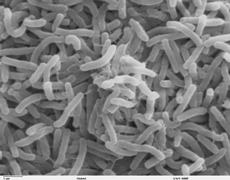
Microscopic view of cholera bacteria.
Cholera is an acute intestinal infection caused by ingestion of contaminated water or food. The infection is caused by the Vibrio cholerae bacterium (Figure above). This bacterium typically travels through water that is contaminated by human or animal feces. Human beings can contract cholera by ingesting water or food contaminated by the V. cholerae bacterium. Symptoms of cholera include diarrhea, abdominal cramps, nausea, vomiting, and dehydration. As the human body does not produce lasting immunity against the cholera bacterium, it is possible that the disease can be contracted more than once. When people die from cholera, it is generally due to severe dehydration caused by the illness. When left untreated cholera generally has a high mortality rate. A cholera outbreak can be widespread, causing a large scale epidemic in which hundreds or thousands of people die.
Activity
Research and review resources on cholera epidemics on the World Wide Web. Refer to encyclopedias from your school library or local library. Prepare a short list of answers that do not exceed 200−300 words for each of the following questions. You might use some of these suggested phrases for searching on the Internet: cholera, epidemics, cholera and water, water-borne diseases, water contamination sources, water quality, water purification.
What were some of the major cholera epidemics of the past?
What are some of the major cholera epidemics of the present?
Where and under what conditions did the cholera epidemics occur?
What role did water play in these cholera epidemics?
How can the quality of water be maintained so the water does not get contaminated from bacteria such as the cholera bacterium?
The 1854 Case of Cholera in London
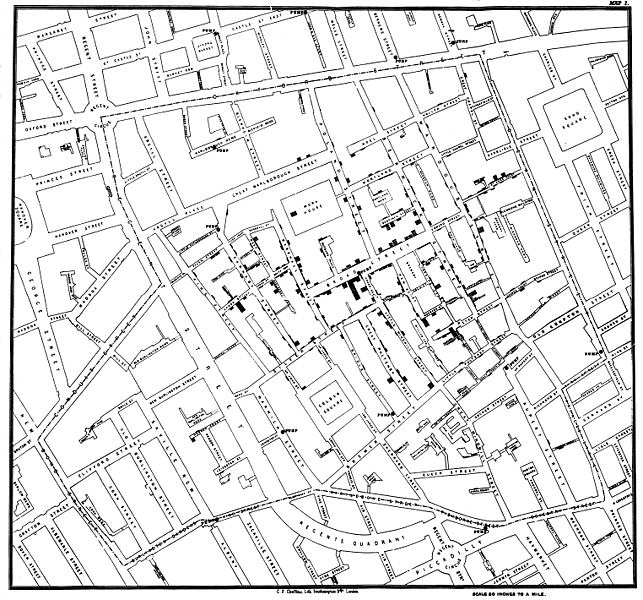
In 1854, hundreds of people living in London died during a cholera epidemic. At that time, very little was known about how the disease was transmitted. Many believed that people could contract diseases such as cholera by breathing bad or foul air. It is estimated that 616 people died during this epidemic. If not for the intervention of Dr. John Snow (b. 1813–d. 1858), who carefully mapped the number of deaths that occurred around water sources, primarily the Broad Street pump, and then worked with other officials to remove its handle, the cholera epidemic of 1854 in London would have been more widespread. It was later discovered that sewage was contaminating the water source for the Broad Street pump. Preventing people from using this pump stopped the use of water from that source. This action has been credited with greatly reducing the number of deaths during this epidemic.
Dr. Snow created the map in the Figure below. The Snow map depicted the area around the Broad Street pump where the number of deaths is indicated by dark blocks at the homes and establishments around the pump.
During an earlier cholera epidemic in London in 1848 and 1849, Snow had proposed the unusual idea that cholera was caused by something that was ingested orally, rather than by inhaling foul air. During the cholera epidemic of 1854 in London, Snow collected data by carefully interviewing people around Broad Street who had not been infected by the water they had been drinking. Others would cite, after Snow’s death in 1858, that the data he had collected supporting his theory that cholera was primarily spread by sewage-contaminated water. Dr. Snow’s research into the spread of cholera locally around the Broad Street pump is an important lesson taught even today to epidemiology students as a model of scientific reasoning. Dr. Snow authored a report about the cholera outbreak in the Parish of St. James, Westminster, during the Autumn of 1854; this as well as his other works are available online at the John Snow Archive and Research Companion website.
Number of deaths at 40 Broad Street. Deaths at homes are indicated by dark lines.
Today most of us know that unclean water carries bacteria that cause disease. We value clean water. However, in the 1800s, the idea that water could carry disease was frightening to many. During that time many people believed that catastrophic diseases such as cholera were visitation of retribution for sinful living of the poor. Dr. Snow had to work hard to convince the local authorities to remove the handle of the Broad Street pump. Now, people know that cholera infection can be avoided by drinking clean water. During the twentieth century, in the western hemisphere, incidences of cholera in the recent past are almost nonexistent. However, it is estimated by the World Health Organization (WHO) that in developing nations only 35% of the population have access to clean water.
According to the WHO, the current response to cholera outbreaks tends to mostly in the form of emergency response whenever there is an outbreak. While emergency response is very important and prevents many deaths, it does not help prevent causes of cholera. Therefore, one cannot emphasize enough the importance of long-term cholera prevention. Key to the prevention of cholera and other waterborne diseases is closely related to the prevention of water contamination and water purification. Separating sewage water from natural water sources, treatment of sewage water, treatment of water resources, and purification of water for storage and delivery for human consumption are key elements of such a strategy that involve engineering solutions. In addition, medical research, personal hygiene, and public health education will play a key role in the prevention of cholera epidemics.
Water Engineering and Management
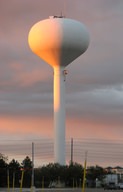
Water towers such as this one help distribute clean water to surrounding communities.
One of our significant challenges today is to obtain water for people and for food production, look after critical ecosystems and habitats, and deal with the variability and uncertainty of water on our earth. Water engineers and managers need to understand the complexity of water use and water resources management. Water for human consumption includes engineering solutions related to water supply and sanitation; management of water treatment and distribution systems (Figure above); storm water, domestic wastewater, and urban drainage; and sustainable management of water for urban and rural areas. Water for food production includes the use of water for agricultural purposes which necessitates engineering solutions related to planning, design, implementation, operation, and maintenance of irrigation and drainage projects. Water for energy production includes the use of engineering solutions such as dams for hydroelectric power. Water management is also related to engineering solutions for uncertain events such as flooding caused by natural and human activities.
Review Questions
The following questions will help you assess your understanding of this section. There may be one, two, three, or even four correct answers to each question. To demonstrate your understanding, you should find all of the correct answers.
Water engineers are concerned with
ensuring that water is drinkable
drinking eight glasses of water a day
transporting water to our homes
marketing bottled water
An example of a disease caused by contaminated water is
a cold
colessus
Cholera
colitis
We can prevent waterborne diseases by
washing our hands
public health education
vaccinations
visits to the doctor
Water engineers look for solutions to mitigate
overfishing the oceans
natural flooding
building ships
human caused flooding
Reflection Questions
Why do North Americans not have to worry about cholera?
When we travel abroad to some countries, we are advised to receive a cholera vaccination. Why is it necessary to receive a cholera vaccination?
Further Reading
Johnson, Steven. The Ghost Map (The Story of London’s Most Terrifying Epidemic and How It Changed Science, Cities, and the Modern World). Riverhead Books, New York, 2006.
Tuthill, Kathleen. “John Snow and the Broad Street Pump: On the Trail of an Epidemic.” Cricket, 31 (2003): 23–31. Available on the web at
Please Sign In to create your own Highlights / Notes
Currently there are no resources to be displayed.
Description
Introduces engineering techniques and practices to high school students. This book is designed for a broad range of student abilities and does not require significant math or science prerequisites.
 AI Teacher Tools

 FlexiA FREE Digital Tutor for Every Student
 FlexBooks 2.0Customizable, digital textbooks in a new, interactive platform
 FlexBooksCustomizable, digital textbooks
 SchoolsFlexBooks from schools and districts near you
 Study GuidesQuick review with key information for each concept
 Adaptive PracticeBuilding knowledge at each student’s skill level
 SimulationsInteractive Physics & Chemistry Simulations
 PLIXPlay. Learn. Interact. eXplore.
 CCSS MathConcepts and FlexBooks aligned to Common Core
 NGSSConcepts aligned to Next Generation Science Standards
 Certified EducatorStand out as an educator. Become CK-12 Certified.
 WebinarsLive and archived sessions to learn about CK-12