You have both a job to do and a heart. Work it out.
Ms. Scott
Society of Professional Journalists' Code of Ethics
Professional journalists follow the Society of Professional Journalists' Code of Ethics. These are the rules under which ethical journalists operate as they go about their work, and the code is the foundation on which ethical journalism rests. The rules belong to four categories: Seek Truth and Report It; Minimize Harm; Act Independently; and Be Accountable.
You should read the code through several times. Some of the rules won't seem relevant to you at first, because you won't have encountered that particular ethical dilemma or challenging situation. But the more you report, write, and edit stories, the more you'll run into situations in which you will need to know the code. The code's language—appropriate for journalists—is concise and clear. You shouldn't skim the list of rules; instead, think about each one, and why it matters, and how you would fulfill it. You will learn so much about ethical journalism—quickly!
The National Scholastic Press Association's Model Code of Ethics
If you are a high school student, you will find terrific guidance in the National Scholastic Press Association's Model Code of Ethics for High School Journalists. The code describes the special world of the student journalist, who is not yet an expert reporter or writer, whose work has an impact on her school, who will be wielding the power of the press perhaps before she's even fully aware of how it works, and who must nonetheless pursue her stories with vigor. This Model Code contains information and priceless explanations for how to do the work ethically and well.
The rules are broken into seven categories: Be Responsible; Be Fair; Be Honest; Be Accurate; Be Independent; Minimize Harm; and Be Accountable.
If you understand and adopt a code of ethics, you will be fearless in your reporting and writing because you'll know your work is good and fair. You'll become adept at handling the challenges every journalist faces even in ordinary stories, and you'll be well prepared to make a good decision when a really difficult ethical dilemma arises.
Ethics Case Studies
Take a walk now in the shoes of experienced journalists confronting those difficult ethical dilemmas. Here's a link to some of the Society of Professional Journalists' recent ethics case studies, in which elements of the ethics code are examined. You should try your hand at figuring out what you would do under these circumstances. (Be sure to read about each case's background and outcome.) I find the case "When Sources Won't Talk" particularly interesting, as it's about a college newspaper. (Note the difference between the fraternity's "apology" and the one offered by the sorority. And note the care with which the college newspaper's editors tracked down what actually happened and made their decisions, given that the college paper itself was involved, tangentially, in the story.)
The Indiana University School of Journalism also has a superb collection of ethics cases, including one titled, "White Lies: Bending the Truth to Expose Injustice." (The cases are based on the work of the late Barry Bingham, Jr., who was the editor and publisher of The Courier-Journal and The Louisville Times.)
The Five Principles for Reporting and Writing
In 2006, veteran journalists Bill Kovach and Tom Rosenstiel queried 1,200 editors and reporters as part of a three-year project on the state of journalism in America. They were looking to see which principles were identified most often as guiding reporters and editors in their day-to-day work. let these principles guide you:
1. Never add anything that wasn't there.
If a person wears a neon necktie one day and clown shoes the next, you cannot describe him as if he's wearing both those things at once. You'll want to, to make the story better, but you can't mess with reality this way, on clown shoes or anything else. Do not add.
2. Never deceive the audience.
Don't change quotes without ellipses or brackets, even to fix grammar. Don't make it appear that you heard something when it was said if you only found out about it later; don't make it appear as if someone said something to you in an interview if they said it in a speech. Don't photoshop pictures; don't give the readers any approximation of the truth. Do not confuse or obfuscate; do not deceive.
3. Be as transparent as possible about your own methods and motives.
The reader should understand where, when, and how you got the information for your story, and should understand your motives for ordering the information as you did. Do not work with secrets.
4. Rely on your own original reporting.
Check out what others tell you, including what is reported in other media. In the end, it's your story.
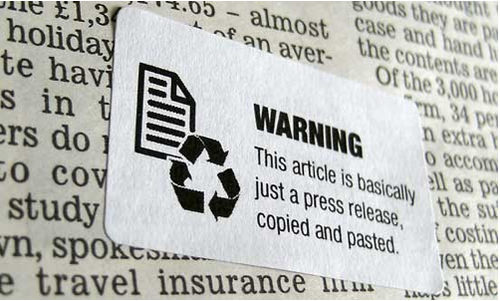
Beware of relying too much on a press release or other sources of secondhand reporting.
5. Exercise humility.
Be skeptical about your own ability to understand a story fully. Of course you must talk to the stakeholders in any story so you hear their point of view. Beyond that, though, you should question yourself: Are you sure you know what a fundamentalist means when he talks about being saved? Are you sure you understand why a school committee member would be opposed to health education? Maybe you don't know all the background. Maybe you don't know all the details. Educate yourself.
Wearing the Press Pass
Let's face it—wearing a press pass is a blast. You don't actually need one to work as a journalist, but you might receive one from your school, or you can apply for one if you're a freelance journalist or photographer. When you throw that thing around your neck, frankly you feel special—and I think you should! The press pass proclaims to the world that you're not just a spectator at this scene but a person on a mission; you're at work. Your senses are heightened, your thoughts are focused, your mind is alert, and you know what you're doing.
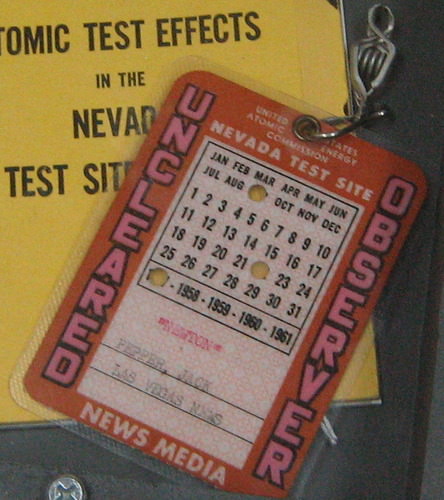
A 1957 press pass for a journalist from the Las Vegas News Bureau to the U.S. Department of Energy's Nevada Test Site.
Except that if you're at all like me, you don't know what you're doing the first few times—or even the first dozen times—you go out on a story. You're a bit shy or a bit confused, and you don't know where you're supposed or allowed to be. Not to worry; you'll learn the ropes. But what you must know from the start are the rules of conduct for wearing that press pass. These rules apply whether you're wearing a physical press pass or not—if you're working on a story, these rules apply. They were written by Melissa Wantz of Foothill Technology High School, one of the country's most fabulous journalism teachers and a former journalist herself, whose students adore her because she is smart and funny and quick, and because she's tough and demanding. You can see her personality right here on the page in her rules for press pass use for her student journalists at The Foothill Dragon Press.
If you are using a press credential, your behavior is impeccable.
You show up when you're supposed to and only work in the area(s) assigned to you.
Your friends (or family) can't come along and you can't hang out with them if they "happen" to be there. You're working.
You are always mindful of your personal space, the space of others, your tone of voice, and your demeanor. (Texting and cell phone use is generally frowned upon.)
You may not wear campaign buttons, team insignias, or anything else that could show that you may have a bias.
There's no free lunch.
You cannot go into restaurants and tell them they're being reviewed. (Ergo, you cannot ever ask for or expect free food.) Take friends (preferably staffers) and order several items, quietly talk about them, and take notes. Only ask the server the type of questions a normal patron would ask. Go back again for a second review if you didn't like the food or service—it may have been an off-day and no business deserves to have its reputation tarnished for one off-night.
You may not collect "freebies" from an event. (Consider your press pass your "souvenir.")
If you cover it, then you will write/publish a photo essay/produce a video about it.
Receiving press passes are a privilege, not a right. They are given for publicity purposes (even if you have to fairly report the play is awful). You need to provide the publicity you promised by attending the event as a member of the press.
If you have a breach in ethics or otherwise break the staff's trust, then you will no longer be able to use [the school's] publication's name to obtain press passes. Our reputation is on the line, too.
Break the class into seven groups, one for each ethic.
Have each group read their section together, discuss the most important ideas, and come up with a skit to demonstrate clearly what not to do and/or what to do.
Have each group perform their short skit for the class the next day, and the class can talk and brainstorm based on what was presented in the skits. Students or the teacher may challenge the performers, asking, "How else could the reporter have handled this situation?" or "Why wouldn't we do this?" if appropriate.
When the skits are over, have students return to their groups and condense their section into no more than 15 words. Then have them write their 15-word sentences on the board. Those seven 15-word sentences become the class's own condensed code of ethics.
For students studying on their own, explore more of the ethics case studies compiled by the Society of Professional Journalists and try your hand at wrestling with some of the difficult scenarios presented.
Explore more of the Indiana University School of Journalism's collection of ethics case studies. Select some cases that interest you and consider how they were handled. Would you have made the same decisions?
Discusses various codes of ethics (specifically, the Society of Professional Journalists' Code of Ethics and the National Scholastic Press Association's Model Code of Ethics) and other principles of ethical journalism and press pass use.
 AI Teacher Tools

 FlexiA FREE Digital Tutor for Every Student
 FlexBooks 2.0Customizable, digital textbooks in a new, interactive platform
 FlexBooksCustomizable, digital textbooks
 SchoolsFlexBooks from schools and districts near you
 Study GuidesQuick review with key information for each concept
 Adaptive PracticeBuilding knowledge at each student’s skill level
 SimulationsInteractive Physics & Chemistry Simulations
 PLIXPlay. Learn. Interact. eXplore.
 CCSS MathConcepts and FlexBooks aligned to Common Core
 NGSSConcepts aligned to Next Generation Science Standards
 Certified EducatorStand out as an educator. Become CK-12 Certified.
 WebinarsLive and archived sessions to learn about CK-12